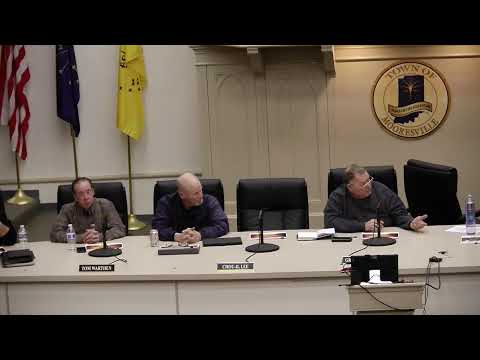
Mooresville and Brown Township hold first public hearing on proposed fire territory
Loading...
Summary
Officials and consultants presented staffing and budget plans for a proposed consolidated fire territory covering Brown Township and the Town of Mooresville, outlined projected tax impacts, and scheduled a non-hearing adoption meeting for March 20; no vote was taken at the hearing.
Mooresville Town Council and the Brown Township board held the first of three statutorily required public hearings on a proposed fire territory that would consolidate fire and EMS operations across both jurisdictions. Presenters—including Brown Township Fire Chief Jeff Stout, financial consultant Paige Sansone of Baker Tilly Advisory Group and outside counsel Jeff Dahlin—described proposed staffing increases, equipment needs and projected property-tax levies; officials said there would be no vote at the hearing and that adoption would be considered at a public meeting scheduled for March 20.
The proposal, as described by presenters, would shift fire and EMS funding and operations to a joint fire territory governed by an executive board appointed by the two participating units. Jeff Dahlin, outside counsel assisting the process, summarized the schedule and legal framework and said, “This is the first of 3 required public hearings that we will have during, this open period for presenting a possible fire territory between the township and the town.” Dahlin emphasized the difference between a territory and a fire district, noting the territory is voluntary and preserves local control while a district (created by county commissioners) is a separate taxing district.
Brown Township Fire Chief Jeff Stout framed the operational case: personnel losses, rising equipment costs and increased call volume have reduced the departments’ ability to meet response and safety standards. Stout said the two units have struggled to recruit and retain paid staff, reporting that Mooresville lost 12 full-time firefighters and Brown Township lost 18 over the last six years. He described rising capital and equipment costs (for example, apparatus and turnout gear have increased materially since 2019) and said an organized territory would allow minimum daily staffing and a full-time ALS ambulance: "If this passes, we will have a minimum staffing of 1 fire truck with 3 paid full time people, 1 part time person...an ALS ambulance with advanced life support at 1 station," Stout said. Stout also cited the National Fire Protection Association (NFPA) staffing safety standard that prevents sending a single firefighter inside a structure alone.
Paige Sansone of Baker Tilly reviewed the financial impact analysis required by state law. She reported 2025 budgets and shortfalls for the two units (the town and township budgets each showed gaps between adopted budgets and expected receipts) and presented a combined three-year outlook for a proposed territory. Sansone gave the consolidated 2026 operating budget at about $8.3 million with a capital/replacement fund of roughly $415,000 and total first-year funding needs near $9.9 million. She said about $1.3 million of that would come from nonproperty sources (vehicle excise taxes and ambulance-billing receipts), leaving roughly $8.6 million to be raised by property tax in year one. Sansone summarized the initial levy rate presented to taxpayers as about $0.7286 per $100 of assessed value (roughly 73¢) in year one, dropping to an estimated ~64¢ in year two because a one‑time cash‑reserve levy is permitted only in the first year.
Sansone used household examples to illustrate taxpayer impact: for an owner‑occupied $100,000 home in unincorporated Brown Township she showed a current annual tax bill near $370 and a projected bill near $482 in year one if the territory is adopted; she noted the entire increase would be directed to fire services. She and other presenters explained that not all levied property tax is collected because of Indiana’s circuit‑breaker credits, and they included that effect in the revenue projections. Sansone also explained that the town of Mooresville was proposed to be the provider unit that would levy and distribute territory revenues and that, if approved by the two legislative bodies, the territory would apply to the Department of Local Government Finance for levy authority.
Board members and residents asked about hiring timelines, whether staffing numbers stated as goals would be immediately guaranteed, station maintenance and equipment replacement cycles, and potential impacts on homeowners’ insurance (ISO ratings). Presenters said staffing increases depend on recruitment success and board decisions if the territory forms; they indicated ISO improvements may take several years and are not guaranteed for every property because grading factors include hydrant proximity and other site‑specific measures. Dahlin and Sansone repeated that no formal vote would occur at the hearing and clarified the next procedural steps: two more identical hearings are scheduled (Feb. 20 and March 6), followed by a public meeting on March 20 when the two legislative bodies may move to adopt or decline the territory. Dahlin said, "If you don't have a majority of both units agreeing to do it, then no territory. You need a majority of 1 and a majority of the other to agree to, to create the territory."
There were no votes on forming the territory at the session. The only formal action recorded in the hearing minutes was a motion and second to adjourn at the meeting’s close; the motion carried by voice vote. Officials encouraged residents to review the packet materials, ask questions by email if they could not attend future sessions and to attend or provide input before the March adoption meeting.
The presentations and packet materials included proposed staffing tables (a stated target of 44 full‑time and 4 part‑time positions in the territory), capital replacement timetables (two fire trucks with multi‑year delivery lead times and ambulance replacement cycles of roughly three years), and proposed roles for an executive board (two representatives from the town and one from the unincorporated township portion, based on assessed‑value shares). Presenters noted the territory would assume responsibilities including operations, equipment planning, discipline and fire code enforcement and would allow a single, unified levy for fire and EMS across Brown Township and the Town of Mooresville.
There being no final action on the territory at this hearing, officials reiterated the schedule for two repeat public hearings and a March 20 adoption meeting where each legislative body will vote separately; a majority in both units is required to create the territory.