
Oklahoma treasurer reports $1.36 billion in unclaimed property, asks to use interest to fund Legacy Capital Fund administration
Get AI-powered insights, summaries, and transcripts
Subscribe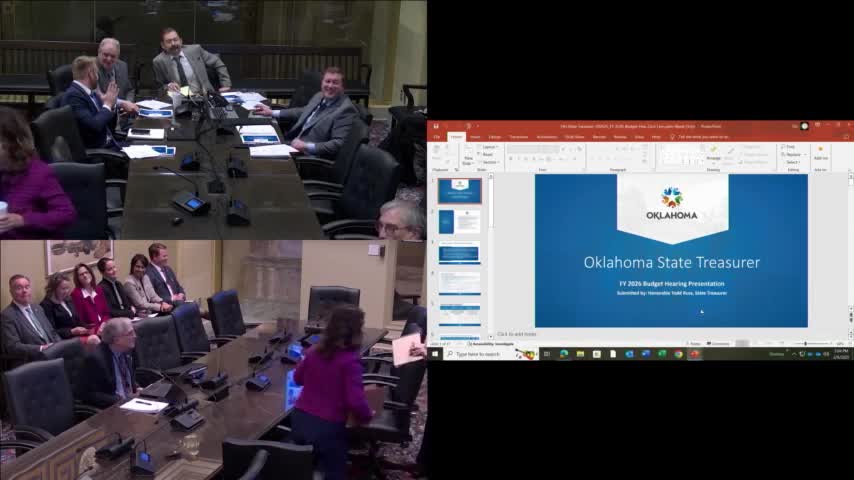
Summary
State Treasurer Todd Russ told the Appropriations and Budget Committee the treasurer’s office holds about $1.36 billion in unclaimed property liabilities, has about $300 million in cash available for claims, and is requesting modest administrative funding for the Legacy Capital Fund and to continue an IT modernization effort.
Todd Russ, Oklahoma’s state treasurer, told the House Appropriations and Budget Committee that the treasurer’s office manages roughly $1.36 billion in unclaimed property liabilities and about $300 million in available cash to pay claims.
“People think we've got over a billion dollars in cash floating around in there and we really don't,” Russ said during his presentation, noting that a large portion of the unclaimed property total represents liabilities to individuals and estates rather than cash readily available for state use.
Russ said the office manages about $17 billion under investment for state accounts and that investment earnings were approximately $376,000,000 last year with a projection to reach about $400,000,000 this year. He reported the treasurer’s office paid just short of $40,000,000 in unclaimed‑property claims during the last year and said his goal is to increase annual payouts to about $100,000,000.
Russ described several treasury programs and recent developments: issuance of nearly $2,990,000,000 in bonds last year; Moody’s upgrade of the state’s outlook and a Moody’s bump to AA1 for the state; development and administration of the Legacy Capital Fund (LCF), which he said has about $777,000,000 authorized for projects; and pilot programs such as AgLink and a rebranded Oklahoma ABLE (STABLE) program.
On operating budgets, Russ said the treasury’s core recurring budget is roughly $3.1 million and that he is not seeking an increase to core operations. He said the office would like an administrative allocation—about $300,000—to cover personnel and other costs associated with managing the Legacy Capital Fund, and he suggested covering that administrative cost from accrued interest earned by the fund rather than through an additional appropriation.
Russ also updated the committee on a multi‑year IT conversion to replace legacy systems, saying the treasurer’s office signed a contract and has passed early benchmarks with a target for portions of the new system to go live in early 2026. He characterized the IT conversion as one of the office’s largest technical projects and said it will improve unclaimed property processing and other treasury services.
Committee members asked questions about the unclaimed‑property inventory, claims processing and the age of items held in custody. Russ said there is no statutory time limit for claims and that the office periodically auctions physical items when vault storage capacity is exceeded; he said the office had recently completed an auction and expected another in the spring.
Russ closed by urging continued legislative coordination on administration of the Legacy Capital Fund and by offering to use accrued interest as a funding source for administrative costs rather than a direct appropriation.