
Treasury reports strong 2024 returns, outlines reserve use and cash-management rules
Get AI-powered insights, summaries, and transcripts
Subscribe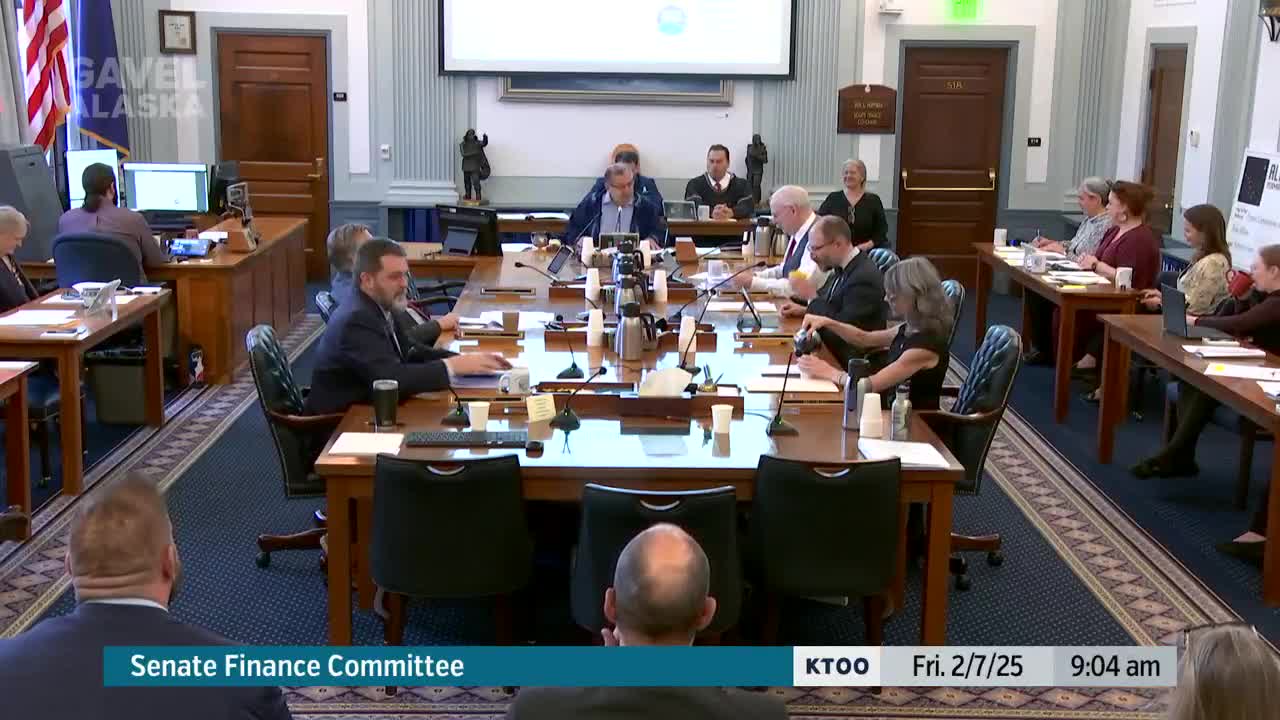
Summary
Department of Revenue officials told the Alaska Senate Finance Committee on Feb. (session date) that state investment accounts returned strong gains in 2024, and described how the Treasury manages daily cash flows, the earnings reserve and the Constitutional Budget Reserve Fund.
The Alaska Department of Revenue told the Senate Finance Committee on a February hearing that state investment accounts produced strong returns in 2024 and that Treasury uses the earnings reserve and other reserve funds to manage short-term cash needs.
Commissioner of Revenue Adam Crum and Treasury Division Director Pam Leary told senators the department closed fiscal 2024 with roughly $9 billion in assorted investment-account balances that produced about $580 million in gains, long-term funds that gained more than 13 percent, and retirement-board assets that added about $2.8 billion and now total about $43 billion after a roughly 9 percent return that exceeded actuarial expectations.
Why it matters: Treasury officials described how daily cash management, coordinated with the investment team, supports payroll, pensions, Medicaid and permanent fund dividends while seeking to maximize invested cash. Committee members pressed officials on the mechanics and limits of short-term borrowing from the earnings reserve and the Constitutional Budget Reserve Fund (CBRF), including vote thresholds and repayment expectations.
Officials described Treasury’s organization and workload. Director Pam Leary said the division manages about $50 billion across roughly 45 investment funds and 30 investment pools supported by about 130 external managers and more than 600 private equity funds. Leary said about half the assets are managed internally and the group oversees roughly 80,000 trades annually. “Cash management is a small but mighty team with a big impact throughout the state, and they do a great job,” Leary said.
Leary and Chief Investment Officer Zach Hanna detailed how Treasury distinguishes cash-flow timing problems from revenue shortfalls and how it uses several tools. Leary said the earnings reserve account (ERA) has become Treasury’s primary tool for addressing cash deficits; she told the committee the state has made 50 draws from the ERA, totaling about $22 billion over seven years. She also said Treasury has drawn roughly $2.5 billion of an approximately $3.6 billion POMV (percentage of market value) equivalent transfer this fiscal year.
Accessing the CBRF requires a three‑quarter vote of the legislature, and Crum and Leary said short-term borrowing from the CBRF has been repaid within the fiscal year in past instances. “The intent on the short term cash borrowing from the Constitutional Budget Reserve, if it does come to that, is the full intent to repay that by the end of the fiscal year,” Crum said. Committee members asked what happens if the legislature does not provide a three‑quarter vote; officials said that would force closer coordination among the governor’s office, the Office of Management and Budget and the legislature to develop a plan.
Committee members also asked about the size and trend of reserves. Hanna said the combined reserve balances peaked at about $17.6 billion in 2014 and are roughly $2.8 billion now. Treasury staff said the CBRF has been positioned conservatively since pandemic drawdowns and is currently invested in short‑term instruments for liquidity; staff said the fund produced a 5.59 percent one‑year return in 2024 and $150 million in gains.
Hanna summarized investment performance across funds: Treasury reported an aggregate 9.1 percent return for calendar 2024 and roughly $4.5 billion in total gains across managed funds. For internally managed, non‑retirement portfolios, Treasury said internal management added about $130 million above benchmark returns in 2024. Hanna said some long‑horizon funds use higher risk profiles to support higher payout goals; for example, the Higher Education Investment Fund is managed with a risk posture intended to support up to a 7 percent spending objective.
Committee members pressed Treasury on longer‑term sustainability. Senators asked whether a 7 percent spending target is sustainable in real (inflation‑adjusted) terms; Hanna and Crum warned that if nominal returns match a 7 percent payout while inflation is positive, the fund’s real purchasing power would erode. Crum said the real expected return after a 2.5 percent inflation assumption would be lower and that such tradeoffs should be part of legislative consideration.
Several procedural and legal questions raised by senators remained open. Senator Stedman asked about the administration’s impoundment tools when appropriations exceed available cash; officials acknowledged they did not have a full answer in the hearing and said they would follow up with the committee. Senators also asked whether consolidation of certain funds had been considered; Crum said the administration had not yet taken a position and would evaluate any specific proposal.
The presentation covered a range of other funds administered or invested by Treasury, including the public school trust fund, which contributed about $32 million to the public education fund in fiscal 2024 and is expected to contribute about $35 million in the current and next fiscal year; long‑horizon retirement funds managed by the Alaska Retirement Management Board, which totaled roughly $31 billion at June 2024; and funds created by specific legislation such as the Higher Education Investment Fund. Hanna said the pension and teachers’ retirement funds returned just over 9.2 percent for fiscal 2024, above the actuarial assumed rate of 7.25 percent.
Committee members thanked Treasury staff for the results and asked for follow‑up on several technical questions and clarifications. Commissioner Crum closed by saying Treasury will follow up with the committee and reiterated the department’s objective to “maximize risk adjusted returns” while keeping management costs low.
No formal committee votes were recorded during the presentation; senators asked questions and requested follow‑up information.