
State board amends R277‑609 rule: replaces repeated use of 'restorative' with 'accountability' and adds definition; sends reporting work to task force
Get AI-powered insights, summaries, and transcripts
Subscribe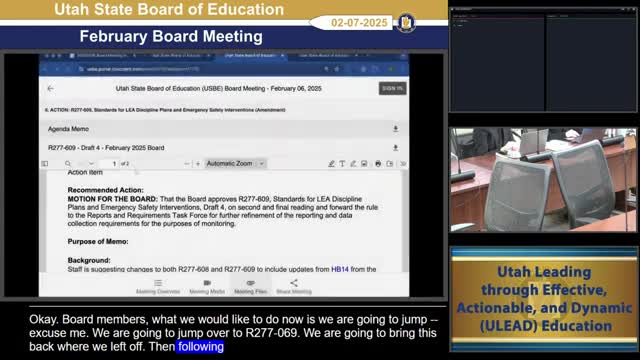
Summary
The Utah State Board of Education amended R277‑609, replacing repeated references to "restorative practices" with a new, defined concept of "accountability practice," reinstated an earlier expulsion definition and sent the draft to the Reports and Requirements Task Force for further work on reporting and data collection.
The Utah State Board of Education voted to amend Rule R277‑609 (Standards for LEA discipline plans and emergency safety interventions), inserting a new definition for "accountability practice," replacing several references to "restorative practices" with the new term, and sending the rule to the Reports and Requirements Task Force for further refinement of reporting and data collection requirements.
The board’s debate spanned several hours and focused on whether the rule should introduce new, technical terminology for local education agencies (LEAs) and whether the rule was sufficiently clear for administrators. Members raised practical and legal concerns about creating unfamiliar definitions without staff research, and some asked that staff return with comparative work on other states and case law.
After the task‑force discussion and a series of amendments, the board adopted a definition that reads, in substance, that an "accountability practice" is any evidence‑based practice that increases academic outcomes, decreases behavior that disrupts the learning environment, and holds students accountable for actions by requiring responsibility for repairing harm and providing restitution when appropriate. Examples listed in the amended rule include adapting instruction to increase engagement, using behavior plans, and restorative practices as one element among others.
Member Carrie (board member) moved insertion of the accountability definition and several members debated whether the rule should require or merely recommend particular practices. Some board members opposed introducing new terminology that LEAs might not recognize; others said the change clarifies emphasis on consequences and measurable expectations.
The board voted in favor of replacing repeated references to "restorative" with "accountability" for several line items in the draft. An amendment defining accountability practices and listing examples passed by a recorded vote of 14–1. Members who spoke against the changes argued the term "restorative" had been politicized and that introducing new technical language could cause confusion without accompanying guidance from staff.
Separately, the board reinstated an earlier expulsion definition from draft 1 into draft 4 after debate about differences between suspension, long‑term suspension and expulsion. That motion passed 14–1. Several members asked staff to research how other states define long‑term suspension and expulsion, to consider legal implications and to return with a short, focused memo; the board directed the Reports and Requirements Task Force to take the lead on reporting and data‑collection refinements.
The board’s final action on the rule was to approve R277‑609 draft 4 as amended on second and final reading and forward the rule to the Reports and Requirements Task Force for further refinement of reporting and data collection. The final rule motion passed with a recorded vote (11 in favor, 3 opposed, 1 absent); opposing members raised concerns about introducing novel definitions and about potential impacts on LEA policy and data collection.
During debate, members repeatedly asked staff to confirm whether local practices and current LEA policies would conflict with the newly added language and requested staff research on whether the proposed time‑based definitions for short‑term and long‑term suspension are in common use elsewhere. Deputy Superintendent Elise Newey noted the agency would have to convert the new language into the rulebook’s required format (for example changing phrasing from "is" to "means") and said staff could work with the task force to align definitions and reporting requirements to other statutes and rules (53G‑8‑208 was cited in discussion).
Ending: The board amended R277‑609 to emphasize "accountability practices," reinstated an earlier expulsion definition, and advanced the draft to the Reports and Requirements Task Force. Members asked staff to return with comparative research and with recommended edits to align reporting and data collection across LEAs and state reporting systems.