State board recognizes school safety needs assessments completed across Utah schools
Get AI-powered insights, summaries, and transcripts
Subscribe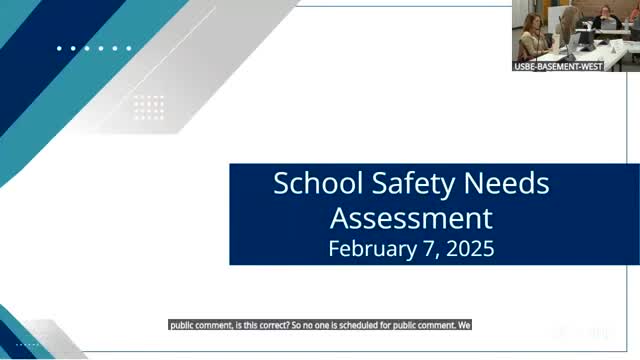
Summary
The Utah State Board of Education’s Standards and Assessment Committee on Feb. 6 recognized the School Safety Center and LEA staff for completing the statewide school safety needs assessments required by 2024 legislation.
The Utah State Board of Education’s Standards and Assessment Committee on Feb. 6 recognized the School Safety Center and local education agency staff for completing the statewide school safety needs assessments required by the 2024 legislative session.
Leah Voorhees, interim deputy superintendent of achievement for the Utah State Board of Education, said the assessments responded to House Bill 84 (2024), which requires each local education agency (LEA) to conduct a school safety needs assessment for every school in the LEA and to report results to the state security chief and the School Safety Center by Dec. 30 of the prior calendar year. “This was a huge undertaking,” Voorhees said, noting the state has about 1,100 schools in scope.
The nut of the recognition: the School Safety Center built a data-tracking tool, provided technical support (webinars, written instructions, individualized help) and worked with local leaders to contact schools that had not completed the report. Committee members heard that those efforts produced a high statewide completion rate, but the transcript does not specify the percentage number.
Chantelle Cota, director of school safety and student services, said the effort involved partnerships among LEAs, county and state safety chiefs, local law enforcement and mental-health partners. “It really was an opportunity to walk through buildings and to identify what is safe in our building, what is not. What do we need to talk about? What are our philosophies on safety?” Cota said. She noted the assessments will help LEAs identify gaps in personnel, training, facilities and safety technology and will support applications for grant funding.
Committee members and staff described how the assessment data will be used. The school safety task force and related grant subcommittees will review the assessment results to prioritize spending from last year’s appropriations and to identify remaining needs. The Department of Public Safety and liaisons from programs such as SafeUT and the Office of Substance Use and Mental Health took part in the center’s work, staff said.
The committee did not take formal action on the recognition item; it was presented as an information and recognition item. No vote was needed on the report itself. Staff repeatedly emphasized that the data will inform grant decisions and future work by the task force and LEAs.
Background and clarifying details: House Bill 84 (2024) established the reporting requirement to the state security chief and the School Safety Center. The assessment covered about 1,100 schools statewide; the transcript records that a completion percentage was reported to the board but does not give the numeric percentage (not specified). The statutory reporting deadline provided to the committee was Dec. 30 of the prior calendar year. The presentation referenced Alyssa’s Law (panic-button requirements) as part of the policy landscape influencing school security measures.
What committee members said: board members thanked School Safety Center staff and LEA personnel for the “huge lift” of completing the assessments and emphasized that the assessment represented a mindset shift for how district staff, law enforcement and mental-health partners approach school safety.
Where this goes next: staff told the committee that the assessment data already had informed funding discussions and that the school safety task force grant subcommittees and the Department of Public Safety would use the findings to target resources. The board did not adopt additional directives or formal motions on this agenda item during the Feb. 6 meeting.
Ending: presenters and board members framed the assessment as groundwork for future, targeted spending and for continued collaboration among education, law enforcement and mental-health partners; the committee moved on to curriculum and standards topics after the recognition.