
Board committee continues 'unsafe school choice' rule amid questions about measuring persistently dangerous schools
Get AI-powered insights, summaries, and transcripts
Subscribe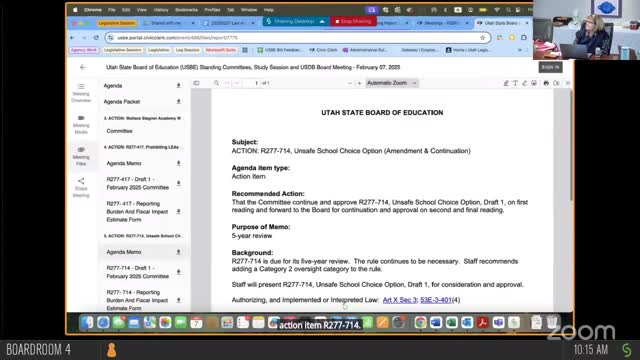
Summary
The licensing committee continued Administrative Rule R277-7714 (Unsafe School Choice Option) on first reading, and members pressed staff to improve data collection and reporting on incidents that could qualify a school as "persistently dangerous."
The licensing committee voted unanimously to continue Administrative Rule R277-7714, the "Unsafe School Choice Option," on first reading and forward it to the full board for continuation and final reading. Committee members used the discussion to press staff for better measurement and reporting of serious incidents that can render a school "persistently dangerous."
Brett Larson, school safety center coordinator, and Sean Takote, director of school safety and student services, explained the rule is federally required to address persistently dangerous schools and noted the committee may set the state's definition. Larson told members that Utah aligns with national practice and that the proposed language adds clarifications on notice requirements and technical edits.
Several committee members asked whether the rule, as written, addresses a federal provision that allows a student who is the victim of certain violent criminal offenses to attend a safe public school. Staff said Utah’s open enrollment law already allows students to enroll in other public schools regardless of victim status, but members said that distinction should be tracked. "If we have students leaving the school because they're a victim of a violent crime, to me, that would be important to know," Chair Carey said.
The committee focused much of its discussion on the definition in the draft rule that a "persistently dangerous school" means a school where at least 3 percent of students for three consecutive school years have been suspended or expelled. Members noted no Utah school met that metric in recent years and questioned whether the bar was too high or whether reporting mechanisms discouraged disclosure.
Takote and Larson urged the committee to consider the state’s forthcoming school safety dashboard under House Bill 84 as a vehicle to gather better data and said the school safety center is working with law enforcement and the Department of Public Safety on data collection. "When you make rules on what has to go into this school safety dashboard, you certainly can look at that as an opportunity," Takote said.
After discussion, Member Lear moved to continue and approve R277-7714 on first reading and forward to the board for continuation and final reading; the motion passed unanimously.
Staff will incorporate the technical edits and notice clarifications and coordinate with the school safety center and other stakeholders on data reporting to the dashboard and related needs assessments.