
Committee approves special-education foundational competencies and associated teacher-preparation rule
Get AI-powered insights, summaries, and transcripts
Subscribe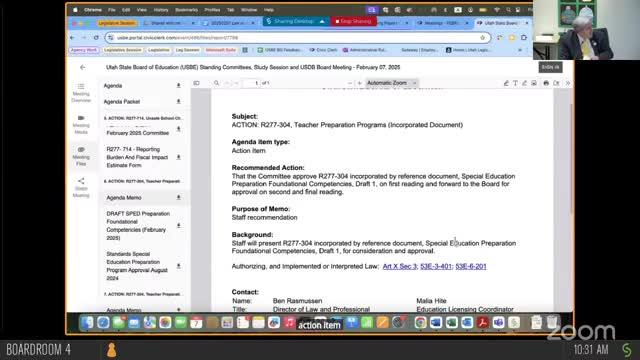
Summary
The licensing committee approved special-education foundational competencies to be incorporated into teacher-preparation rules and continued amendments to Administrative Rule R277-304 on first reading.
The licensing committee approved an incorporated document that establishes foundational competencies for special-education teacher preparation and then voted to continue and approve amendments to Administrative Rule R277-304, which incorporates the competencies by reference.
Malia Haidt, executive coordinator of educator licensing, said the competencies were developed with higher-education faculty, special-education directors and classroom teachers beginning in 2022 and refined after public comment. "The document before you is the special education preparation foundational competencies," Haidt said, adding the standards are required for teachers seeking a special-education license in K–12 settings.
Kim Bridal, director of special-education programs, described competency SF06.04, which requires knowledge of preventive and responsive practices to prevent behavioral incidents from escalating and to participate in de-escalation and debriefing. "We have it throughout this document to understand behavior differences, how to respond to them," Bridal said, explaining competencies address behavior intervention planning and staff and student safety.
Committee members welcomed the detail but raised concerns about how subject-area endorsements interact with special-education licensure. Several members questioned the requirement that secondary special-education teachers demonstrate advanced mathematics competencies (including calculus concepts) to be qualified to teach secondary-level math courses. That requirement, staff said, is driven by national expectations for content-area competency and the need to ensure all students have access to content-qualified teachers.
Vice Chair Bollinger, a special-education teacher by training, said the competencies are specific and useful but asked staff to consider pathways that avoid putting excessive additional barriers in front of teachers who wish to remain in special education rather than move into general education because of endorsement requirements.
After discussion, Member Bollinger moved to approve the incorporated special-education foundational competencies (document R277-304) on first reading and forward them to the board for approval; the committee voted unanimously. The committee then approved R277-304 (teacher preparation programs), draft 2, on first reading and forwarded it to the board for final approval.
Staff said programs may adopt the new competencies immediately and that provisions in the rule include a date by which candidates enrolled in prior programs will transition to the new competencies.