
House Economic Matters advances consumer-refund bill, clears multiple measures in voting session
Get AI-powered insights, summaries, and transcripts
Subscribe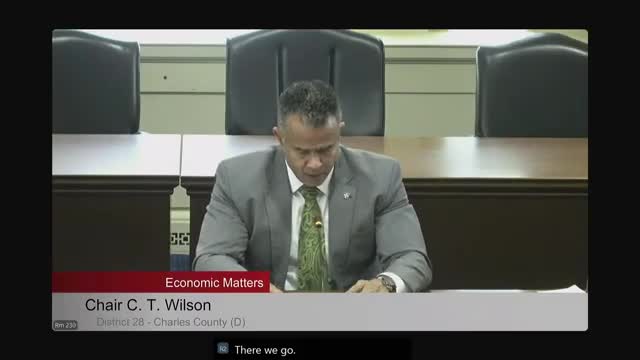
Summary
The House Economic Matters Committee approved a bill requiring merchants to refund return-shipping costs for incorrectly shipped items and moved a series of other bills forward during a recorded voting session. One bill was held and several unfavorable actions were withdrawn as a consent calendar.
The House Economic Matters Committee voted Wednesday to advance a bill that would require merchants to refund consumers for return-shipping costs when a merchant ships the wrong item, and it moved a slate of additional bills forward during a recorded voting session.
The consumer-refund measure (House Bill 194) would require a merchant to reimburse a consumer’s return-shipping cost within 30 days after the consumer’s request when an incorrect item was shipped. Committee members discussed whether the measure duplicates protections in the state’s Consumer Protection Act and whether tax or administrative fees tied to deliveries would also be refunded; committee counsel described the bill’s intent as creating a direct, merchant-facing remedy instead of requiring consumers to pursue the Attorney General’s office. Committee members also raised the criminal-penalty language in the underlying consumer-protection statute and said that the possible maximum penalty — cited in the session as up to one year in jail under current law — prompted concern and a desire to consider changes in a future bill.
Beyond HB 194, the committee advanced several largely noncontroversial measures on a favorable-motion basis with either voice approval or recorded roll call votes. Measures that moved forward included bills to extend termination dates for certain state licensing boards, to lengthen the time a former HVAC (heating, ventilation, air conditioning and refrigeration) contractor may restore an expired license, to clarify handling of electric cooperative nonissued capital credits, and to authorize the Secretary of State to suspend or waive late fees for charitable organizations and cancel registrations if reporting requirements go unmet for three years.
The committee also advanced House Bill 270, which requires the Maryland Department of the Environment, the Maryland Energy Administration and the University of Maryland School of Business (in coordination with the Department of Legislative Services) to analyze environmental, energy and economic impacts of data-center development in the state. The final report is due to the General Assembly by Sept. 1, 2026. Committee members asked whether the study would pause or block ongoing data-center negotiations; the committee was told the bill contains no such restriction and would not halt construction or negotiations while the study is underway.
One bill was held for later consideration: House Bill 224 (text not discussed in the session). Separately, the committee recorded an unfavorable-withdrawn consent action covering three bills listed by number during the session’s close.
Votes at a glance: - House Bill 63 — extends the State Board of Public Accountancy termination date by five years; motion favorable, committee reported bill forward (voice approval: “all present and voting favorable” recorded). - House Bill 73 — extends the State Commission of Real Estate Appraisers and Appraisal Management Companies termination date; motion favorable, reported forward (voice approval). - House Bill 92 — extends the time to apply to restore an HVAC/refrigeration contractor license from 90 days to 4 years; motion favorable, reported forward (voice approval). - House Bill 194 — requires merchants to refund return-shipping costs for incorrect shipments within 30 days of a consumer’s request; motion favorable, roll call recorded and bill moves forward. Committee discussion addressed overlap with the Consumer Protection Act and the scope of refundable taxes/fees. - House Bill 224 — discussion limited; bill held. - House Bill 227 — establishes rules that nonissued capital credits held by electric cooperatives are not presumed abandoned and authorizes specified uses for those funds; motion favorable, reported forward (voice approval). - House Bill 239 — authorizes the Secretary of State to suspend or waive late fees for charitable organizations and cancel registrations for failures to file required documentation for three years; motion favorable as amended, reported forward. - House Bill 270 — requires a cross-agency analysis of data-center impacts, with a report to the General Assembly by Sept. 1, 2026; motion favorable as amended, reported forward. - Consent/unfavorable withdrawn — House Bills 213, 2604 and 568 (unfavorable withdrawn as a consent calendar).
The committee concluded its matters after the recorded voting list. Several bills passed with little debate; the session included focused discussion on the consumer-refund measure’s relationship to existing consumer-protection law and on criminal-penalty language that members said warrants future attention.