
Scappoose council considers changing 1995 leak-adjustment rule; asks staff to draft operational policy
Get AI-powered insights, summaries, and transcripts
Subscribe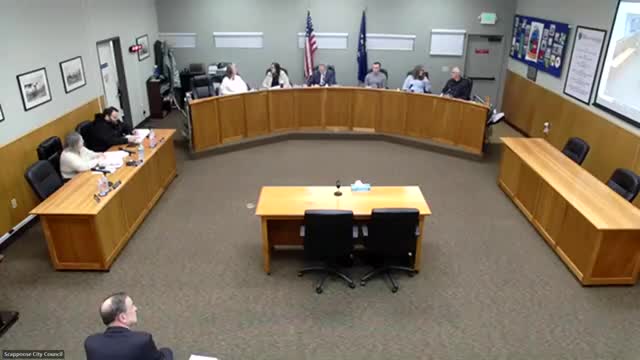
Summary
City staff and council discussed whether to expand a 1995 resolution that limits water-bill adjustments to leaks between the meter and the house. Council directed staff to compile operational resolutions and research peer cities; no change to the existing resolution was adopted at the work session.
Scappoose City Council members on Monday discussed whether to revise a 1995 council resolution that limits water-bill adjustments to leaks occurring between the meter and the house, and asked staff to compile a list of similar operational resolutions and survey peer cities before any change is adopted.
City Manager Ben Bergner told the council that a property owner had challenged the city’s existing resolution and requested an adjustment after a leak; the example cited in the packet was a $353 bill tied to a sticky toilet. Bergner said the city’s current rule allows adjustments only for leaks between the meter and the house, not for leaks inside a residence or on irrigation lines. “It is more of an operational policy, but since it was enacted by a resolution by the council…we brought [it] to the council,” Bergner said.
The discussion focused on three options: keep the existing rule; adopt a more lenient approach like some neighboring cities that allow a one-time adjustment (often with caps and documentation requirements); or adopt a stricter rule that requires customers to pay for any use regardless of location. Bergner told the council staff estimated the cost of current adjustments at about $1,000 per year and that a more lenient policy might raise that to $2,000–$3,000 annually, though he framed that as an estimate.
Council members referenced policies in St. Helens and Portland as models. Council members noted St. Helens limits adjustments (discussed in the meeting as a $1,000 cap and a one-time adjustment within a two-year window) and typically requires documentation that a leak was fixed. A council speaker noted that Portland and other cities commonly allow an adjustment if the customer shows the leak was repaired and has limits that aim to prevent abuse.
Several council members and staff emphasized designing clear, objective criteria to avoid favoritism claims. One council member said the city should “have a policy and clear criteria” to protect staff who would review claims. Mayor Joe Backus described a customer-service perspective, saying, “As a customer service man, I myself, I'm always trying to help the customer,” while also supporting caps and timeframes to limit liability.
Options discussed for a potential new policy included a one-time credit within a multi-year period, requiring documentation that the leak was repaired, using an average of prior usage to compute adjustments (staff confirmed the city currently averages a prior year for adjustments), setting an annual budget cap for the program, and extending the application period (for example, a 90-day window cited for peer cities versus suggestions of up to six months). Bergner and staff proposed redirecting operational financial policies from council resolution to an administrative policy handled by staff, with the council retaining the ability to review or override by motion.
By the end of the work session the council did not change the existing 1995 resolution. Instead members asked staff to assemble a prioritized list of old operational resolutions for review, survey peer city policies (via listservs and other contacts), and return with recommended language and potential fiscal impacts. Council members repeatedly emphasized that any leniency should include objective criteria, caps, and timeframes.
No formal motion or vote to amend the existing leak-adjustment resolution took place at the work session; the council’s direction was to have staff research and draft potential administrative policy changes and report back. Staff indicated estimated fiscal exposure under a more lenient approach would be small relative to the overall budget but recommended caps and clear criteria to protect ratepayers and staff.