
Appropriations committee debates jail mental‑health grants and advances several human‑services and transparency bills
Get AI-powered insights, summaries, and transcripts
Subscribe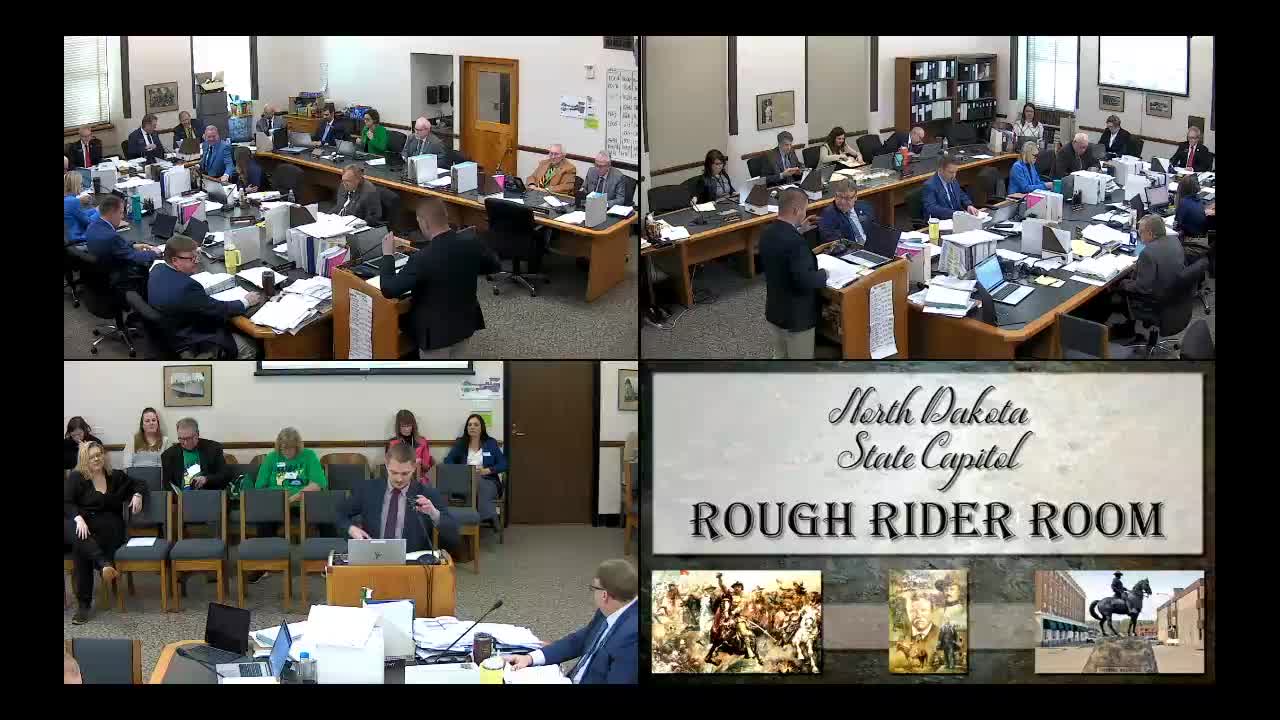
Summary
The House Appropriations Committee on Wednesday heard extensive testimony on a proposed $10 million grant to expand mental‑health services in county jails and acted on multiple human‑services and transparency measures, voting to recommend against advancing the jail grant and approving measures to raise a nursing‑home personal allowance and create a Legacy Fund disclosure website.
The House Appropriations Committee on Wednesday heard extended testimony on a proposed $10 million grant program to expand mental‑health and substance‑use services in county jails and took votes on several other human‑services and transparency measures.
The panel heard from bill sponsor Rep. Matt Ruby (District 40) and Pam Segnus, executive director of behavioral health at Health and Human Services, about House Bill 13‑37, a one‑time $10,000,000 grant program modeled on a Walsh County pilot. Rep. Matt Ruby said the bill would fund mental‑health and, when eligible, substance‑use services in county jails; Walsh County used leftover ARPA dollars to run a pilot that served about 294 participants over three years, Ruby said.
Segnus told the committee that behavioral‑health services already exist in jails in various forms — the SUD voucher, contracted private providers, the Integrated Telehealth Partners (ITP) telepsych contract, and state human‑service centers — but that those resources are fragmented and insufficient to meet demand. “We still can’t meet need,” Segnus said, noting that HHS has served about 1,300 individuals in jail settings this biennium and provided just under 6,000 services.
Committee members questioned how the proposed grant would interact with existing programs and whether the state should instead expand ongoing reimbursement mechanisms such as the SUD voucher or emphasize rollout of Certified Community Behavioral Health Clinics (CCBHCs). Representative Russell Nelson moved a “do not pass” recommendation, saying he was uncomfortable with a stand‑alone county grant without integration into the department’s broader behavioral‑health work; Representative Nathie seconded the motion. The committee approved the do‑not‑pass recommendation.
Other bills the committee handled included:
• House Bill 14‑85: The committee approved a “do pass” recommendation to increase the monthly personal allowance that individuals in nursing homes and some long‑term care facilities may keep to $110 (up from $100), with a cost‑of‑living inflator going forward. Committee members discussed whether the change would affect Social Security benefits; Segnus and others said it would not reduce federal Social Security payments. The committee reported the bill favorably on a roll call reported as 20‑0 with 3 recorded absences.
• House Bill 13‑19: Amended to narrow requirements, the bill directs the Retirement and Investment Office (RIO) to develop a public Legacy Fund disclosure website (with protections for legitimately sensitive data). Jody Smith, interim executive director at RIO, said a public site would also reduce costly open‑records requests and allow the office to show both investments and legislative appropriations from the fund. The committee gave the bill a do‑pass recommendation.
• House Bill 14‑87: Representatives discussed a proposal to transfer a DOT parcel in Minot to be used by the Bureau of Criminal Investigation (BCI) and the Highway Patrol and to authorize up to $4.9 million in construction funds (State Infrastructure Fund) for a new shared facility. Patrick Leonard (BCI) and Tom Iverson (chief of operations, Highway Patrol) described program needs including secured evidence rooms, vehicle garage space and a joint forensic/computer lab for an Internet Crimes Against Children task force. Committee members asked whether existing leased space could be renovated or purchased instead; officials said renovating the Job Service building was considered but the estimate for purchase and renovation was roughly $4.34–4.6 million plus relocation costs, making a new build on state land a comparable option. No final committee vote on the bill was recorded in the transcript.
• House Bill 12‑66: The committee discussed an amendment to the disabled‑veteran property tax credit that would raise the taxable‑value exemption to align with the homestead level (from $8,100 to $9,000). Brian Crotius, Tax Commissioner, testified about program utilization (approximately 8,000 applicants and an average effective benefit modeled at 85% disability) and the fiscal impact; the updated fiscal note was reported near $7.4 million for the change. Members discussed overlaps with the homestead credit and other property‑tax relief programs.
• House Bill 15‑04: The committee considered a bill to direct state funds to the Post War Trust Fund and the Veterans Affairs Fund (used for, among other things, veteran homelessness services). Committee language replaced an earlier proposal to redirect gaming tax receipts, with sponsors explaining they wanted to avoid opening gaming tax revenue to many competing requests.
• House Bill 15‑24: Representatives also heard testimony about a $1 million biennial appropriation (committee amendment) to regional development councils to fund grant writers and staff capacity. Vice Chairman Jared Haggart said the councils together leveraged hundreds of millions in project investments from 2019–2023 and that modest state support could increase federal and private leverage. The committee discussed distribution formulas and whether a pilot or phased rollout was appropriate.
Votes at a glance
- HB 13‑37 (grant program for jail behavioral health): Committee motion — Do Not Pass (mover: Rep. Russell Nelson; seconder: Rep. Nathie). Roll call recorded as the committee adopting the do‑not‑pass recommendation; transcript shows the motion carried and the bill will be carried by Rep. O’Brien. (Committee action: recommend do not pass.)
- HB 14‑85 (raise nursing‑home personal allowance to $110): Motion — Do Pass. Roll call reported as 20 yes, 0 no, 3 absent. (Committee action: recommend do pass.)
- HB 13‑19 (Legacy Fund disclosure website): Motion — Do Pass (amended to protect sensitive data). Roll call reported as 21 yes, 0 no, 2 absent. (Committee action: recommend do pass.)
What remained unresolved
Several bills (including the Minot site/property transfer and construction appropriation, the disabled‑veteran tax credit amendment and the regional councils appropriation) were discussed but not finally acted on in the recorded portion of the hearing. Committee members repeatedly urged coordination between the Human Services Division and the appropriations process before moving one‑time grants into ongoing budget lines.
Key quotes
“I just wanna be really clear that we utilize private partners to be extenders of the services that we can’t meet the need of,” Pam Segnus, executive director of behavioral health, said of current jail services. “So although it’s happening, it isn’t necessarily where we have the capacity to see everyone.”
“We’re looking at $10,000,000 in this bill to continue the program they have there,” Rep. Matt Ruby (District 40) said of the Walsh County pilot the measure would scale.
“We did pull that out. I do think this isn’t a website that will be built in a couple of months,” Jody Smith, interim executive director of the Retirement and Investment Office, said about the Legacy Fund disclosure site and its expected development time.
Ending
Committee members said they will continue working with relevant agencies (Human Services, OMB, RIO and DOT) and the bill carriers to refine budget language and consider program integration before final floor action. Several items heard Wednesday were scheduled for follow‑up in later floor or committee sessions.