
Senate panel reviews bill to fund apprenticeship start-up grants up to $3,000
Get AI-powered insights, summaries, and transcripts
Subscribe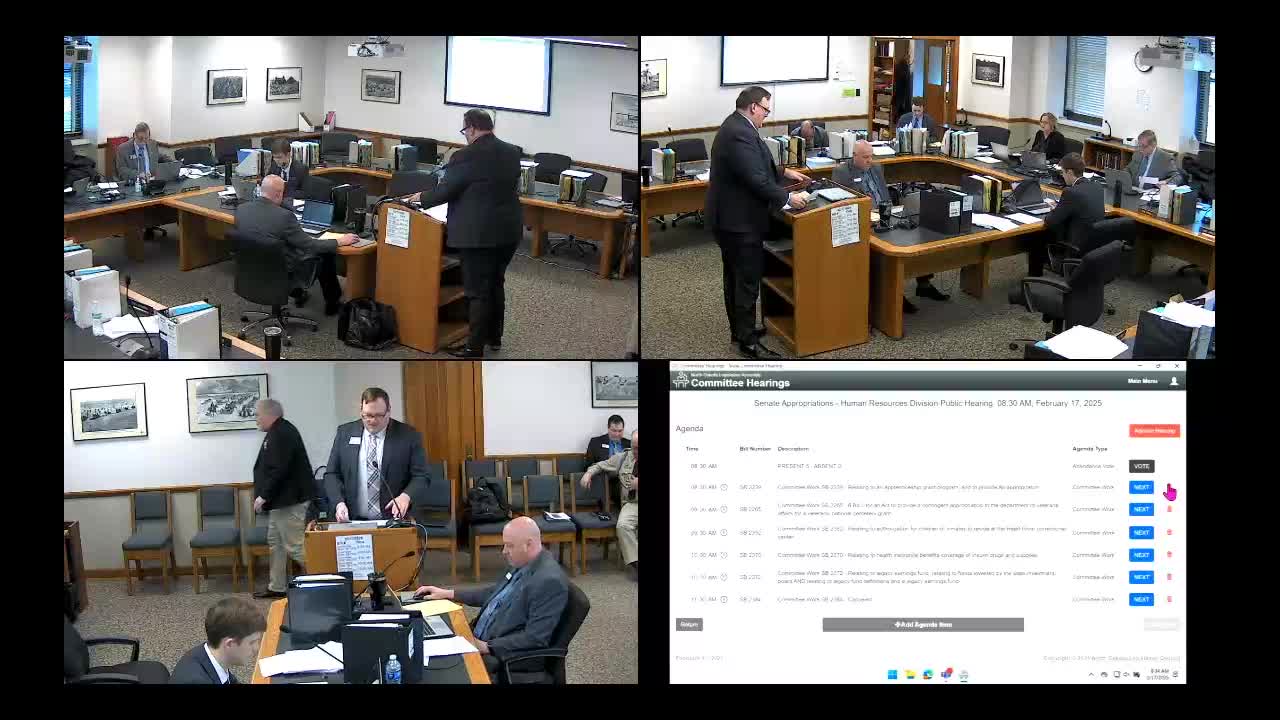
Summary
A Senate human resources subcommittee heard testimony on Senate Bill 2239, which would create a state grant to help apprentices with up‑front costs; sponsors said the $3,000 cap is flexible across a three‑year apprenticeship window and is designed to reach people excluded by scholarship GPA rules.
State senators heard details of Senate Bill 2239 on a proposal to create a state grant program to help people entering registered apprenticeships cover start‑up costs such as tools, clothing and related instruction.
Josh Baucher, State Senator for District 44 and sponsor of the bill, told the Senate Appropriations Human Resources Division the measure grew from last year’s effort to let North Dakota Scholarship dollars support apprenticeships. Baucher said some prospective apprentices were excluded from the scholarship because the scholarship’s statute requires a 2.75 minimum GPA.
"Several of the students who wish to access the North Dakota Scholarship for their registered apprenticeships didn't actually qualify for the scholarship because of GPA requirements," Baucher said. He described SB 2239 as an alternate pathway to address that gap by creating a grant of up to $3,000 within the first three years of a registered apprenticeship, with flexibility for how funds are used across that period.
Wade Sick, State Director for the Department of Career and Technical Education, and other committee members described the structure of registered apprenticeships as three components: on‑the‑job training, related technical instruction (generally about 144 hours), and progressive pay increases. Sick said apprenticeship participants can be as young as 16 under child labor rules when enrolled in a registered apprenticeship and that apprenticeships have expanded beyond traditional trades into health care, technology and public service.
Committee members raised questions about how eligibility, enrollment and progress would be determined. Baucher and Sick said the bill would rely on the Department of Labor and coordinating entities such as Career and Technical Education to vet apprenticeship sponsors and set program guidelines. The committee and witnesses also discussed outreach and employer recruitment, and a companion bill in the other chamber to create an Office of Apprenticeship to help employers set up programs.
No formal vote on SB 2239 was recorded by the committee during the hearing.
The measure as described would create a state‑level grant program targeted at registered apprenticeships, separate from the North Dakota Scholarship program and intended to reach nontraditional students, career‑changers and others excluded by GPA limitations.
Senators who led the discussion said they view the proposal as supporting workforce development goals and making apprenticeships more accessible to a broader pool of applicants.