
Committee hears resolution urging U.S. Supreme Court to restore marriage as union of one man and one woman
Get AI-powered insights, summaries, and transcripts
Subscribe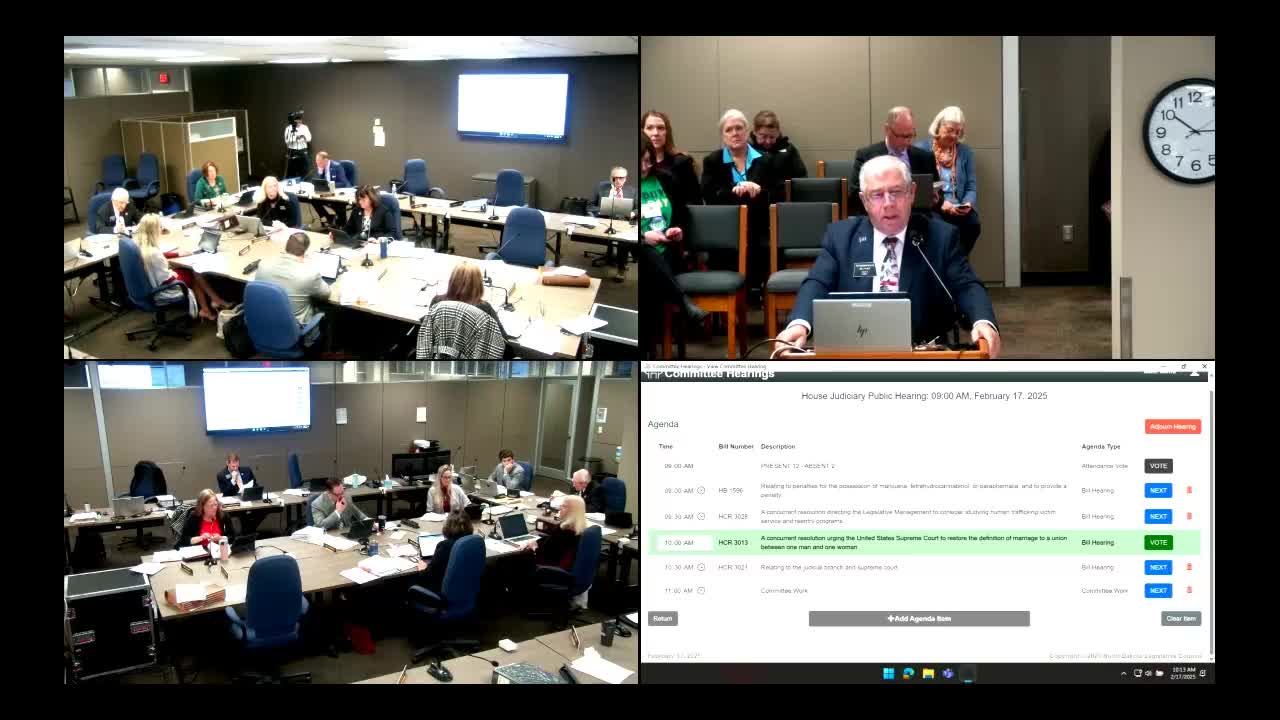
Summary
House Concurrent Resolution 3013 received extensive testimony both supporting and opposing a call for the U.S. Supreme Court to overturn Obergefell v. Hodges and restore a traditional definition of marriage; testimony reflected deeply held legal, religious and civil-rights views but the committee took no vote.
Representative Bill Twythe (sponsor) told the committee HCR 3013 urges the U.S. Supreme Court to reconsider Obergefell v. Hodges and "restore marriage to a union between one man and one woman." He framed the resolution as an attempt to return marriage definitions to states and to the people.
Testimony in support included Arthur Schomper, field director for Mass Resistance, who argued the Obergefell ruling overstepped the Constitution and predicted consequences for religious liberty and public health; David Tamasia of the North Dakota Catholic Conference and Mark Grama of North Dakota Family Alliance Legislative Action also supported the resolution, invoking religious teachings and traditional-family arguments.
Supporters cited constitutional and historical arguments and said state-level action is appropriate. Representative Twythe framed the question in historical and religious terms and asked the committee for a "do pass" recommendation.
Opponents included Christina Sambor of the North Dakota Human Rights Coalition, who argued the resolution would harm lesbian, gay, bisexual and transgender residents and would remove legal protections and tangible benefits, such as tax and inheritance rights. Sambor also challenged reliance on centuries-old texts as a basis for current civil-rights policy.
The committee heard additional public testimony both for and against the resolution, including brief floor readings and in-person and online witnesses. No committee action or vote was recorded at the hearing.
Ending: The committee closed the hearing after a full panel of supporters and opponents presented written and oral testimony; members had no recorded votes at that time.