
Upcycled sunflower protein project stalled by federal freeze; small processor and retail partners face cash and production risks
Get AI-powered insights, summaries, and transcripts
Subscribe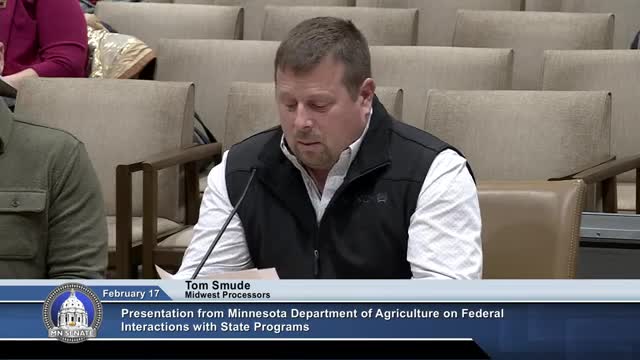
Summary
Midwest Processors and cereal maker 7 Sundays told a Senate committee that a $530,000 RFSI reimbursement grant has been delayed, leaving the processor with equipment orders, loans, and production halted until funds or approvals resume.
Tom Smooty, a farmer and owner of Midwest Processors, told the committee that his RFSI grant award of $530,000 was structured as a reimbursement and that federal delays left his processing line torn out and production paused. "This is a reimbursement grant. So we went out and got a loan or a temporary loan to cover everything," Smooty said. He told the committee he and his wife personally guaranteed roughly $250,000 of the project and that equipment has been ordered and partly received but the processing line is out of service while reimbursement is on hold.
Brady Barnstable, co‑founder of 7 Sundays, which uses the sunflower protein in a puffed cereal sold at major retailers, said the project enables contracts with large customers and that the delay threatens production schedules. "Due to the unique nature of the supply chain, the fact that it's upcycled, we don't really have a plan B," Barnstable said, noting commitments to retailers and the need to process tens of thousands of pounds to meet orders.
Why it matters: The RFSI grant was intended to scale an on‑farm or local processing line that makes upcycled sunflower protein — a specialty ingredient used by small food companies and regional buyers. Because the award is reimbursement-based, Smooty said his business borrowed and put up personal collateral to pay vendors and temporarily stop production, creating acute cash‑flow pressure and risking missed retailer deadlines.
Additional operational disruption: Smooty also recounted a separate, short-term business shock: a cease-and-desist order related to grain‑buying licensing that briefly halted operations and required him to obtain a licensed grain buyer bond. He said the new compliance steps added an estimated $10,000 per year in licensing and auditing costs for his small business and required an immediate $200,000 short-term loan to cover lost revenue and payroll while operations restarted.
Committee response: Members asked whether the grant process or licensing rules could be adjusted to reduce risk for small processors. Senator Quebec foreshadowed a Wednesday bill to modify grain-buyer reporting and audit thresholds to ease burdens on small buyers; Smooty said an exemption or scaled requirement would help small processors who are not large commodity buyers.
Ending: Small processors and their retail partners asked lawmakers to press federal agencies to release funds and consider state-level supports for reimbursement‑based grants or to soften compliance costs that create acute cash‑flow strains for rapidly scaling local food businesses.