
Oregon Health Authority outlines public health priorities, funding needs in HB 5025 briefing
Get AI-powered insights, summaries, and transcripts
Subscribe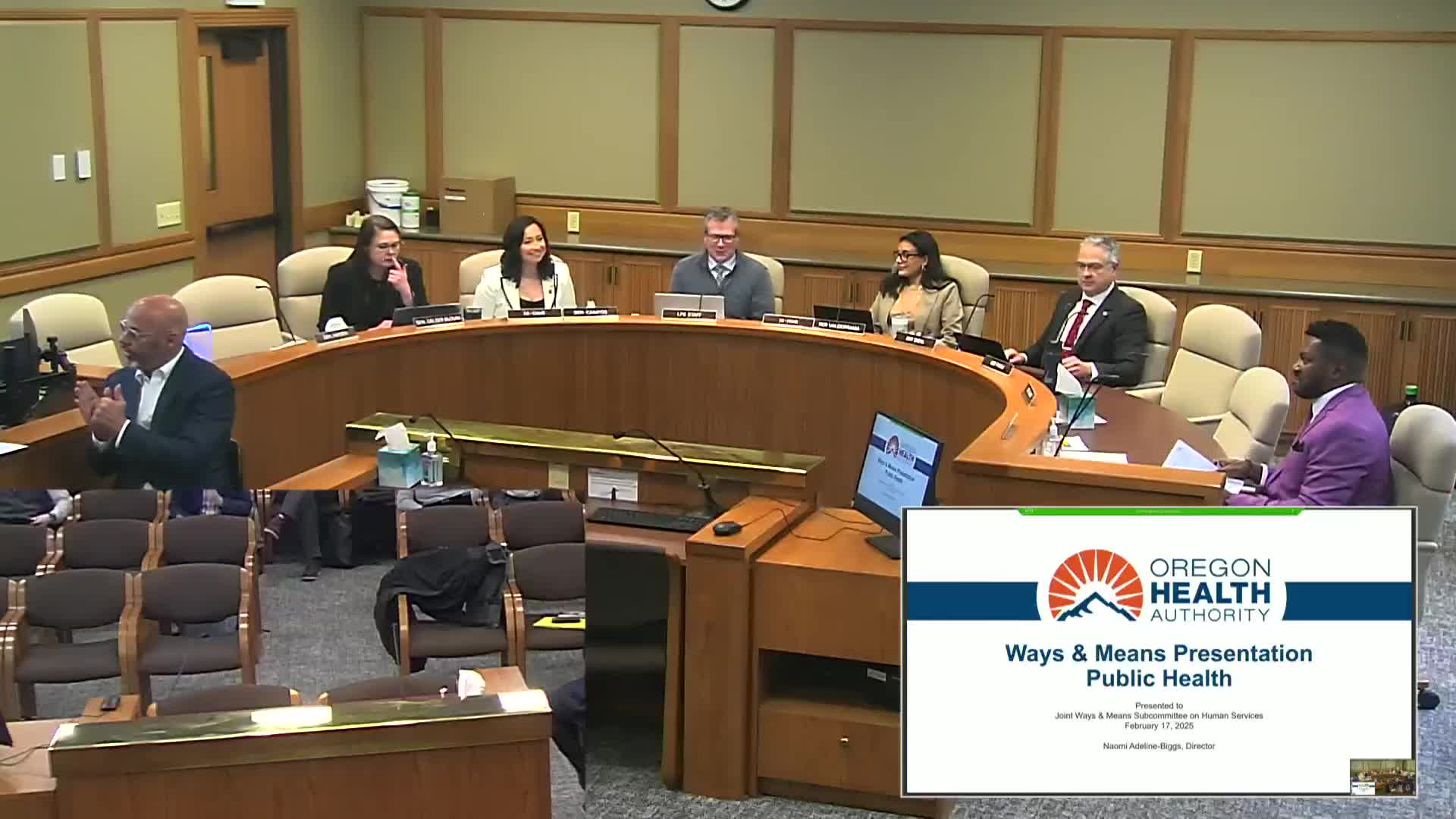
Summary
Oregon Health Authority officials told the Joint Subcommittee on Human Services that public health modernization, domestic well nitrate response, communicable disease prevention, hospital licensing, school-based health centers and tighter tobacco rules are priorities in the governor—s budget request tied to House Bill 5025.
PORTLAND, Ore. — Officials from the Oregon Health Authority (OHA) presented an overview of the Public Health Division—s work and budget priorities tied to House Bill 5025 during an informational hearing of the Joint Subcommittee on Human Services on Feb. 17.
Naomi Adeline Biggs, public health director at the Oregon Health Authority, told co-chairs Campos and Valderrama that "the public health division is here to ensure that all people in Oregon can achieve their best health," and outlined how the division uses the public health modernization framework adopted by the Legislature in 2015 to allocate resources across state, local and tribal partners.
The presentation summarized recent program successes, ongoing risks and the governor—s recommended investments. Highlights included: emergency and continuing responses to elevated nitrates in private wells in the Lower Umatilla Basin; expansion of the Family Connects newborn visiting program; new positions funded through public health modernization for local public health authorities (LPHAs) and community-based organizations (CBOs); data modernization work; a proposed increase in hospital licensing fees to bolster complaint and inspection capacity; funding to expand school-based health centers and reproductive-health access; and a policy package to close loopholes allowing oral nicotine products to avoid tobacco regulation.
Why it matters: OHA officials said state investments in foundational public health functions flow largely through local public health authorities, tribes and CBOs and are intended to reduce health inequities. Director Biggs and deputy director Dave Baden warned that one-time federal pandemic funds are phasing out, creating sustainability and capacity risks for ongoing services.
Officials gave specific program details and asked the committee to consider the governor—s budget proposals as ways to sustain and expand services. Biggs said the public health modernization approach "prioritizes preventive, cost-saving responses and flexible cross-sector funding" and noted Oregon remains underfunded compared with some neighboring states.
Domestic wells and drinking water: OHA described a rapid response after outreach and testing in the Lower Umatilla Basin identified about 3,300 households with potentially at-risk domestic wells; 1,900 wells have been tested to date and roughly 500 exceeded the 10 milligrams per liter nitrate standard used to identify households in need of alternative drinking water. About 200 in-home filtration systems have been installed for households whose wells tested between 10 and 25 mg/L; approximately 540 households are receiving water deliveries, agency staff said. Staff emphasized there is currently no certified treatment available for wells testing over 25 mg/L.
Communicable disease and vaccination: A policy option package (POP) proposed a $2 million incremental investment to sustain and expand communicable disease prevention work through tribes, LPHAs and CBOs. Officials said Oregon saw its highest whooping cough numbers since 1950 in 2024 and described goals such as increasing the two-year-old vaccination rate toward 80% and adult influenza vaccination toward 60%. Biggs said increasing trust and improving culturally appropriate access are central to boosting uptake: "Trust is one of the challenges that we are working on," she said, noting the division works with trusted community partners to reach populations where public trust has declined.
Family Connects, WIC and CBO partnerships: OHA reported Family Connects Oregon has served nearly 4,000 families since 2021 and operates in 12 of the state—s 36 counties. The Women, Infants and Children (WIC) program served more than 114,000 participants last year and distributed about $59 million in benefits. The public health equity grant funded 194 CBOs in 2024, and OHA said modernization-funded CBOs conducted hundreds of local events and provided linguistically and culturally specific outreach; officials said efforts continue to improve geographic distribution and funding access for rural organizations.
Hospital licensing fees and complaint response: OHA proposed increasing hospital licensing fees to hire staff and modernize licensing systems, citing workload increases over 15 years and a spike in complaints from 177 in 2017 to 414 in 2023. Officials said existing staffing constraints have led to delayed complaint responses and limited language-access services; proposed fee increases would pay for complaint intake, on-site surveys, technical assistance and improved electronic licensing tools.
School-based health centers and reproductive health: The governor—s request includes $7 million for school-based health centers (with $6 million flowing to the Public Health Division and $1 million to Behavioral Health for suicide-prevention work) and $2.5 million in pass-through funding to Seeding Justice plus a $2.5 million reproductive health emergency reserve.
Tobacco and nicotine regulation: OHA proposed amending statutory definitions to include nicotine from any source, close face-to-face sale loopholes, prohibit flavored oral nicotine giveaways to youth, and shift enforcement to civil authority rather than individual criminal penalties. Revenue estimates from the Department of Revenue projected about $9.3 million related to oral-nicotine taxes, with $900,000 allocated to the Public Health Division and $8.4 million offsetting Medicaid general fund.
Questions and follow-up: Legislators pressed staff on metrics, geographic distribution of CBO funding, how trust will be rebuilt for vaccinations, the sustainability of psilocybin-service licensing fees, and a request for precise historic staffing and budget numbers. OHA committed to provide several follow-up items on the record, including: current timelines for complaint investigations, more detail on the licensing-fee proposal, the state health assessment timeline, and clarifications on fee structures and federal funding status.
The presentation concluded with committee members announcing a rescheduled public hearing for HB 5025 to take public testimony later in the week. No formal motions or votes were taken at the informational meeting.