
Senate committee sends telecommunications amendments to the Senate after stakeholder-backed changes
Get AI-powered insights, summaries, and transcripts
Subscribe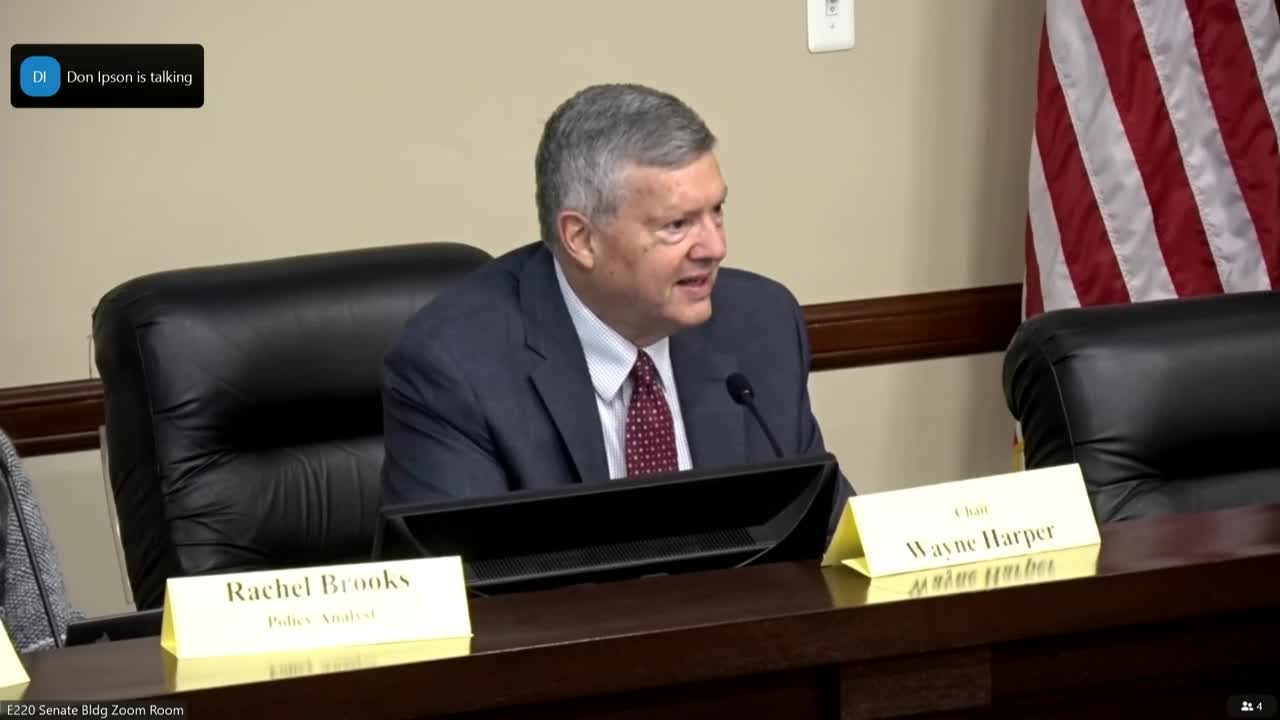
Summary
The Senate Transportation committee unanimously recommended Senate Bill 269, which updates state rules on telecommunications carriers, clarifies carrier-of-last-resort relief, and focuses state universal-service funds on noncompetitive areas after stakeholder negotiations.
Senator Harper, chair of the Senate Transportation, Public Utilities, Energy and Technology Standing Committee, said the committee unanimously passed Senate Bill 269, Telecommunications Amendments, with a favorable recommendation to the full Senate.
The bill updates state law related to incumbent telephone corporations, clarifies distinctions between price-regulated and rate-of-return carriers, and provides a process for carrier-of-last-resort relief while preserving consumer protections and state universal service funding for noncompetitive areas.
Senator Harper told the committee the bill "goes and makes amendments to laws relating to telecommunications companies" and is intended to "ensure that everybody has access to a variety of telecommunication products." He added the bill "does not relieve any carrier of obligations to continue service" and includes technical changes to how authorized areas are deemed competitive as of July 1, 2025.
Tim Kunkleman, regional director for Lumen Technologies (CenturyLink), testified in support and described SB 269 as "a result of a collaborative stakeholder effort" that balances consumer protections with regulatory relief to enable investment in next-generation networks. Kunkleman said the bill "provides relief for a carrier of last resort" and that the sponsors had tried to ensure "no customer is gonna be left behind." He also told the committee Utah has "about a little over 4,000,000 voice lines across the state" and that roughly 2.9 percent remain under older regulation.
Committee discussion emphasized the multi-stakeholder compromise. Senator Ravey moved the bill out of committee with a favorable recommendation; the motion carried unanimously.
The committee record shows the measure was presented, discussed with industry stakeholders and agency staff, and advanced to the Senate floor for further consideration.
Votes at a glance: Senate Bill 269 — Favorable recommendation to the Senate (unanimous).