
United Way’s Working Bridges tells House transportation committee short-term, workplace-centered strategies help keep low-income workers employed
Get AI-powered insights, summaries, and transcripts
Subscribe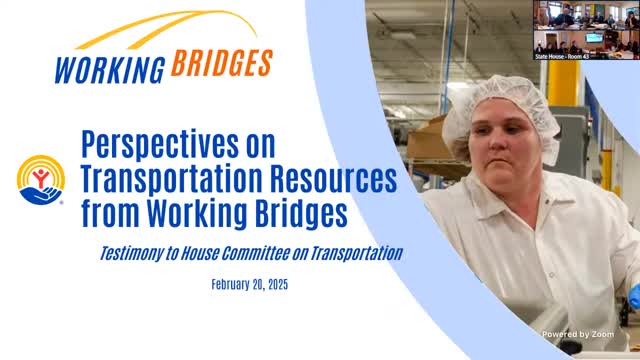
Summary
United Way’s Working Bridges told the House Transportation Committee about program work connecting employees to short-term flexible transportation funds, vanpool pilots, and employer-based resource coordination to reduce workforce loss from transportation breakdowns.
Connie Beal, director of United Way’s Working Bridges, told the House Transportation Committee on Feb. 21 that transportation disruptions are a common cause of employment loss for low-income, frontline workers and described employer-centered interventions the program uses to keep people on the job.
Beal said Working Bridges provides resource coordinators on site with employers to help workers navigate transportation options, provide financial coaching and, when needed, short-term flexible funds to cover car repairs, gas or bus passes. She described a 2019 six-month pilot that provided on-demand van rides and occasional rides by cab for employees who lost access to a vehicle; the pilot served 67 employees and cost about $1,938 over six months using grant funds.
Beal said that in 2024 the program served more than 1,600 employees across more than 30 employer partners and that 27 employees requested transportation help. Of those, seven received short-term bridge-fund assistance in 2024 for repairs, gas or bus passes. She recommended continued engagement with employer networks, local customizable on-demand services, short-term flexible funds and employer-designed “healthy car funds” as strategies that work for employees in deep scarcity.
Beal said employers are well-placed to identify ZIP-code clusters and to convene nearby employers for shared services, but that vanpooling and fixed-route transit do not always meet needs for multi-shift worksites, irregular schedules or employees who live far from service corridors.
Committee members asked whether Working Bridges received state or federal funding; Beal said the program uses a mix of state dollars, fee-for-service revenues from employer contracts and philanthropy, and that the model has moved toward greater sustainability since 2019. Members also asked about the earlier Vermont Employment Transportation Initiative (VETI), which Beal said had been useful and is missed by current resource coordinators.
Beal closed by urging the committee to consider employer-networked pilots and short-term funds that are locally tailored to meet the needs of workers in financial scarcity. No formal action was taken.