
House Education committee advances bill to stop repeat waiver hearings for classified school employees
Get AI-powered insights, summaries, and transcripts
Subscribe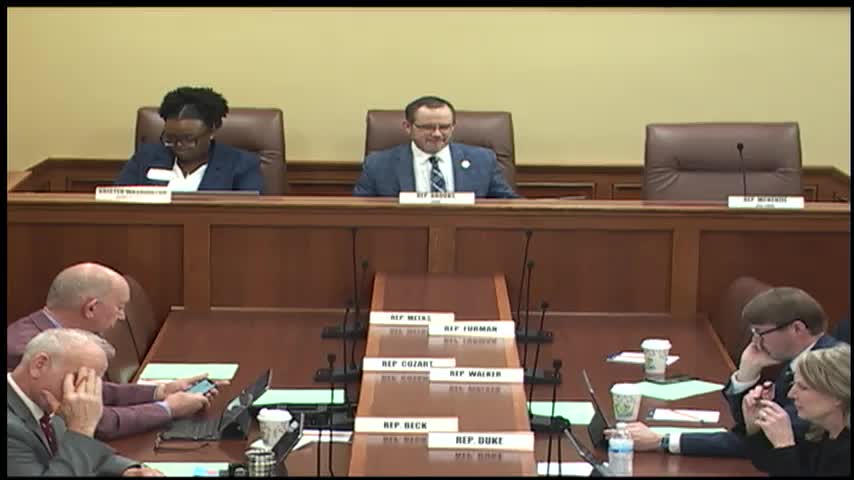
Summary
Representative Tommy Hawk introduced Senate Bill 228 to the House Education Committee, proposing that a waiver from the State Board of Education remain valid for classified school employees while they remain employed, instead of requiring renewal every five years.
Representative Tommy Hawk introduced Senate Bill 228 to the House Education Committee, asking the committee to stop requiring classified school employees to seek board waivers every five years once the State Board of Education has already granted a waiver.
"Once that they get the waiver from the Department of Education, and they stay in good standing with the school district, that they don't have to get another waiver as long as they are employed with the school," Representative Hawk said.
The bill responds to differences in how the law treats classified (noncertified) and certified staff. Dr. Karen Walters, superintendent of Bryant Public Schools, told the committee that certified employees who receive a waiver from the State Board are not required to return to the board, while classified staff currently must seek renewal every five years. "We think it's really a cleanup bill. What we're asking in this language is that we treat our classified staff the same way as our certified staff are being treated," Walters said, adding that her district had required a long-serving classified employee who works with special-needs students to appear before the board again after five years.
Walters and Hawk described guardrails in the bill. If a classified employee leaves the district and later returns, the bill would require a new waiver. If an employee obtains a new disqualifying conviction while employed, that new offense would trigger renewed review. Walters said district boards consider the age of an offense when deciding whether to recommend a waiver.
Representative Kevin Beck asked how the bill would handle a situation where an employee who already held a waiver later incurred a new qualifying conviction. Walters replied that districts receive limited information about the qualifying event and would bring a new offense to the board for reconsideration; she said she would not recommend a waiver for a recent offense.
No members of the public signed up to speak for or against the bill. Representative Parker moved "due pass"; after no discussion the committee approved SB 228 by voice vote.
Discussion: Committee members asked procedural and safeguard questions; presenters emphasized the staffing burden created when long-ago offenses force repeated board appearances and said the change would ease recruitment and retention for positions such as janitorial and classified support.
Action: The committee approved SB 228 on a voice vote (no roll call recorded in the transcript).