House caucus reviews score of 2025 bills, including major transportation and public-safety appropriations
Loading...
Summary
Members heard short presentations by committee staff on more than 40 bill summaries across appropriations, transportation, education and health committees, including appropriations for road projects, a $50 million public-safety allocation and multiple education and health measures; no formal votes were recorded in the caucus.
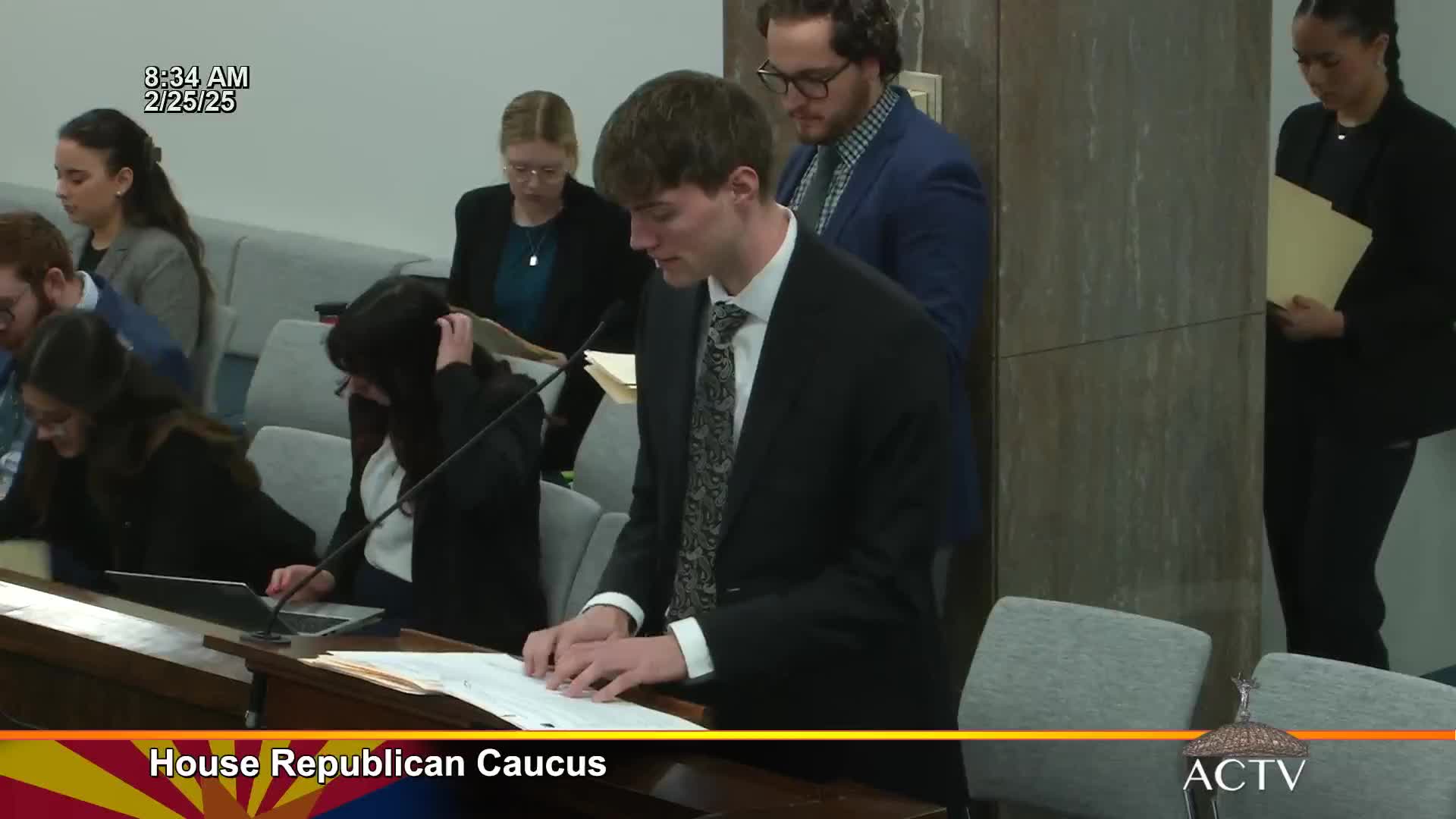
A morning House caucus at the state Capitol heard brief presentations from committee staff on more than 40 bills across appropriations, transportation, education, health and other committees, with major items including a $50 million appropriation for border-related public-safety work, multi-million-dollar road projects and several education funding and school-policy measures.
Committee staff opened the session and then summarized bills in order by committee. Appropriations Committee staff presented a range of funding measures, including a $6,000,000 allocation from the State General Fund to the Arizona Department of Transportation for the Wolford Road Extension Project in the City of Show Low (House Bill 2220) and $16,291,610 from the State General Fund to widen and improve State Route 347 between Interstate 10 and the City of Maricopa (House Bill 2557). Staff also outlined a $50,000,000 FY 2026 appropriation to the Department of Public Safety to enhance enforcement, prosecution and detention of border-related crimes (House Bill 2606).
The caucus also received summaries of non-appropriation policy bills. Commerce Committee staff described bills to streamline municipal building-permit approvals (House Bill 2869) and to revise the definition of fantasy sports contests (House Bill 2328). Education Committee staff outlined proposals affecting teacher pay and school finance including a strike-everything amendment to a bill that would require schools to revise salary schedules if voters approve an increase to the permanent state school funds distribution rate and would create a teacher pay fund (House Bill 2185). Health and Human Services staff summarized measures ranging from maternal mental health education materials to a proposal to fund a research study on ibogaine requiring a matching commitment (House Bills 2332 and 2871).
Several bills include specific matching or reporting conditions. For example, the bill to award a grant for ibogaine research requires the grant recipient to demonstrate at least $5,000,000 in matching funds; a grant to the Arizona Department of Administration for a fire incident management program was presented as a $2,000,000 appropriation (House Bill 2456); and a bridge replacement appropriation to Yuma County for Somerton Avenue requires Yuma County to demonstrate at least $200,000 in matching funds from non-state sources to receive the $1,300,000 (House Bill 2562).
Other items presented as committee actions included proposals to change agency names and structures (for example, renaming the Arizona Commission of African American Affairs to the Arizona Office of African American Affairs, House Bill 2160), regulatory clarifications for ambulance interfacility transfers, provisions related to minors’ data protection on social media platforms (House Bill 2861), and several election- and federalism-related bills, including prohibitions on using foreign-government funds for election administration and limits on Attorney General actions against county supervisors who decline to certify elections under certain good-faith beliefs (House Bills 2521 and 2440).
No formal votes or final actions were recorded during the caucus; presenters repeatedly closed each summary by saying they were available for questions. The session agenda covered appropriations, policy changes and interim-reporting requirements, and caucus leadership indicated a second part of caucusing would be distributed and held later.
The meeting text indicates that many measures are on consent calendars or have been amended by committees; specifics of committee amendments and final floor scheduling were not decided or recorded in this caucus summary. Several bills carry statutory or administrative reporting deadlines if enacted—for example, a requirement that the Department of Health Services submit reports on the Arizona Health Care Directives Registry by 12/31/2025 and 06/30/2026, with that reporting requirement repealed on 01/01/2027 (House Bill 2329).