
House committee approves substitute to shift 'plans of safe care' lead to Department of Health
Get AI-powered insights, summaries, and transcripts
Subscribe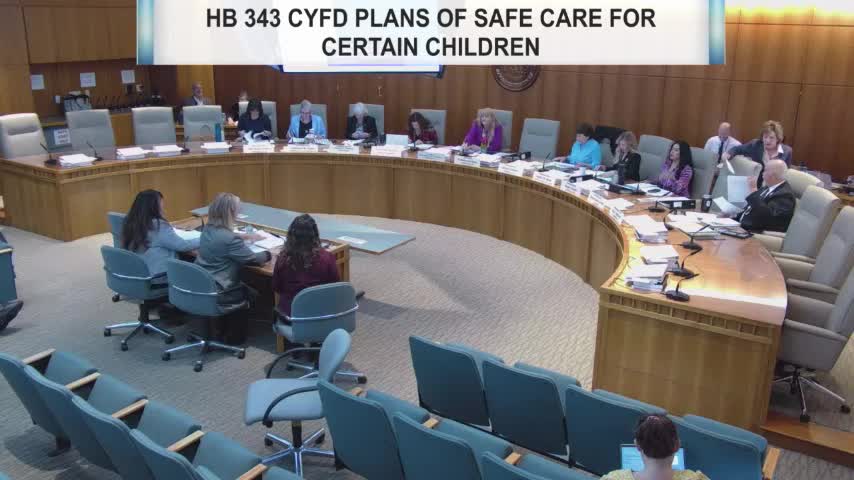
Summary
The House Health and Human Services Committee voted 9-0 to advance a committee substitute to House Bill 343, shifting leadership for "plans of safe care" for substance-exposed infants from CYFD to the Department of Health and adding new reporting, care-coordination, and rulemaking requirements.
The House Health and Human Services Committee voted 9-0 to advance a committee substitute to House Bill 343, moving responsibility for plans of safe care for substance-exposed infants from the Children, Youth and Families Department (CYFD) to the New Mexico Department of Health (DOH) and setting more specific expectations for care coordination.
The substitute, described to the committee by Representative Armstrong, directs DOH to take a public-health approach to care coordination, requires in-person support and active follow-up with families, connects all families issued a plan of safe care to home visiting services and substance use disorder prevention and treatment providers, and requires improved data collection and reporting. It also clarifies that CYFD must be notified and proceed with an investigation under the New Mexico Administrative Code (NMAC) when families refuse recommended services that result in potential immediate risk to a child.
Committee supporters said the change addresses persistent gaps in how plans were implemented and aims to prioritize upstream supports for families impacted by substance use disorders. "This substitute makes Department of Health the lead on care agency with more specific expectations about the roles and responsibilities of care coordination," Representative Armstrong said. Family members, foster-care advocates and providers testified in support; Jeremy Martinez, a kinship guardian, said he has seen plans "fail over and over" and urged reform. Barbara Yell, a social worker and director of a foster/adoption nonprofit who also serves on the governor's policy advisory council for CYFD, testified she was "in huge support of fixing CARA and of this bill."
Representatives pressed for operational clarity. Representative E. Chavez asked who would be the lead when both a DOH navigator and a managed-care organization (MCO) care coordinator were involved; staff answered that DOH care navigators would be the lead and could proceed if an MCO coordinator failed to follow through. Committee staff and sponsors said hospitals, midwives and birthing facilities are in scope for reporting and that DOH and hospitals are developing standardized screening tools and revised "plan of safe care" paperwork. The substitute also requires DOH to promulgate rules by Jan. 1, 2026; staff said the program is already operating and that rules will be developed by that date with public comment required.
Representative E. Chavez repeatedly requested additional materials before implementation: current CYFD tools, proposed training curricula, and details on who will be hired as care navigators and their supervision. Sponsors said weekly case reviews and additional training will provide oversight and that the navigators will work closely with hospital staff, NICU clinicians and MCO coordinators.
The committee recorded its formal action as a paired motion: do not pass on the original House Bill 343 and do pass on the committee substitute. The clerk announced the result as a "do pass 9 to 0." Representative E. Chavez gave a statement explaining her vote and reiterated requests for the tools and training documentation.
The substitute requires DOH to coordinate with partners on safe-sleep education and to work with community partners on housing placement when needed; if a family refuses services and immediate child-safety risk exists, CYFD must investigate under NMAC.
Supporters urged the Legislature to allow DOH and CYFD to implement the change and then evaluate results; opponents on record were none.
The committee advanced the substitute to the next stage; sponsors and staff must supply the requested operational documents to members as implementation proceeds.