
Oregon Judicial Department warns 10% cut would force layoffs, court closures; seeks $1.23 billion for 2025–27
Get AI-powered insights, summaries, and transcripts
Subscribe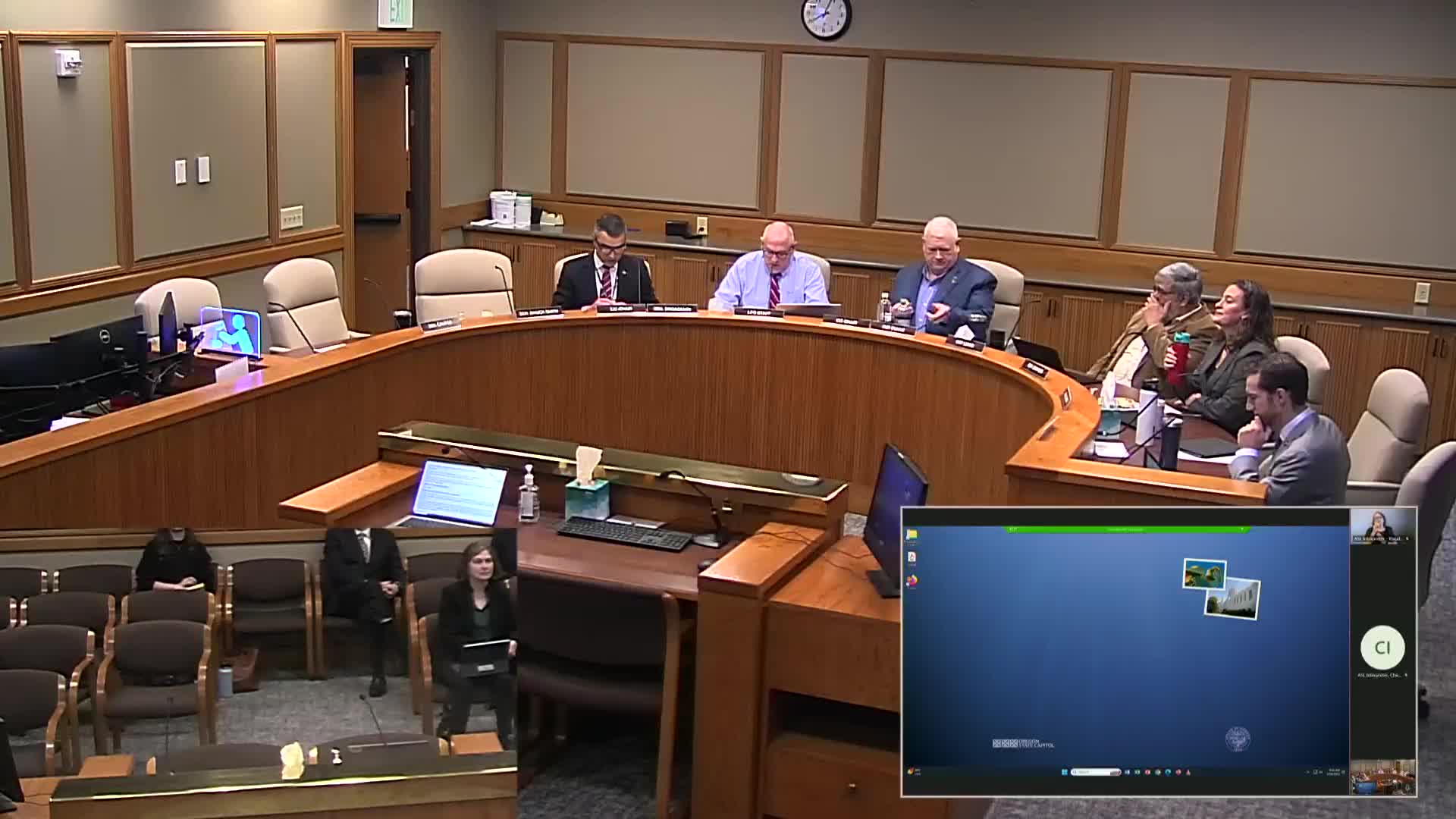
Summary
The Public Safety Subcommittee heard on Feb. 26 that the Oregon Judicial Department (OJD) is seeking $1.23 billion for the 2025—27 biennium to maintain court operations, prevent staff layoffs and address courthouse safety and technology shortfalls.
The Public Safety Subcommittee heard on Feb. 26 that the Oregon Judicial Department(OJD) is seeking $1.23 billion for the 2025—27 biennium to maintain court operations, prevent staff layoffs and address courthouse safety and technology shortfalls. Jessica Roser, Assistant Deputy State Court Administrator for Operations, told the committee the departmentmost of its costs are people: "most of our costs, almost 84% are in our people, judges and staff, which is why it's very difficult to absorb any cuts to our budget."
The request is filed as House Bill 5012, described at the hearing as the Judicial Department's primary budget measure. OJD presented a current service level (CSL) figure of $893,900,000 across all funds and said the Chief Justice's recommended budget for the 2025—27 biennium is $1,230,000,000. The department said the recommended package would increase general-fund support for judicial compensation, operations, mandated pass-throughs and technology.
Nancy Kozine, State Court Administrator, told the committee cutting OJD's budget would have outsized effects because 23% of the department's spending (judicial compensation, debt service and DAS surcharges) is legally or practically protected from reductions, forcing any mandated cuts onto the remaining operations budget. "We are now facing so many mounting pressures that budget cuts are simply not possible without creating great harm," Kozine said. She and Roser said a 10% cut to the overall OJD budget would translate to roughly a 13.5% reduction in operations, which OJD estimates would require laying off about 100 staff statewide or closing courts for weeks to months.
OJD outlined the specific shortfalls that make cuts especially damaging: a $2,400,000 projected shortfall in the Application and Contribution Program (ACP) that funds verifier staff; roughly $7,500,000 in shortfall for mandated accounts that pay juries and interpreters; and an estimated $2,300,000 shortfall in the State Court Technology Fund. OJD warned that without policy option packages (POPs) to fill revenue gaps, a 2% operational cut tied to unresolved CSL revenue gaps would still mean roughly 42 staff layoffs or more than 14 court closure days statewide.
The department described four priority buckets in its POPs: courthouse and community safety, judicial compensation, timely justice (staffing and new judges), and technology and training. For courthouse safety, OJD asked funding to pilot security screening at courthouses in Coos, Curry, Grant, Harney, Jefferson and Polk counties in 2026 and Clatsop and Linn counties in 2027, add marshal office positions and offer grants for entry renovations. Roser said an initial pilot located three loaded guns and 662 edged weapons at one courthouse between January and October 2024.
On judicial compensation, OJD said circuit judges are statutorily paid the same amount statewide (described in the hearing as $185,508) and presented a bill package that would raise that statutory salary; the department said increases would be implemented by statute and that judges already receive any executive-branch management-class cost-of-living adjustments when those are provided. Senator Brock Smith and other members asked about COLA and supplemental mechanisms; OJD staff said there is no automatic indexing beyond the existing management-class COLA mechanism.
OJD requested 24 positions for family court facilitation and remote services to help self-represented litigants, 18 positions to implement House Bill 4002's new drug-related misdemeanor and conditional discharge work, and continuation of positions added under Senate Bill 337 to manage unrepresented litigant caseloads and prevent warrants being issued because defendants were not tracked. OJD said the National Center for State Courts estimates Oregon needs 35 new trial judges statewide and that OJD's current request seeks six new judges in specific counties.
Technology and training requests included $13.3 million for network upgrades, $4.2 million for software licensing and maintenance, lifecycle equipment replacements in Multnomah County, and funding for 22 positions (12 audio/video specialists and 9 central IT staff) to support remote hearings, cloud services and cybersecurity. OJD also asked for $1.3 million and four positions to develop an AI evaluation and governance roadmap, and for expanded judicial and staff training teams (20 staff-training positions plus judicial education staff) to reduce turnover and improve caseflow management.
OJD outlined capital and pass-through requests: planning and improvements ($2.9 million POP 118), critical repairs ($13.3 million POP 119), construction requests ($5.6 million POP 120, plus a late Hood River request described at the hearing), and increases in mediation pass-throughs and civil legal aid (OJD requested $11.9 million for domestic relations mediation and $9.85 million for legal aid, with $4.35 million dedicated to civil legal aid and about $5.5 million for immigration services). OJD also asked to shift some programs from other funds to the general fund to stabilize revenue streams, including the ACP verifier program and the State Court Technology Fund.
Committee members asked for follow-up materials; Representative Helfrich requested details on DAS surcharges, and OJD staff agreed to provide them. No formal committee action or vote occurred at the informational hearing; the subcommittee chair closed the hearing and previewed public testimony scheduled for the following day.
Chief Justice Megan Flynn closed the departmentpresentation by saying the courts are "essential problem solvers" and urging sustained funding to preserve access to justice, courthouse safety and timely case processing. "Ensuring stable funding for the courts benefits all Oregonians and keeps the justice system functioning effectively," Flynn said.