
Oregon March forecast trims current biennium, raises next biennium; tariffs, manufacturing and demographics cited as risks
Get AI-powered insights, summaries, and transcripts
Subscribe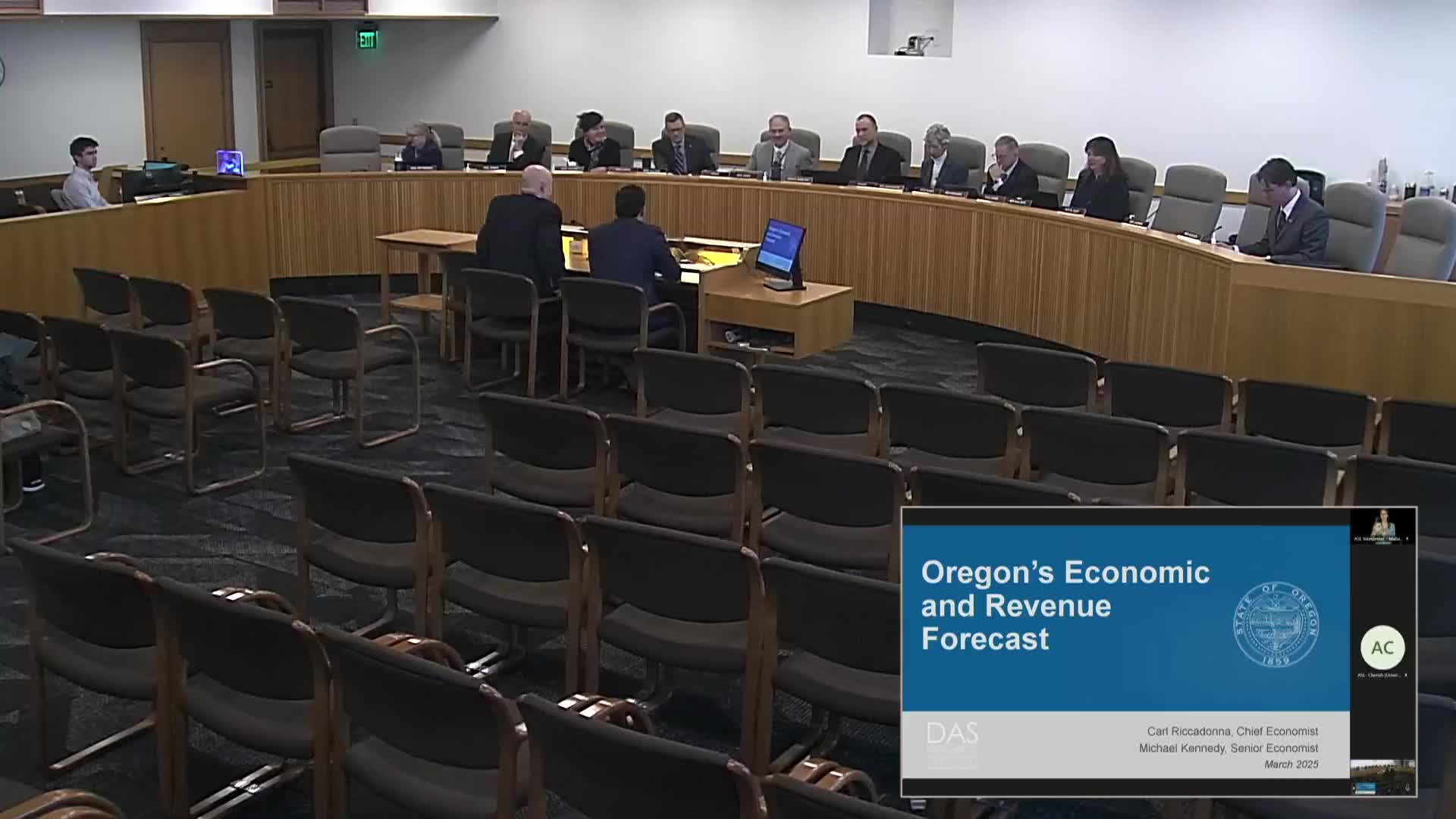
Summary
The Office of Economic Analysis presented the March 2025 Economic and Revenue Forecast to the Senate Committee on Finance and Revenue on Feb. 26, projecting a $89 million reduction in revenue for the current biennium, a $551 million increase for the next biennium and an overall increase in available resources of roughly $350 million compared with the December forecast.
The Office of Economic Analysis presented the March 2025 Economic and Revenue Forecast to the Senate Committee on Finance and Revenue on Feb. 26, projecting a $89 million reduction in revenue for the current biennium, a $551 million increase for the next biennium and an overall increase in available resources of roughly $350 million compared with the December forecast.
The forecast matters because the revenue picture determines the state’s available resources for the 2025–27 budget, affects the projected kicker refund and guides planning for reserves amid heightened uncertainty. Michael Kennedy, senior economist with the Office of Economic Analysis, told the committee: "For the current biennium, we're reducing revenues by 89,000,000." Kennedy also said new tax return data raised next-biennium revenue projections. Carl Rickadonna, chief economist for the state of Oregon, described the broader economic backdrop and risks, saying the "distribution of risks has widened" even though consensus forecasts hold at about 2% national growth for 2025.
The most immediate accounting changes driving the numbers: a larger-than-expected wave of refunds and tax processing in late 2024 reduced current-biennium receipts by about $275 million relative to the December forecast, the presenters said. Separately, recently received tax-return data showed stronger-than-expected growth in taxable wages and salaries for 2023–24 (the forecast team raised its wage-growth estimates into the mid-6% range), a more persistent source of taxable income that pushed the next-biennium revenue estimate up by $551 million. Because the December special session increased appropriations by $110 million, the net effect on the projected ending balance for the current biennium is roughly a $200 million decline from December, the economists said; projected available resources for 2025–27 are higher by roughly $350 million.
Kennedy described the composition of taxable income: wages and salaries plus retirement income account for about 80% of taxable income, while capital gains and Schedule E (pass-through/business) income are roughly 12% combined. He told the committee that earlier forecasts had attributed much 2024 revenue strength to volatile capital gains; new return data shifted more of the growth to wages, which the office treats as more persistent. He said the refund timing and larger-than-expected refund volume were largely an accounting and timing phenomenon tied to complicated returns, the kicker and the pass-through entity elective tax.
On fiscal mechanics, the economists said the kicker projection is lower by about $68 million in part because the office’s projection of the ultimate current-biennium revenue tabulation is reduced. Kennedy emphasized, "We're not reducing the kicker. The kicker is our projection of revenues for the biennium relative to the close of session forecast." He also noted that agency spending out of appropriations after the biennium ends (reversions/unspent appropriations) remains uncertain and that the Office of Economic Analysis, the Legislative Fiscal Office and the Chief Financial Office will work before May to refine the available-resource estimate.
On the economy, Rickadonna summarized national and state conditions: the consensus national forecast remains near 2% growth for 2025 and roughly 2.8% inflation, and unemployment is expected to drift mildly higher. He warned that Oregon is more exposed than most states to manufacturing and export activity and to trade with Pacific trading partners, making tariff and trade-policy developments a larger tail risk for the state. He recalled that the 2018 trade tensions reduced Oregon's growth relative to the nation and said the state’s recent slowdown left it on a weaker footing heading into possible trade disruptions.
At the state level, Rickadonna said Oregon’s 2024 growth slowed to about 1.2% (state GDP data are available only through Q3) after earlier stronger periods, with job creation uneven across sectors. He noted recent two‑quarter reacceleration in GDP but said hiring has been lopsided: private education, health care, services, government and utilities accounted for most gains while construction, manufacturing, transportation/warehousing, finance and retail showed net job losses over the past year. He pointed to high employment‑to‑population ratios and solid labor-force participation that support household incomes but said housing affordability and elevated mortgage rates continue to weigh on construction and housing-sector recovery.
The forecast team highlighted demographic constraints as a longer-term drag: Oregon's population growth has slowed, the office projects roughly 0.6% annual growth going forward, and net births no longer offset deaths in recent data. Rickadonna said the demography team is tracking migration, birth/death rates and other population flows at the county level and that policies to attract and retain skilled workers and graduates are an important consideration for long-run growth.
Committee members asked about tariffs, manufacturing, high‑income outmigration and the role of tax policy. On tariffs, Rickadonna said the office will keep an open mind, noting that tariffs can have complex effects—some protection could advantage particular domestic industries, but historically Oregon, with its export and manufacturing exposure, was more negatively affected during past trade tensions. On migration, economists said high‑income households have shown county‑level mobility and that tax and local conditions appear among factors influencing location decisions, but they deferred detailed causal claims to targeted research such as county migration studies.
The forecasters cautioned about uncertainty ahead of the May forecast. Kennedy said the office estimates a plausible range of change in the available‑resources figure of roughly $500 million either way between March and May, but that most probability mass lies near the current forecast. Reserve policy: the forecast retains a 10.5% reserve target for the coming biennium; the presenters noted that a historically normal ending balance would imply reserves near 12% and that the largest past closed-session revenue drops in severe recessions were about 15–16%.
The committee asked for a March update on any unemployment impacts from recent federal job cut announcements; Rickadonna agreed to provide an update as data become available. The informational briefing concluded with the presenters advising that the May forecast—after tax‑season filings and further data—will be definitive for budget finalization.