
DOR collections division reports $1.68 billion inventory, spike in automated write‑offs and cancellations
Get AI-powered insights, summaries, and transcripts
Subscribe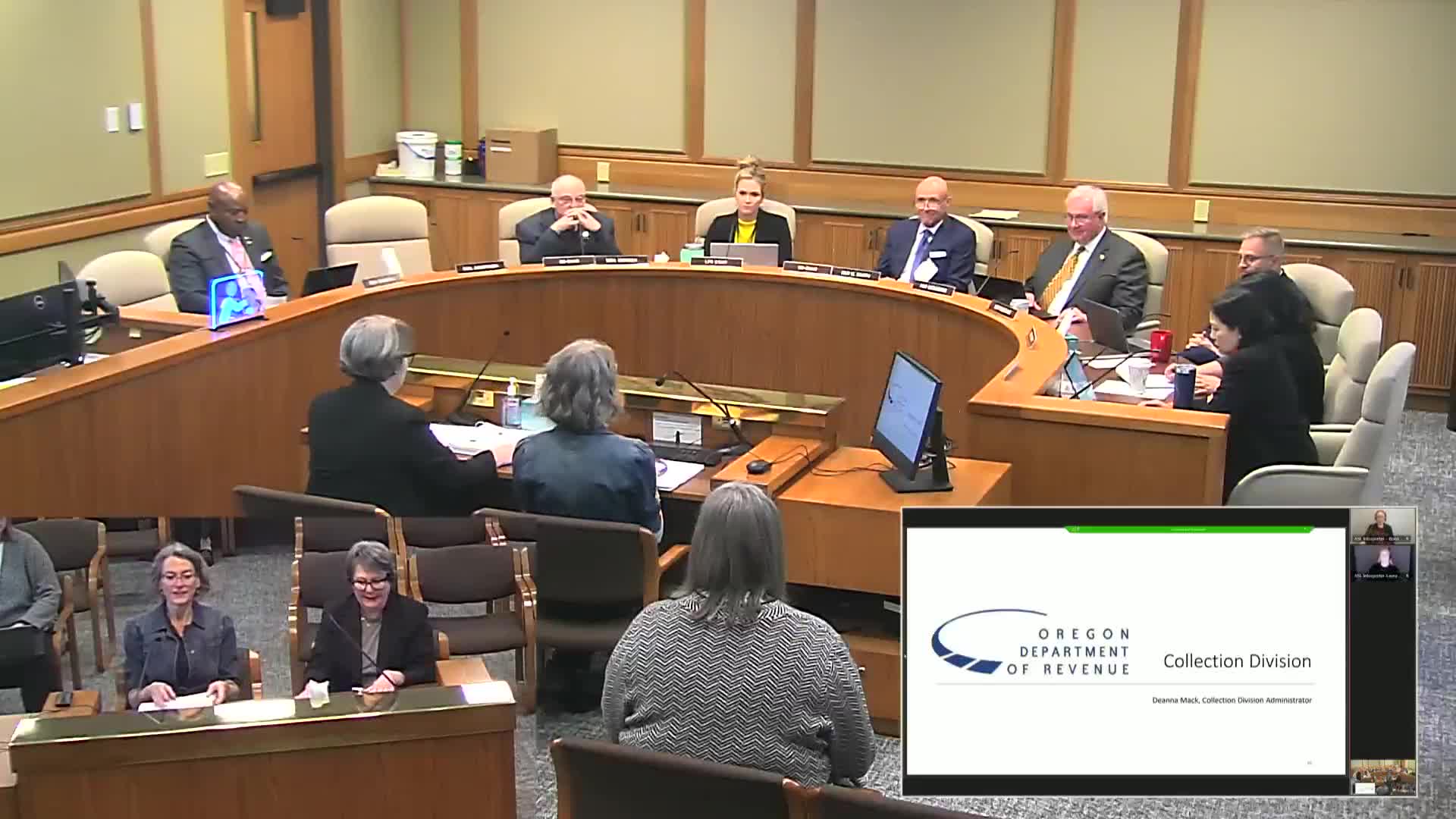
Summary
Collections Division Administrator Deanna Mack told the Ways and Means subcommittee the department has $1.68 billion in collectible debt inventory, assigned nearly 30% to private collection firms, and canceled $68.9 million in uncollectible debt in fiscal 2024 after automating write-off processes.
Deanna Mack, administrator of the Department of Revenue Collections Division, told the Joint Committee on Ways and Means Subcommittee on General Government on March 11 that the collections division now consolidates tax and non‑tax collections, manages other‑agency accounts (OAA), and is using automation and analytics to improve performance.
Mack said the department's debt inventory available for collection was about $1.68 billion in fiscal 2024. She said roughly two-thirds of that inventory is tax debt and one‑third is assigned by other agencies; about 30% of the total inventory is assigned to private collection firms.
Why it matters: The collections division acts as the state's centralized collections agent for many agencies and local governments; changes in collections, write-offs and cancellations affect state and local agency revenues and accounting.
Collection rates and recent changes: Using Legislative Fiscal Office methodology, Mack reported a 15.7% collection rate for the department's tax debt in fiscal 2024; OAA collection rate was 5.9% and private collection firms' rate rose to 2.4% in the same period. The department projects roughly $440 million in tax collections and about $100 million for other‑agency accounts in the 2025–27 biennium.
Write-off automation and cancellations: Mack said that the department automated its write-off process in 2019 and that automation led to a backlog being processed; as a result, $68.9 million in uncollectible debt was canceled in fiscal 2024 when accounts aged out per statutory timelines. She explained that an account can be restored to active collections if new assets or activity are identified while it is in write-off status. The department cited ORS 293.240 for write-off authority during the discussion.
Settlement offers and other resolution tools: Mack said the department canceled $2.2 million under its settlement-offer process in fiscal 2024 and recently updated rules and planned an online calculator to improve accessibility of the settlement-offer tool.
Staffing, customer service and technology: Mack said the collections division has about 250 staff who manage payment plans, hardship reviews and active enforcement, and that turnover is a perennial challenge because many positions are entry level with active internal promotion. Mack said call-center modernization, improved website content, a department chatbot (informally referred to as ‘‘Doug’’), and analytic hires (a Research Analyst 4) are part of the division's strategy to improve customer experience and prioritization of accounts. She said the division uses data analytics to identify accounts most likely to pay voluntarily and to prioritize enforcement resources.
Ending: Mack said staff would return for additional meetings; committee members asked for follow-up materials including agency-specific breakdowns for large OAA contributors and additional detail on out-of-state collections and use of private collection firms.