
Appropriations committee advances DOT budget bill with new flex fund allocations and 5¢ gas tax
Get AI-powered insights, summaries, and transcripts
Subscribe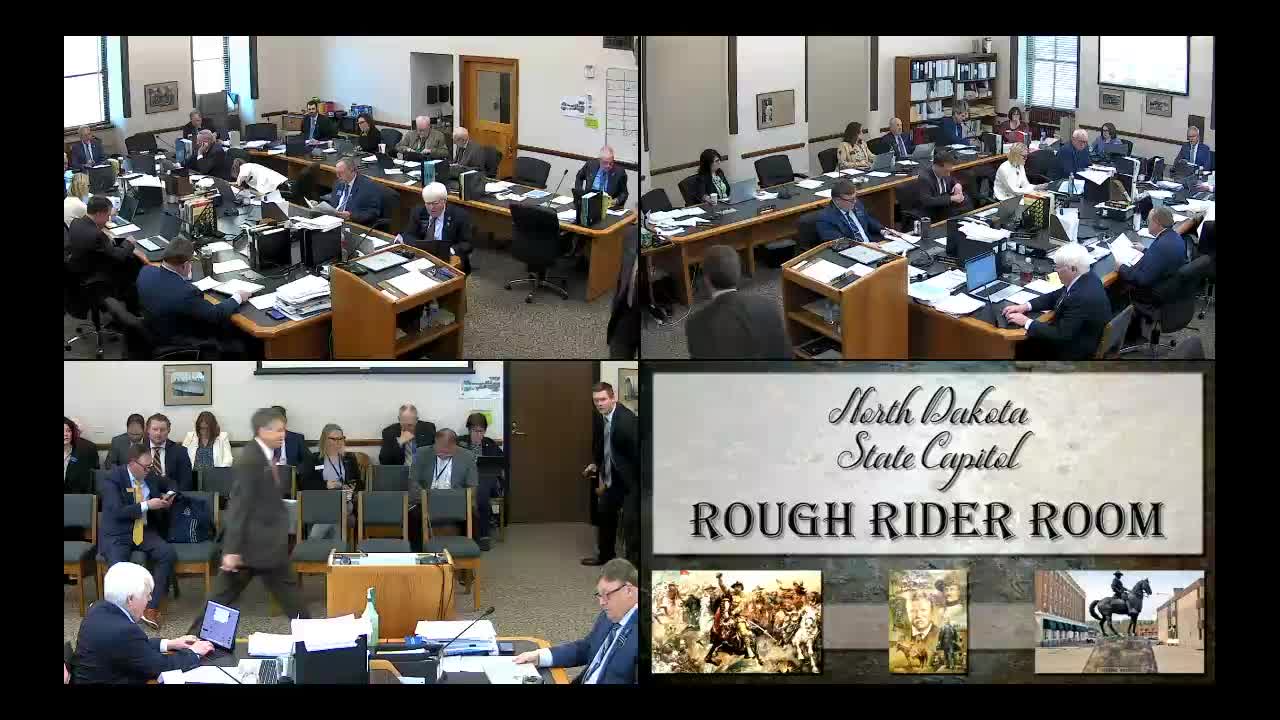
Summary
The House Appropriations Committee voted to advance Senate Bill 2012, the Department of Transportation budget, after adopting an amendment that reworks flexible ("prairie dog") funding into a new flex transportation fund, adds bonding for Highway 85 and includes a 5-cent gas-tax increase projected to yield about $70 million.
The House Appropriations Committee on Thursday advanced Senate Bill 2012, the Department of Transportation budget, adopting an amendment and voting to send the bill to the floor. The measure as amended reallocates the former "prairie dog" bucket into a new flexible transportation fund, authorizes $155 million in bonding for Highway 85, and adds a 5-cent increase to the state gas tax projected in committee discussion to generate about $70 million in new revenue.
The committee adopted the amendment (version 02/2009) on a recorded vote (motion carried 19-1 with three members absent) and later approved a due-pass recommendation for SB 2012 as amended (motion carried 20-0 with three absent). Representative Marvin Brandenburg, the bill carrier, led the committee through line-item changes; Speaker Robin Weiss provided an overview of the policy tradeoffs. "We desperately needed more money going into the general fund," Speaker Weiss said during the presentation.
Why it matters: The bill restructures several long-standing revenue buckets that pay for roads and bridges, shifting money and control toward a grant-driven flexible fund while preserving guaranteed distributions to political subdivisions. Committee discussion focused on how the changes would affect townships, cities and counties, the ability to match federal grants, and risks to multi‑mile projects such as Highway 85 if matching funds are not secured.
Major provisions and figures discussed
- Overall DOT totals: Representative Brandenburg said the bill shows a base fund of about $1.7 billion, adjustments of roughly $1.0 billion and a total near $2.7 billion; FTEs were described as roughly 1,001 with net additions the legislature had previously approved that leave the total near 1,006.
- Highway 85 bonding: The bill authorizes $155 million in bonding to complete a 19-mile stretch; committee discussion said 13 of those miles qualify for a federal grant ($55 million) while the remaining 6 miles do not and were estimated in committee discussion to cost about $100 million. Committee members said completing the full 19 miles is necessary for safety and to preserve a previously completed NEPA study.
- Flexible transportation fund (replacement of "prairie dog"): The committee was shown a breakdown of the proposed flex fund allocations. Representative Brandenburg recited percentages and committee figures: about 43.43% (~$159 million) for non-oil counties; 13.5% (~$49.9 million) allocated statewide (discussed as a payment to DOT for statewide projects and matching needs); 7% (~$25.9 million) for townships; 11.5% (~$42.5 million) for non-oil counties; and an equal $42.5 million figure discussed for cities. The bill also changes the oil‑producing county threshold from 5 million barrels to 10 million barrels, which committee discussion said reduces the counties classified as "oil producing" to Williams, McKenzie, Dunn and Mountrail counties.
- Gas tax increase: The amendment includes a 5-cent increase to the excise gas tax (committee discussion described it as adding $0.05 to an existing $0.23 rate), which committee speakers estimated would generate roughly $70 million in new revenue and was intended to reduce pressure on the State Infrastructure Fund (SIF) and create a more predictable revenue stream for highways and local distributions.
- Legacy earnings and distributions: Committee members said the bill raises the legacy-earnings distribution from 7% to 8% for the first biennium, a change the presenters projected would yield about $688 million gross; after an estimated $102 million deduction for bond payments, about $586 million would remain, with 25% directed to DOT (approximately $146 million) and 75% to the legacy property tax relief fund (about $437 million), per committee figures.
- Matching federal funds and grant strategy: Committee speakers stressed that DOT needs standing match dollars to be competitive for federal grants and that the bill's structure is intended to ensure DOT can provide those matches. Speaker Weiss said that federal grant matches and the ability to show local matching reduced the chance of receiving federal funds if match money is not already available.
- Workplace items and operational details: The bill includes a small provision allowing DOT workplace appliances (example list given: coffee makers, microwaves, refrigerators) for employees such as snowplow crews working overnight.
- Electronic titling and other operational items: Committee members asked about electronic titling and licensing. Robin Weiss and committee staff said the licensing portion is expected within roughly six months; titles were noted as requiring further follow-up and possible additional work with staff and the department.
Committee debate and concerns
Committee members raised several policy and distribution questions: whether cities and counties would receive the same or more funding under the new structure compared with prior prairie-dog distributions; how grant scoring and criteria would be set; whether townships that adopt ordinances exceeding state statute could be penalized in grant scoring; and the potential for unintended consequences if local political subdivisions block energy or infrastructure projects.
Representative Brandenburg described committee-created grant scoring as a process involving DOT, counties, cities, townships and the Department of Commerce. He said the grant-review committee would score projects and that preference points could reflect local ordinances that exceed state statutes or unreasonably limit energy or agriculture facility projects. Representative Brandenburg stated at one point: "Every dollar here is oil money," arguing that the funding structure relies heavily on energy-related revenues.
Votes and motions at a glance
- Amendment 02/2009 (as distributed in committee): Moved by Representative Marvin Brandenburg; seconded by Representative Ron Munson. Committee adopted the amendment (motion carries 19-1, 3 absent). Representative Martinson was recorded as the lone no vote in the roll call on the amendment.
- Motion to remove language (page 7, lines 8–12 green language) that would allow grant scoring to consider local ordinances: Moved by Representative Nelson; seconded by Representative Murphy. Motion failed on the roll (5 in favor, 15 opposed, 3 absent).
- Motion to excuse Representative Berg from voting on SB 2012: Moved by Representative Bosch; seconded by Representative Swan Tech. Motion carried by voice vote and Representative Berg was excused from voting.
- Final committee action: Representative Brandenburg moved and Representative Munson seconded a due-pass recommendation for Senate Bill 2012 as amended. The committee voted to pass SB 2012 as amended (motion carries 20-0, 3 absent). Representative Brandenburg was designated the bill carrier.
What the committee did not decide
Committee discussion left several implementation and allocation questions to conference committee and to further work with the state treasurer and DOT staff, including precise spreadsheets comparing distributions for individual cities and counties under the old prairie-dog structure versus the new flex fund, and details about how DOT will allocate the 13.5% statewide DOT portion that committee materials identified for statewide projects and matching.
Where it goes next
The bill was advanced to the floor and conference-committee schedules were discussed; committee staff said some technical clarifications would be resolved in conference or with the treasurer's office.