
Senate committee hears testimony on bill to exempt up to $17,500 of military retirement pay for older veterans
Get AI-powered insights, summaries, and transcripts
Subscribe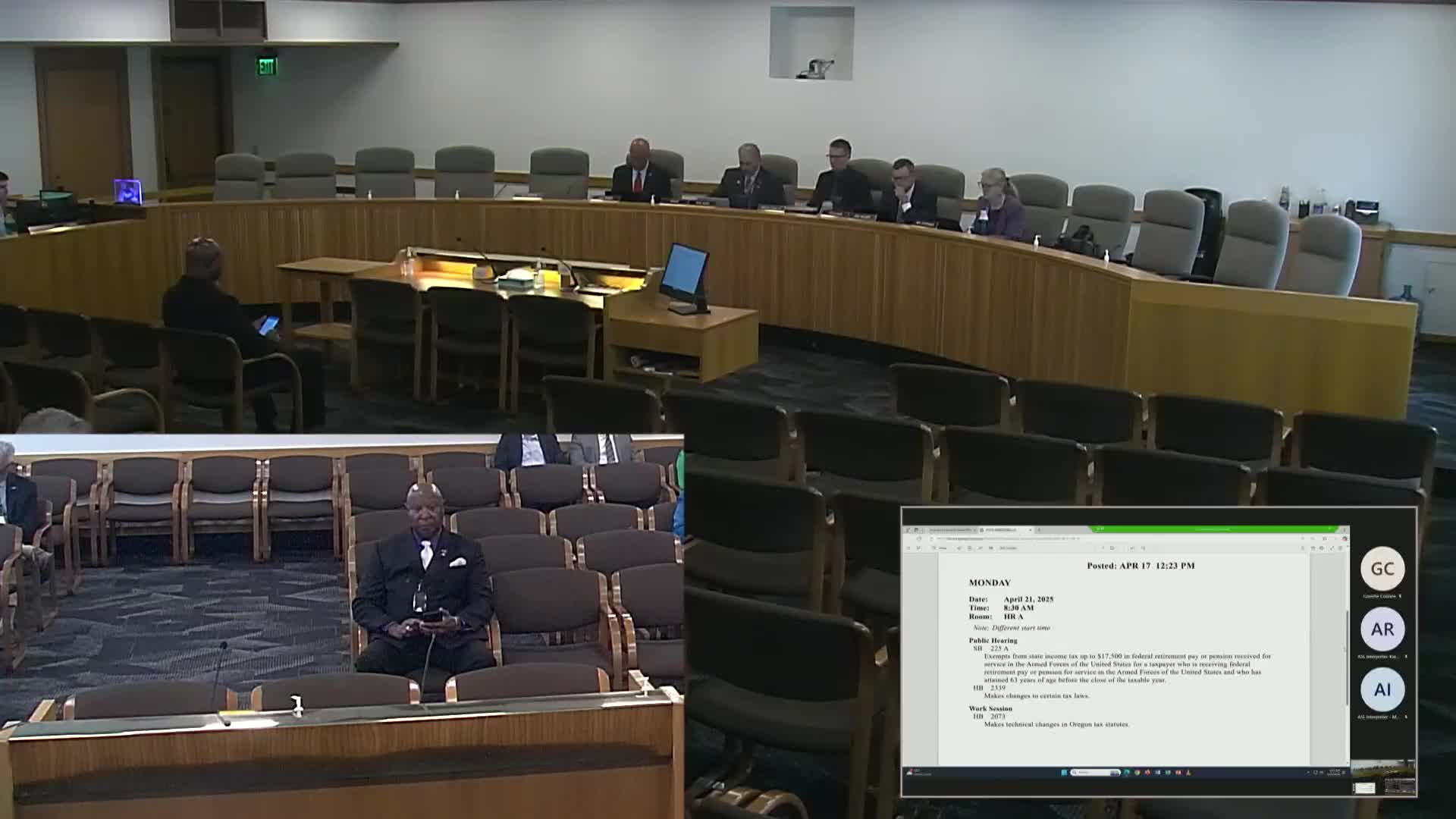
Summary
Senate Bill 225A would allow a personal income tax subtraction of up to $17,500 for military retirement pay for taxpayers age 63 and older, indexed to inflation and made applicable beginning tax year 2025; supporters called it a modest gesture to retain veterans, opponents said it is a poorly targeted tax cut.
Senator James Ivory Manning Jr. told the Senate Committee on Finance and Revenue on April 21 that Senate Bill 225A would create an Oregon personal income tax subtraction for military retirement income of up to $17,500 for taxpayers age 63 or older, indexed to inflation and applicable beginning tax year 2025.
"This bill is something that I had been working on for a number of years and here's here's the reason why," Senator James Ivory Manning Jr. said, arguing the change would send a positive message to veterans and retirees and could encourage Oregonians who retired out-of-state to return. "These are federal dollars that are being taxed for, pensions that have been earned by armed service personnel that have served 20 years or more on active duty."
The bill drew mixed public testimony. John Calhoun, representing Tax Fairness Oregon, said the average benefit—he estimated about $1,500 per year after phasing and eligibility—is too small to motivate retirees to move and warned the measure could cost the state an estimated $15 million to $17 million per biennium. "Trying to compete with other states by handing out income tax exemptions to honored groups is a fool's errand," Calhoun testified. He also said the benefit is not targeted to veterans with disabilities, homelessness, or other high needs.
Marsha Kelly of the Oregon Women's Rights Coalition told the committee the state already provides many veteran supports—property tax exemptions for disabled veterans, veterans homes, workforce preferences and education benefits—and said the bill would risk opening demands for similar pension exemptions for other public employees. "We have many, many things that we thank our veterans for in many programs," Kelly said. "We think this is a bad idea because then, as Mr. Calhoun pointed out, you give a tax benefit to somebody, somebody else is gonna want it."
Timothy Cowan, Legislative Commission of the American Legion, Department of Oregon, spoke in support. He described volunteer and community contributions by veteran organizations and said the measure would reduce a deterrent to returning home for some veterans. "It's more of a retention than it is an attraction," he said.
Committee members asked clarifying questions about the benefit amount and eligibility. Chair Meek noted the committee and Senator Manning have pursued similar measures previously. Vice Chair MacLean indicated support during the hearing, saying briefly, "That's a good bill. Let's get you to vote twice." Senator Manning noted the bill had passed out of the Senate Committee on Veterans, Emergency Management, Federal and World Affairs unanimously.
No formal committee vote on SB 225A is recorded in the transcript; the record shows only the public hearing and closing of the hearing.
Why it matters: proponents called the bill a modest way to show appreciation and reduce a disincentive for veterans to return to Oregon, while opponents said the benefit is narrowly targeted, could cost millions, and could prompt calls for similar exemptions for other pensioned workers.
Votes at this hearing: none recorded for SB 225A. The public hearing closed and the committee moved on to other bills.