
Conference committee reviews bill 2033 to help ‘distressed’ ambulance services
Get AI-powered insights, summaries, and transcripts
Subscribe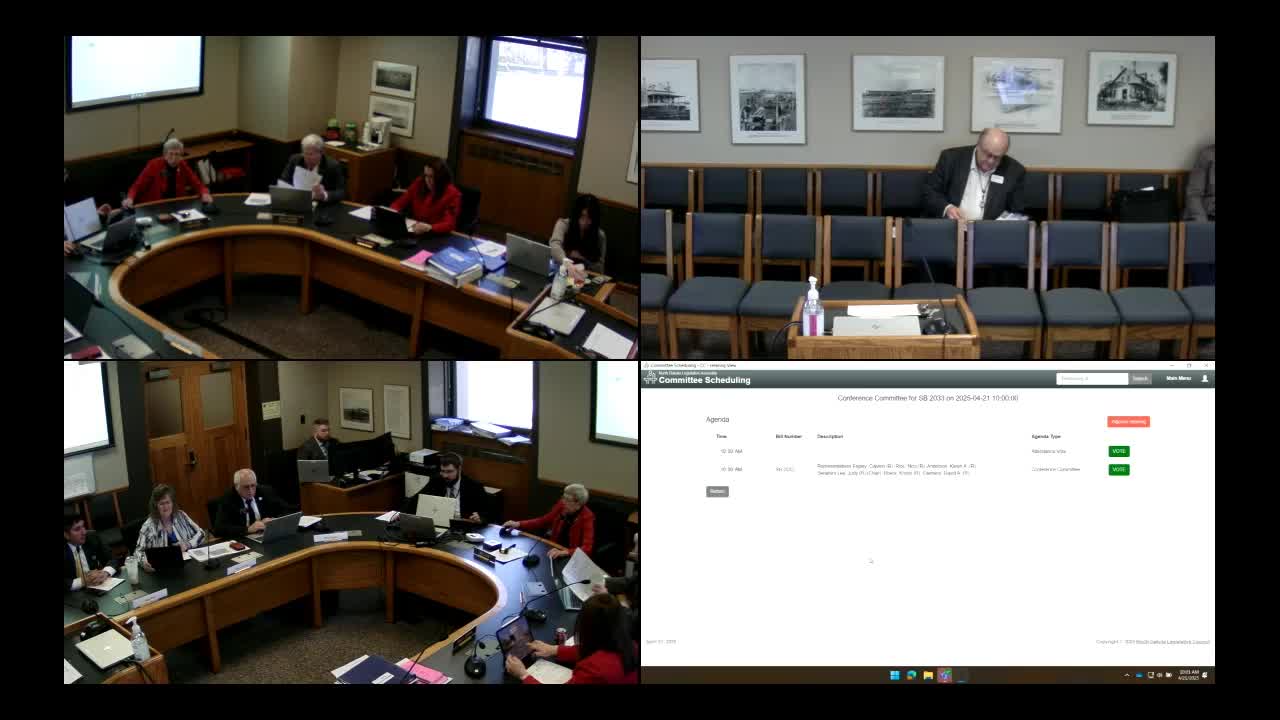
Summary
Senator Lee convened a conference committee on bill 2033 to reconcile House and Senate language aimed at identifying and helping ambulance services at risk of closure, committee members said.
Senator Lee convened a conference committee on bill 2033 to reconcile House and Senate language aimed at identifying and helping ambulance services at risk of closure, committee members said. The draft defines a “distressed ambulance service” as having a substantial likelihood of closure within the next year and would let services self-report and enter a state-assisted planning process.
The bill would require the department to identify stakeholders and schedule an initial public meeting within 45 days after identifying a distressed service. Stakeholders listed in the draft include county and city governments, hospitals and clinics, adjacent ambulance services and other local EMS providers; later language adds law enforcement, school boards, ambulance district boards and a citizen representative. The work group created after the initial meeting would collaborate with the department to produce a detailed emergency medical services improvement plan.
“the department does not want to close any ambulances. That simply is not the case,” Tim Wiedrich, section director for the Health Response and Licensure Section, told the committee, describing the department’s intent to be collaborative and to use regulatory action only as a last resort.
Committee members discussed how the legislation combines elements of the House and Senate bills so that help can be offered earlier in a service’s decline. The draft allows the department to divide a service’s licensure level if the work group determines that is necessary; committee members asked staff to check whether that language conflicts with other code provisions about votes and district actions.
Lawmakers and witnesses repeatedly urged a neutral facilitator to manage the local work group and meetings so volunteers and community members would not feel directed by a regulator. “I really like the idea of the neutral party … we don't want, you know, the, human services saying, no, you have to do this, and then, no, we're not gonna do it. We need somebody to be that neutral, kind of that, kind of that, judge thing,” Representative Anderson said.
Representative Begley warned that volunteers in small services are at risk of burnout and could withdraw if the process feels heavy-handed: “they're just gonna say, I'm done.” Several legislators said the bill should preserve local control where possible while providing early help.
Wiedrich told the committee the department is not seeking additional full-time staff for the program in the governor’s budget. He said existing grant funding can be used for operational expenses, including hiring staff locally if a service requests it, and later clarified that roughly $14,000,000 is available for ambulance grants in the current biennium. A one-time appropriation referenced in the draft was also noted; members said they will consult budget staff about how to establish the program without a standing coordinator if no new FTE is provided.
Committee members asked for legal and fiscal follow-up on several items, including (1) whether changes to district voting or taxes create a conflict with existing tax-district law and (2) how debt and boundary realignments are handled when a taxed district closes. Representative Figley said she would review the Century Code provisions on tax-district dissolution and send a memo to the group. The committee asked staff to invite Allison Hicks (staff) to the next meeting to explain current law on tax-district debt and income handling.
No formal vote was taken. The conference committee adjourned with plans to meet again after staff and legal counsel provide clarifications on the vote/conflict question, the Century Code provisions, and funding/implementation details.