Parents, students and teachers urge board to protect Advanced Learning Program amid proposed cuts
Summary
Multiple public commenters, students and teacher/administrator groups urged the Board of Education not to cut the district’s Advanced Learning Program (ALP). Speakers described ALP’s effects on students, classroom teaching and equity and asked the board to prioritize academics when closing the budget gap.
Public comment at the Board of Education meeting centered heavily on the district’s Advanced Learning Program after administrators listed potential reductions as one savings option.
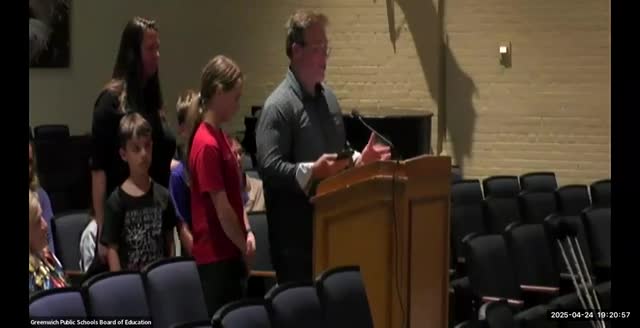
Students, parents and teacher representatives described the program’s impact on motivation and instruction. Sabrina Hess, a fourth-grader at Cos Cob Elementary, told the board, “In ALP, I get to do challenging work that pushes me to explore topics more deeply.” Several other students and parents described ALP as both acceleration for participating students and a structure that helps classroom teachers differentiate instruction for other students.
Lillian Perrone, president of the Greenwich Education Association, said teachers and staff are “overworked” and urged the town to fund the BOE’s proposed operating budget rather than force cuts that would affect teaching positions and programs.
Administrators presented the arithmetic of potential reductions: eliminating second-grade ALP enrichment was listed as roughly 2.2 full-time-equivalent (FTE) positions (about $171,000); removing the grade 3–5 science ALP component was estimated at roughly $257,000. District staff noted those totals translate to about 5.5 FTE when expressed across multiple buildings and fractional assignments.
Several board members said they were reluctant to cut instructional programs. In the board discussion that followed the public comment period, multiple trustees said they would not support reductions to core instructional programs such as ALP. The board ultimately tabled final budget action to a follow-up meeting so administration can provide additional modeling and the public can submit input.
The next budget meeting will be the venue for any formal proposals to reduce staff or programs; until then the administration will post detailed numbers and staffing implications so the board and community can review them.