
Committee advances insurance-premium tax overhaul; bill would set a flat rate and narrow certain credits
Get AI-powered insights, summaries, and transcripts
Subscribe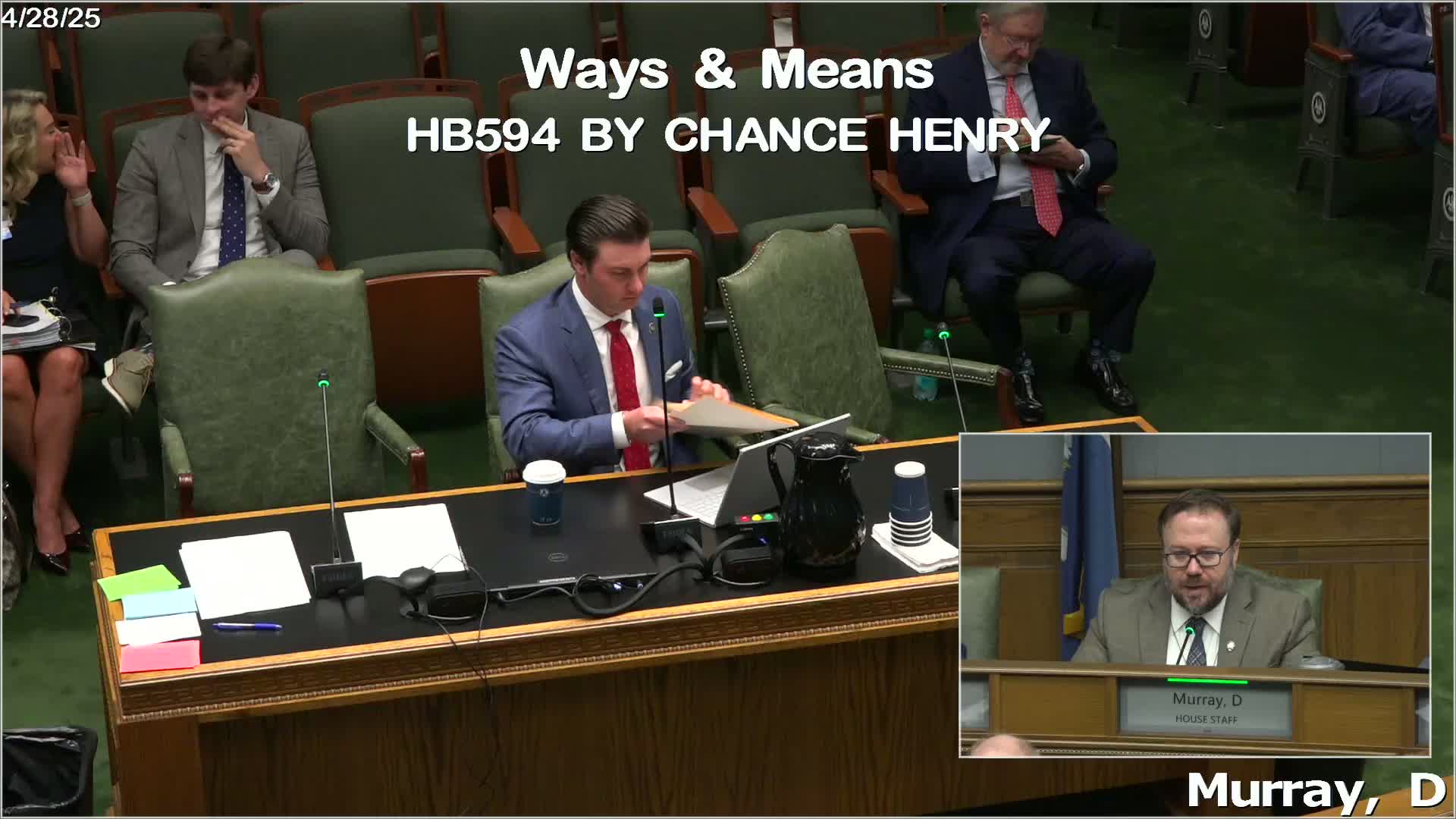
Summary
House Bill 594 would set a flat insurance-premium tax (proposed 1.66%) and repeal or narrow several investment credits and exemptions; the author and industry witnesses said the measure aims to make Louisiana more competitive with neighboring states and reduce premium burdens. The committee adopted a 13-amendment package and reported the measure.
House Bill 594, presented April 28, would establish a flat insurance-premium tax framework and repeal or limit a set of existing premium-tax credits and exemptions. Representative Henry, the bill's author, said Louisiana's premium-tax code is complex, that effective rates vary because of credits and exemptions, and that a flatter, simpler net rate would improve competitiveness and reduce premium burdens on policyholders.
Substantive changes described in committee and in the amendment set included:
- A baseline flat rate for most lines (author presented 1.66% as the target effective rate) and a narrowed set of investment credits. - An altered definition for the domestic-insurer investment credit that requires at least 60% of the combined total of employees and corporate officers to be located in Louisiana and that the company maintain core business functions in-state (customer service, IT, enrollment, provider relations). - Automatic, collections-based rate reductions: amendment language (amendments 8 and 11 in the set) provided for a 0.2 percentage-point premium-tax rate reduction on January 1 of each year beginning 2027 if prior-year collections exceed the 2024 baseline; the Department of Insurance would post notice of any reduced rate. - The amendment set restored the present-law credit for retaliatory taxes paid by certain domestic insurers (amendments 2 and 13) rather than repealing it, reversing that portion of the original bill.
Industry witnesses and the author said the measure was intended to correct a competitive disadvantage that Louisiana companies face when selling insurance into other states: because Louisiana's statutory gross rates have been high but offset by credits, domestic companies can be disadvantaged in out-of-state markets; a simpler flat rate could generate retaliatory tax revenue when companies from higher-rate states write policies here and could make Louisiana more attractive for domestication of insurers.
Committee procedure and votes: the author offered a 13-amendment set (amendment set 17-32); the committee adopted the amendment package after discussion. Committee members expressed concern that the fiscal note should be updated in light of amendments; the author acknowledged LFO and Department of Insurance follow-up would be necessary. After amendment adoption the committee moved the bill forward.
Clarifying details from the hearing: the author and Secretary Nelson (and industry witnesses) said the HMO tax line is not covered by the bill and some of the premium-tax revenue streams are distinct (HMOs and other lines). The transcript records an LFO-style discussion of estimated ranges: the author's initial calculations placed a roughly $45 million impact for a 0.3-percentage-point net reduction and a larger gross fiscal shift depending on composition and credits; the amendment to restore the retaliatory-tax credit requires updated fiscal analysis.
Outcome: the committee adopted the amendment package and reported HB 594 favorably; the author and industry representatives asked LFO and the Department of Insurance to produce updated fiscal notes reflecting the amendments.