
Subcommittee weighs loosening remote-participation rules for subcommittees, defers full-board changes
Get AI-powered insights, summaries, and transcripts
Subscribe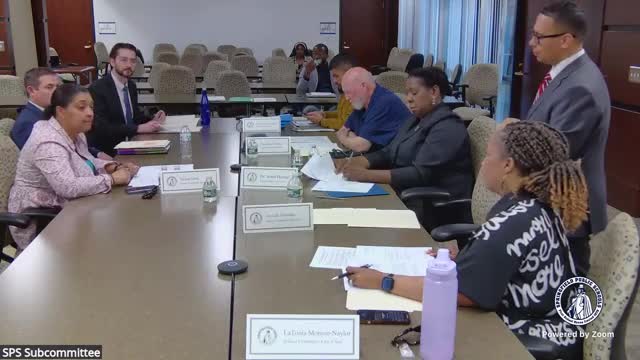
Summary
After the governor extended COVID-era exemptions, Springfield Public Schools’ Legislative & Contracts Subcommittee debated whether to relax its remote-participation policy for subcommittees, with members generally open to limited changes for subcommittees but hesitant to loosen rules for full committee meetings or executive sessions.
The Legislative & Contracts Subcommittee opened an informational discussion on the school committee’s remote participation policy after staff said Governor Maura Healey had extended an act “relative to extending certain COVID‑19 measures.” Attorney Keith told the committee the extension exempts certain regulations and “the law states you don't have to have a physical quorum” and allows an entire meeting to be remote so long as there is live access.
Attorney Keith advised the committee that the district’s current policy is more restrictive than the temporary exemptions and that the policy can remain in place or be revised by the committee. Members described repeated scheduling problems at subcommittee level—meetings canceled or rescheduled because of lack of quorum—and said greater flexibility for subcommittees would reduce delays in advancing routine items to the full committee.
Member Collins and others argued for keeping stricter attendance expectations for full committee meetings so the public has a consistent in‑person presence at City Hall. Several members said the chair’s advance approval requirement for remote participation has functioned as a control to prevent too many members from joining remotely; others said the rule can be inequitable and that elected members should be trusted to make attendance decisions and be held accountable by voters.
Security concerns were raised about executive sessions. One member said executive sessions “scares me because of security,” and members discussed whether secure facilities or secured connections would be required before allowing remote attendance for confidential sessions.
By the end of the discussion members generally supported drafting an amendment that would remove the physical‑quorum requirement for subcommittees and give subcommittee chairs discretion—after consulting the superintendent and relevant staff—to declare a subcommittee meeting remote or in person, while retaining stricter in‑person expectations for full committee meetings and further study of executive‑session rules. No formal vote was taken; committee members asked legal staff to prepare amended policy language for future consideration and indicated a goal of returning the item to the committee before the last meeting in June.