
San Marcos Unified spotlights inclusive practices, parent-led special‑education council and student success
Get AI-powered insights, summaries, and transcripts
Subscribe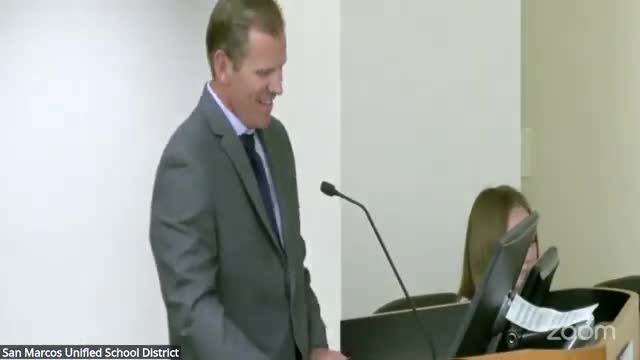
Summary
San Alejo Elementary and district teams described daily inclusive practices, a parent-led special-education council, an Ability Awareness Fair and student supports including braille instruction and orientation and mobility services highlighted by a middle‑school student speaker.
SAN MARCOS, Calif. — The San Marcos Unified School District on Thursday presented examples of campus‑level inclusion and special‑education supports and described a parent‑led council that district leaders plan to expand systemwide.
Gary Pope, principal of San Alejo Elementary School, said the school has emphasized a sense of belonging and inclusion, adding the campus has worked to include students with disabilities in events and classroom practices. Pope described restorative circles, morning meetings and ‘‘buddy classes’’ that pair general‑education students with peers in specialized programs.
Parent volunteer Carly Brennan said she and other parents helped form a parent student council to share resources, smooth transitions between school levels and increase access to events. Brennan described practical changes at San Alejo that included adding room parents for special‑needs classrooms, ensuring an aide was present at a winter performance so all students could participate, and establishing monthly parent meet‑ups.
Pope and Brennan credited a districtwide Ability Awareness Fair and related classroom lessons for helping general‑education students better understand learning differences. Pope said the fair included adaptive games, communication and assistive technology demonstrations, sensory‑regulation activities and student‑led sign‑language lessons.
The board also heard from seventh‑grader Eloise Dazraff of San Elijo Middle School, who spoke about growing up blind and learning braille and cane travel. Eloise told the board, “You are more than you are on the outside, you more than your disability, you are more than your biggest challenge.” Her instructional team described intensive braille and technology instruction, orientation and mobility training and district and county special‑education services that support her access to curriculum.
Why it matters: district staff said the work reflects a broader strategy to embed inclusive practices across classrooms so all students can participate in learning and school life.
Clarifying details: San Alejo instituted room parents for special‑needs classrooms and mounted a multi‑day Ability Awareness Fair; a district special‑education director has begun coffee chats to share practices across sites. Staff said the district provides orientation and mobility, braille and assistive‑technology services through the county consortium for special education but did not state total staff counts or program budgets at the meeting.
Looking ahead: presenters said the parent council model will be expanded districtwide and staff will continue site‑based inclusive events and training.