
Conference committee sets $25 million for new housing incentive program, drops dedicated slum-and-blight carve-out
Get AI-powered insights, summaries, and transcripts
Subscribe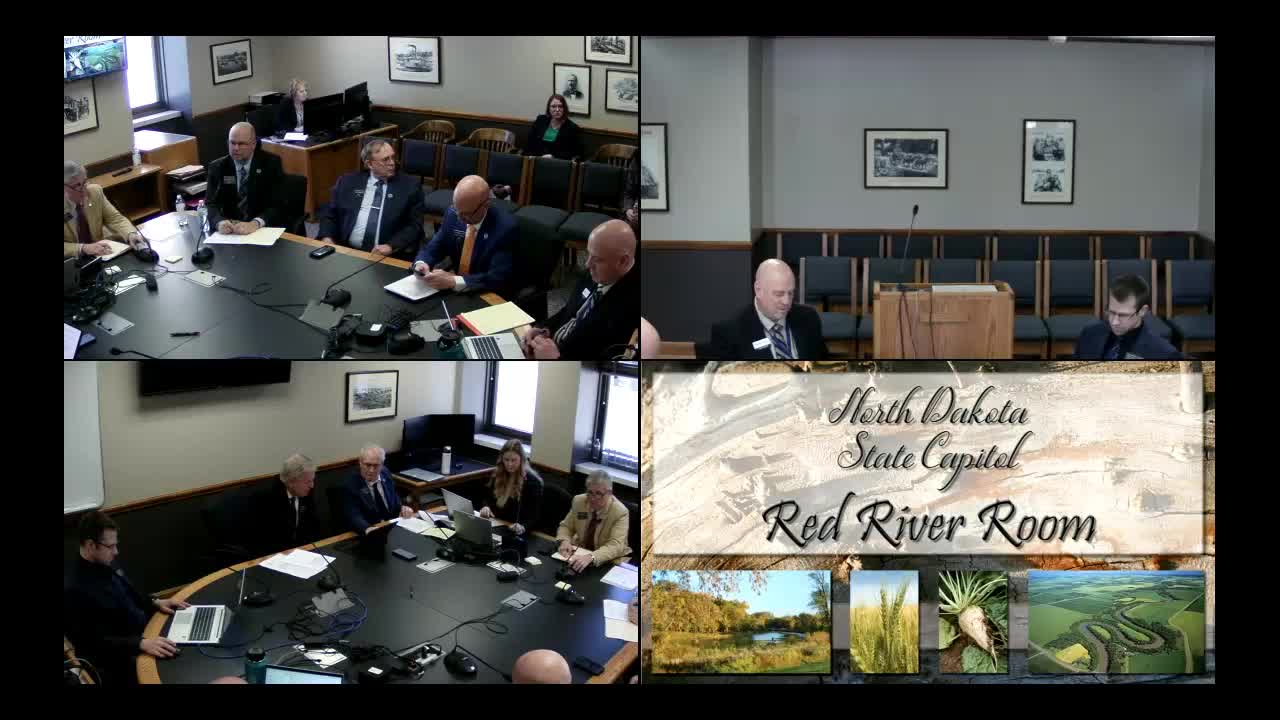
Summary
A legislative conference committee agreed to $25 million for a new housing incentive program and approved a distribution across four population “buckets,” after rejecting an earlier motion to adopt a $20 million floor with a $3 million slum-and-blight set-aside.
The conference committee on Senate Bill 2225 approved a $25 million total to start a new state housing incentive program and removed a separate, dedicated $3 million carve-out for slum-and-blight remediation, the committee decided during a session on Oct. 12.
The committee vote adopted a $25,000,000 total and set the program’s distribution by population buckets at $7,000,000 for subsection A, $10,500,000 for subsection B, $6,000,000 for subsection C, and $1,500,000 for subsection D. The committee also removed the explicit $3,000,000 enumeration for slum-and-blight on page 1 while leaving slum-and-blight remediation as an eligible use in program language.
Committee members debated the size and source of funding for much of the meeting. Chairman Sickler said the smaller amount under discussion would still establish the program: “20,000,000 gets something, gets us started,” and members repeatedly described the plan as a pilot that should be evaluated over time. Staff fiscal briefed the committee that, as previously reported in a separate conference committee for the Industrial Commission, that fund had been discussed at $35,000,000 total, “of which 10,000,000 is from the general fund and 25,000,000 is from SIF,” according to Levi, the staff member who provided the number.
Lawmakers on both sides said they want the new program to be viable but acknowledged competing priorities and limited state resources. Representative Machtenbacher and others pushed for a larger allocation reflecting House proposals and earlier versions of the bill. Senator Dwyer and Senator Wanzek voiced support for giving a smaller, starter amount a chance to prove its effectiveness before committing more funding.
The committee rejected an initial motion to keep the total at $20,000,000 while removing the $3,000,000 slum-and-blight dollar figure but preserving slum-and-blight language. That motion, moved by Senator Wanzek and seconded by Senator Dwyer, failed on a 3–3 roll call (Chairman Sickler: yes; Senator Dwyer: yes; Senator Wanzek: yes; Representative Louser: no; Representative Anderson: no; Representative Moshenbacher: no).
A subsequent motion to set the total at $25,000,000, with the bucketed distribution noted above and with the explicit $3,000,000 slum-and-blight enumeration removed, passed on the next roll call. The clerk recorded the votes as: Chairman (recorded as “Chairman Sinclair” in the roll): yes; Senator Dwyer: no; Senator Wanzek: yes; Representative Lausser: yes; Representative Anderson: yes; Representative Moshenbacher: yes. The committee chair declared the motion passed and adjourned.
Members said the $25 million was intended as a compromise between the House’s larger proposal and the Senate’s position, and to function as a pilot to be revisited. Several members discussed matching rules and leverage: committee comments referenced a two-thirds matching structure in which non-state match is expected to cover two dollars for every one state dollar, a ratio members said could magnify the program’s impact if projects find local or private matches.
Leaders and members also discussed the question of funding source. Some legislators said early versions contemplated general-fund support, while others said the current plan would use SIF (the state investment fund); Levi advised the committee that the Industrial Commission discussion had indicated both general fund and SIF splits on related housing funding in prior work. Committee members agreed to sort final source language as the broader budget process continued.
The bill text approved by the committee keeps slum-and-blight remediation in the list of eligible activities but removes a fixed $3,000,000 assignment to that purpose; lawmakers said their intent was to leave flexibility for administrators to allocate funds where projects are most viable. Members also asked that the program be treated as a pilot with a report or review to determine whether expansion is warranted in future sessions.
The committee recessed several times for caucus discussions during the negotiation and reconvened to take the two recorded motions and votes. With the $25 million agreement in place and the slum-and-blight dollar figure removed, the conference committee adjourned.
What happens next: The committee report on Senate Bill 2225 will be folded into the overall conference committee report and the broader budget and bill reconciliation process. Lawmakers said they expect to track the new program’s performance and coordination with existing housing funds, including other Industrial Commission programs and the housing incentive fund previously discussed in a separate committee.