
Senate approves wide emergency-preparedness overhaul with new rebuilding flexibility, study and evacuation changes
Get AI-powered insights, summaries, and transcripts
Subscribe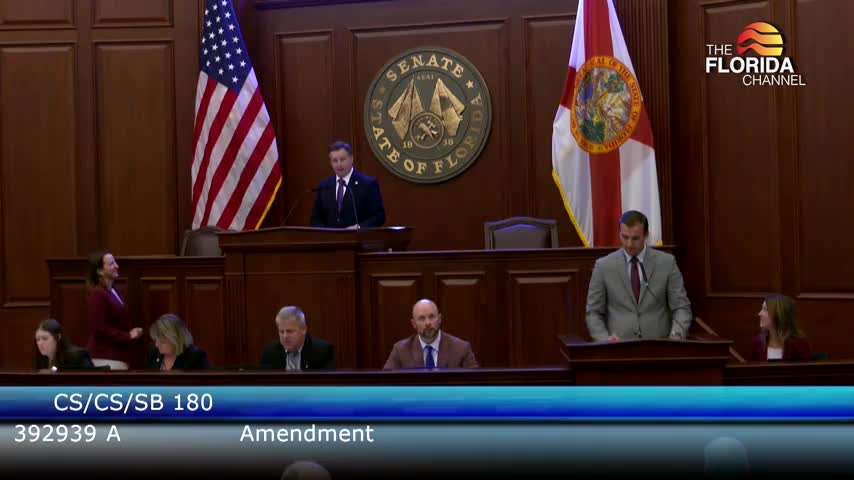
Summary
The Florida Senate on May 2 passed a major emergency-preparedness and response measure with amendments that ease some homestead rebuild rules, extend evacuation clearance for the Keys and add a state study of post-storm local moratoria. The bill passed 34-1 after floor amendments.
The Florida Senate on Friday passed committee substitute for committee substitute for Senate Bill 180, a sweeping emergency-preparedness and response measure that alters rebuilding rules, evacuation planning and several post-storm regulatory requirements. The Senate adopted the House amendment as amended and approved the bill 34-1.
The measure, as amended on the floor, removes most of the homestead-assessment provisions in the House amendment but keeps a provision allowing homeowners some flexibility when rebuilding after hurricane damage. "The amendment allows a homeowner to increase the size of a residence up to a total size of 2,000 square feet, which is up from 1,500 square feet, or to 30%, which is up from 10% of the size before the damage," said Senator DeSigley, sponsor of the amendment.
Why it matters: The bill changes how local governments and state agencies handle recovery after hurricanes, including permitting, tax assessment, shelters and debris operations, and could affect who pays for repairs and how quickly homeowners can rebuild.
Key floor changes and context
- Homestead assessments: The Senate amendment removed most of the House's homestead assessment changes but retained a limited rebuilding flexibility allowing modest increases in home size without triggering a larger tax assessment. DeSigley said the change was intended to let families "make the repairs they need to do without being hit with a larger or the higher tax bill."
- Evacuation for the Keys: The amendment restored a provision increasing recommended hurricane evacuation clearance time for the Florida Keys from 24 hours to 24.5 hours; the change was linked to prioritizing allocations of up to 900 permits for vacant, buildable lots intended to support affordable housing in the Keys.
- State coordination and studies: The House had added language requiring DEM to coordinate debris removal with fiscally constrained counties; the Senate amendment removed that requirement citing fiscal concerns. The Senate did, however, add back an OPPAGA study (referred to on the floor as an OPOGA/OPPAGA study) to examine local-government actions—such as moratoria—after storm events.
Senators pressed the sponsor on scope and local-government impacts. "These moratoriums after a natural disaster ... stop development and, even more importantly, halt recovery," DeSigley said, citing municipal examples in his district. Senator Rodriguez, who represents the Keys, thanked the sponsor for working with her and stakeholders to protect workforce and affordable housing needs in her region.
Discussion, directions and final action
The Senate recorded a roll-call: 34 yeas, 1 nay; the motion to concur in the House amendment as amended carried and the bill moved forward for final steps. Floor discussion distinguished policy choices (what the amendment contains) from implementation questions (how DEM and local governments will apply the rules), and senators asked staff to provide further operational details during the conference process.
What remains unclear
Several floor exchanges made clear some implementation details will be resolved later: how FEMA's evolving hazard-mitigation policies will interact with the bill, specific timelines for DEM guidance, and precise coordination roles for fiscally constrained counties. Those operational questions were not resolved on the floor and were left to the implementation and budget process.
Ending note
Senators said the changes aim to balance rapid recovery for homeowners with fiscal and planning responsibilities for local governments. The bill advanced with broad support on the floor after the adopted amendment narrowed several House proposals.