
Circuit 13 advisory board recommends adopting Pinellas/Polk civil‑citation model to raise utilization
Get AI-powered insights, summaries, and transcripts
Subscribe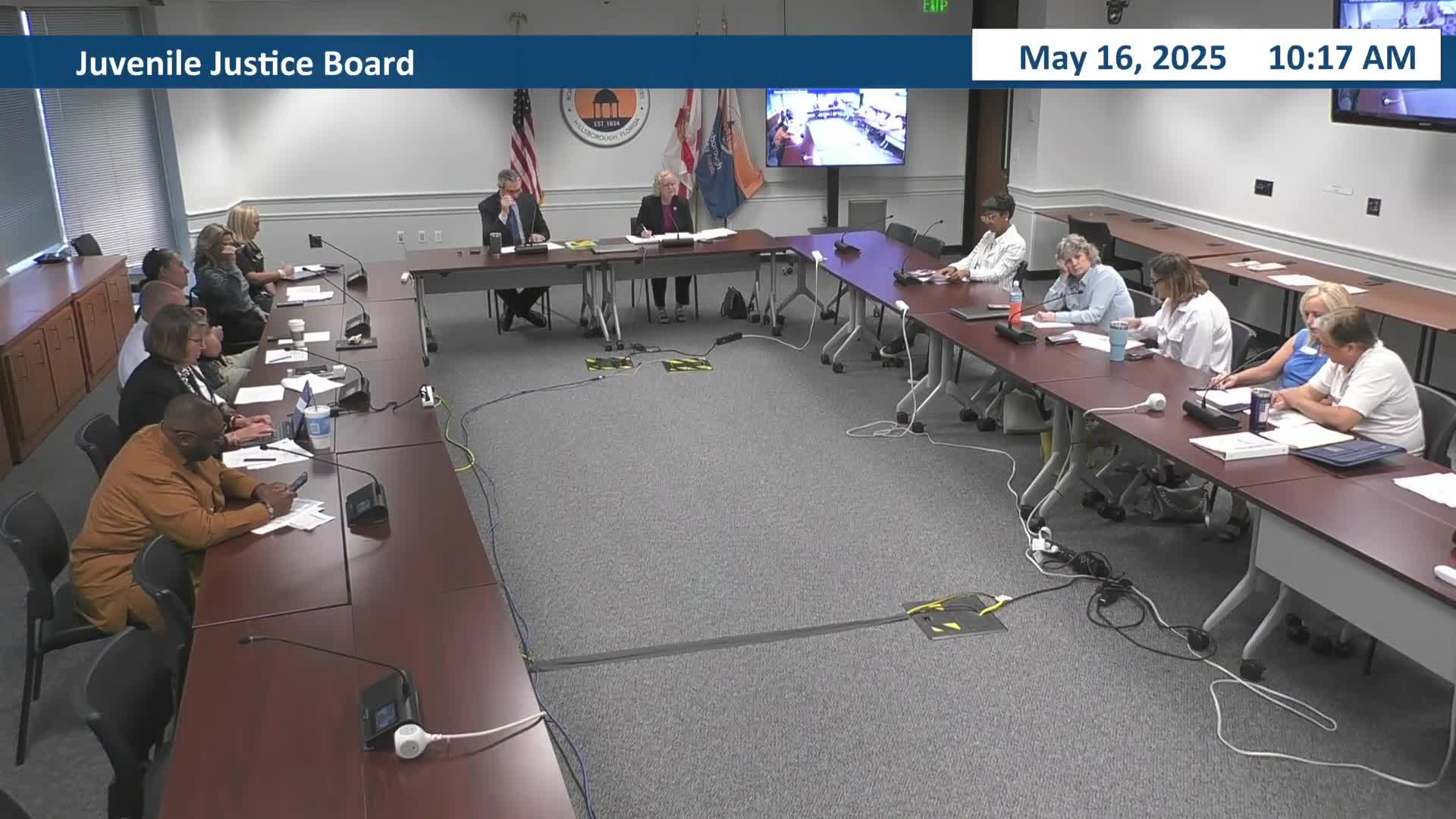
Summary
The Circuit 13 advisory board voted to recommend that stakeholders adopt a model used in Pinellas and Polk counties to increase pre‑arrest delinquency citation use, and approved related steps including SOP updates, training, and improved documentation of non‑issuance.
Rob Parkinson, vice chair of the Circuit 13 Advisory Board for Juvenile Justice, moved and the board approved a recommendation that stakeholders adopt a Pinellas/Polk civil‑citation model to increase local issuance of pre‑arrest delinquency citations.
The recommendation grew from a multi‑year review by a data‑driven subcommittee led by juvenile diversion staff. Judy Royston, a juvenile diversion representative, presented recent citation data and the subcommittee’s findings. “For the month of April 2025, we processed 65 pre arrest delinquency citations. 36 were from the community, and 29 were from the schools,” Royston said during her presentation.
Why it matters: the subcommittee’s review found Hillsborough County’s civil‑citation utilization rates lag regional peers. The committee reported utilization rates of 66% (Dec. 2021–Nov. 2022), 64% (Dec. 2022–Nov. 2023) and 62% (Dec. 2023–Nov. 2024). By contrast, the committee cited Pinellas County at about 90% and Polk County at about 80% utilization; those counties allow civil citations to be processed through their juvenile assessment centers, the report said.
The committee recommended a package of steps intended to raise utilization: adopt the Pinellas/Polk model; require law‑enforcement agencies to update standard operating procedures to reflect the MOU dated 06/01/2021; provide ongoing training and education for officers and stakeholders; require clear documentation when a citation is not issued; and regularly review missed‑opportunity reports produced by the Department of Juvenile Justice (DJJ) and law enforcement.
The motion to recommend adoption of the committee’s proposals was offered by Rob Parkinson, who said, “I feel comfortable making a motion that we recommend that stakeholders adopt this model based on your report and recommendations.” The motion was accepted by voice vote; the transcript records the motion as “adopted” but does not record a roll‑call tally or named yes/no votes.
Discussion during the meeting noted practical barriers to reaching Pinellas/Polk levels without structural changes. The committee and several speakers said opening the county Juvenile Assessment Center (JAC or JACC) to accept civil citations and avoiding fingerprinting for eligible youths brought to the center were among the changes that most directly raise utilization. The group also discussed domestic‑violence cases and other circumstances in which law enforcement currently diverts to other processes.
What happens next: the advisory board’s recommendation is advisory—board members noted it cannot compel elected officials or independent agencies. The committee suggested presenting the recommendations to stakeholder agencies (law enforcement, the state attorney’s office, court administration and the DJJ) for adoption of SOP changes and expanded JAC procedures.
Clarifying details: the committee’s recommendation package included (1) SOP updates to match the MOU dated 06/01/2021; (2) ongoing training for new officers and stakeholders; (3) a documented justification requirement when a citation is not issued; (4) regular review of DJJ and agency missed‑opportunity reports; and (5) exploring JAC procedures to accept eligible citations without creating fingerprint records.
The advisory board recorded the motion as “adopted” by voice vote; no individual roll call of yes/no votes was recorded in the meeting transcript.
Ending: the board asked staff to circulate the committee’s PowerPoint and the monthly reports used in the presentation and suggested follow‑up with contiguous counties and the state agencies that control JAC practice. The recommendation will be forwarded to stakeholders for consideration and possible operational changes.