
City Council approves 12-month contract with national firm to manage violence-interruption program amid local objections
Get AI-powered insights, summaries, and transcripts
Subscribe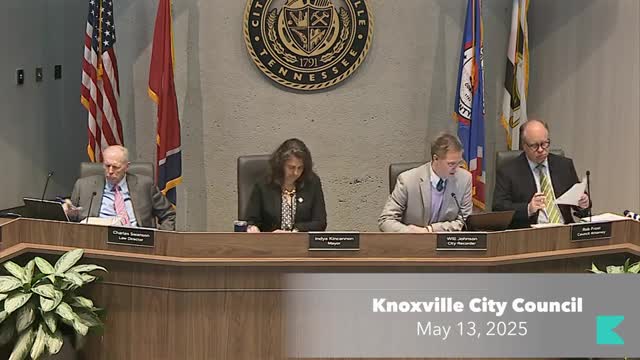
Summary
The Knoxville City Council voted to authorize a one-year contract extension with the National Institute for Criminal Justice Reform to manage community violence intervention services and provide training and technical assistance, approving funds cited in the agenda to support that work despite strong objections from some local practitioners.
The Knoxville City Council voted to authorize the mayor to extend a contract with the National Institute for Criminal Justice Reform (NICJR) to manage implementation of community violence intervention programming and provide technical assistance for a period of up to 12 months. The resolution—listed as agenda item 11k—says NICJR would be paid "in an amount not to exceed $519,750" under this extension, bringing the total contract cap cited in the agenda to "not to exceed $826,800." Council approved the action after prolonged public comment and debate.
Councilmember Amelia Parker said the city needs capacity building but remained concerned that the contract in its current form did not guarantee local leadership would return at the end of the year. "This contract is insufficient to address the issues that we need addressing," Parker said during deliberations.
Supporters and opponents addressed council during the public comment period. Darius El Shabazz, executive director of Formative Futures, urged the council to "invest in peace," saying local organizations are the frontline of violence prevention and need sustained funding. Rashad Woods, Tennessee director of Renounce Denounce (a local intervention group), told the council he had reviewed the resolution and concluded, "Do we want our organization to be a part of this effort as employees? After careful consideration, my answer is no." Denzel Grant, the executive director of Turn Up Knox, urged collaboration and said, "If it takes me walking away, that's what I'll do," describing the personal stakes community leaders see in the work.
City staff and NICJR representatives described the contract as a temporary bridge to restore boots-on-the-ground outreach for summer months while local organizations receive training and organizational support. Lakenya Middlebrook, director of the Office of Community Safety and Empowerment, told council NICJR would hire locally for the positions and provide technical assistance so local organizations could later respond to a request for proposals (RFP) to operate the program long term.
Several council members pressed staff for specifics. Councilmember Roberto asked whether NICJR would provide training and technical assistance to existing local groups; Middlebrook answered yes and said NICJR would help the city develop an RFP and onboard a permanent provider after the contract period. Councilmembers asked for and discussed adding reporting requirements; Vice Mayor Smith requested six-month reporting and additional oversight language during implementation.
The contract description given to council said NICJR would hire a total of six local positions: five violence interrupters and outreach/life-coach roles plus a program manager to handle administrative duties, reporting and training coordination. NICJR's project manager would also make regular on-site visits to Knoxville to support implementation and capacity building.
The vote followed competing motions. A motion to deny the contract failed after a voice vote. A motion to postpone the item for two weeks failed on roll call (3 in favor, 6 opposed). A subsequent motion to approve the contract carried; council took no additional formal amendments on the record.
What was left unresolved in council debate was how NICJR hiring would interact with existing local organizations. Council members and local practitioners repeatedly emphasized that many organizations already perform street outreach and that staff turnover or the temporary reassignment of experienced local workers to NICJR-paid positions could weaken existing programs. Several community speakers recommended that NICJR use its training capacity to shore up local groups rather than hire a new, stand-alone team.
Council members who supported the contract said the city needed a manageable, accountable implementation now to avoid gaps in street outreach as summer begins. Supporters stressed that the contract is explicitly temporary, that it includes capacity building and that an RFP will be issued near the end of the term so local groups can apply for long-term funding.
The council action authorizes the mayor to execute the contract extension and related documents; budget and procurement steps will follow under city administration. Councilmembers and speakers asked staff to return with written reporting metrics and a clear timeline for the planned RFP and transition to local management.
The debate highlighted deep tensions between stabilizing immediate outreach services and preserving and growing local organizations' capacity and leadership. Council provided direction that NICJR must document outreach outcomes and provide capacity-building support to local partners while the city monitors progress.