
Resident urges city to fund eviction-prevention legal aid as filings rise
Get AI-powered insights, summaries, and transcripts
Subscribe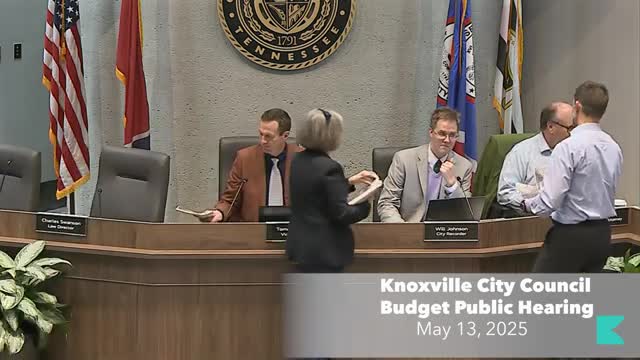
Summary
At a City Council legislative budget public hearing, Adam Hughes urged municipal funding for eviction-prevention services, citing a sharp rise in eviction filings, reduced legal-aid capacity and potential HUD cuts that could increase housing instability.
Adam Hughes, a resident of the Fourth District, told the City Council during a legislative budget public hearing that the council’s proposed municipal funding for eviction-prevention work with Legal Aid of East Tennessee is a necessary first step to address rising evictions in Knoxville.
Hughes said the city’s support is meaningful as eviction filings have risen sharply: “You’ve all seen that eviction filings increased by over 50% between 2022 and 2023,” he told the council, and he warned that preliminary 2024–25 data “will show that this elevated trend will and has continued.”
Hughes, who gave the council a copy of a 66-page Appalachian Justice Research Center report titled Housing Stability and Tenant Representation in a Changing Knoxville, described several near-term risks. He said legal-aid capacity is “substantially below what it was as the surge in evictions began” and that rental-assistance programs are running out of funds. He told council members that on the day he spoke there were 238 families on the eviction docket and that the highest recent daily total had been 360 families.
Hughes said reduced legal-aid capacity and declining rental assistance will make court outcomes worse and increase contested hearings. He described legal aid’s role as more than individual defense: it helps “bring order to this entire process,” negotiate deals that can reduce back payments, and keep evictions off renters’ records when possible. He also warned about possible cuts to U.S. Department of Housing and Urban Development programs, including Section 8, that could reduce permanent supportive housing and rental relief, increasing pressure on eviction courts.
The public hearing had four speakers signed up; only Hughes spoke. The presiding official opened the public hearing portion of the legislative budget meeting, called the four registered names in order and asked each to state their name and address for the record. After Hughes’s remarks, the other listed speakers—Nzinga Amani, Siobhan Caspanza, and Solange Munoz—were not present and the meeting adjourned for the day.
Hughes asked the council to treat the Appalachian Justice Research Center report as a detailed source on eviction-court patterns and to consider continued or increased municipal funding so legal aid can meet rising demand. The council took no formal vote or formal direction on funding during the public-comment segment recorded in the transcript.