
Allentown School District leaders present balanced $481.5 million 2025–26 budget, pledge no local tax increase
Get AI-powered insights, summaries, and transcripts
Subscribe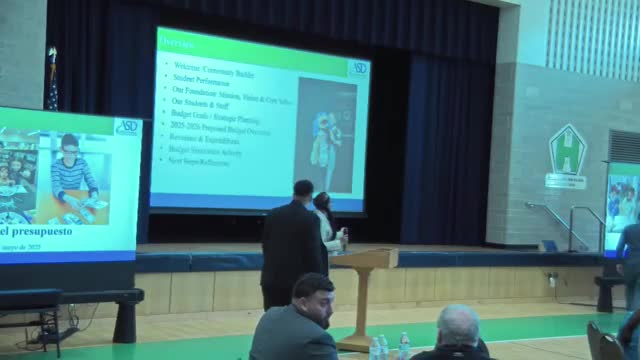
Summary
Superintendent and CEO Dr. Carl Burks and Chief Financial Officer Jeffrey Cuff presented the Allentown School District’s proposed 2025–26 budget at a community forum, saying the plan totals approximately $481,528,215 and does not include a local tax increase.
Superintendent and CEO Dr. Carl Burks and Chief Financial Officer Jeffrey Cuff presented the Allentown School District’s proposed 2025–26 budget at a community forum, saying the plan totals approximately $481,528,215 and does not include a local tax increase.
The proposal matters because the district serves about 16,712 students and faces large mandated costs — including charter payments and special-education expenses — even as state funding has increased. "We're presenting a balanced budget with no tax increase," Dr. Burks told residents, and Cuff said the district is “at a tone of approximately $481,000,000 for our children, our community.”
Cuff and Burks said state revenue is the single largest revenue source for the district. Cuff described the Ready to Learn (RTL) block grant — the adequacy funding that followed litigation over the state funding formula — as a major contributor to recent increases in Allentown’s state subsidy. Cuff said local sources, including real-estate taxes and Act 511 collections, account for roughly $100 million of revenues, while federal funds (Title I, II, III and IV and Medicaid reimbursements) make up a smaller portion of the total.
Officials gave several specific figures during the forum: charter school tuition payments total about $81,000,000; the state special-education subsidy is roughly $17,000,000 while the district’s total special-education costs run “close to $60,000,000 to almost $70,000,000,” and the homestead/property tax rebate allocation to the district is expected to increase by about $1,300,000 to $15,300,000 next year. Cuff also said the district currently maintains a general-fund balance in the low tens of millions of dollars — reporting both "approximately $32,000,000" and later saying "$34,000,000" when describing recent changes in the fund balance.
Cuff described the district’s expenditure mix as dominated by personnel costs: roughly 62–63% of the budget is for salaries and benefits, with the remainder covering professional services, transportation, facilities and debt service. He said the district recently improved its bond rating by two notches, which lowered borrowing costs and saved about $300,000 on recent borrowing and could reduce long-term interest costs by an estimated $1.5 million to $2 million.
Board members in the room praised recent reductions in administrative overlap and said savings have been redirected toward classroom priorities. Cuff said the district is presenting a balanced budget in part because of sustained state support and careful fiscal management. "In Allentown, we are very fortunate that we have legislators that are looking out for us and working on our behalf," he said.
Officials cautioned that federal funding remains uncertain. When asked whether the district expects reductions in federal grants, Cuff said federal allocations appear likely to be “kept constant” for now but acknowledged national discussions about cuts; he said formal federal allocations for the next year were expected from state or federal authorities in late May or June.
Cuff and Burks emphasized the district’s accounting structure: the general operating fund covers the budget presented, while other funds such as food services and capital projects are kept separate. They said the food-service fund is in a healthy position, aided by the Community Eligibility Provision (CEP) and operations that have produced a positive food-service fund balance; Cuff noted that food-service surpluses cannot be transferred to the general fund but may be used for equipment and program upgrades.
No formal vote or Board action occurred at the forum; the session was a presentation and public engagement event. District leaders said final budget allocations will reflect state and federal allocations when those amounts are finalized and will be subject to future Board review.
Residents asked detailed questions during the forum about revenue sources, fund balance, contingency planning and what would happen if federal funds are reduced. Cuff said contingency funds in the budget are minimal and that the district prefers to preserve fund balance rather than use it for recurring expenses. "We have a fund balance of about $34,000,000," he said, describing that as a reserve the district prefers to protect.
The district also ran a community budgeting exercise during the meeting in which residents prioritized mental-health counselors, class-size reductions and after-school enrichment; leaders said the activity was intended to illustrate trade-offs and to collect public priorities as administrators finalize recommendations.
Next steps: district officials said they will continue budget work with finance staff and Board members and will report allocations after state and federal grant allocations are finalized.