
Coffee County EMS: staffing improves; board asks for response-time map and station study
Get AI-powered insights, summaries, and transcripts
Subscribe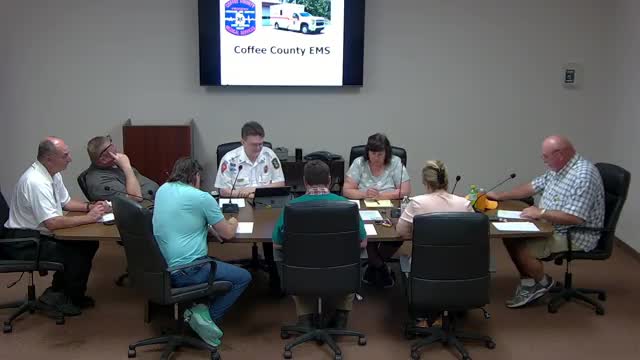
Summary
Board members reported improved medic staffing and asked staff to produce a breakdown of long ambulance response times by range and area to help decide whether to open a station near Hillsborough.
Coffee County EMS officials told the county advisory board that staffing has improved and asked for data showing where long ambulance response times are clustered so the board can consider opening a station near Hillsborough.
Board members said call volume has tapered from peak pandemic levels and that current staffing increases are returning unit availability toward pre-pandemic norms. "We are way better in staffing right now," one service leader told the board, and staff reported no active work-comp cases and several new hires in training.
The board pressed for more granular response-time reporting beyond the average times the service already publishes. A board member requested a report that breaks calls into ranges (for example, 0–5 minutes, 5–10 minutes, 10–15 minutes, etc.) and shows how many calls fall into each range and where the long-range calls occurred. That member said the information is needed to make a case to the county commission for a new station near Hillsborough, where runs into the county can reach 25–35 minutes.
Staff described practical limits to response-time measurement: overlapping calls, rigs already committed to other calls, and unit rotations that keep mileage even across towns. Staff said they can generate range-based reports and that the communications center may be able to export location points for mapping.
Board members and staff discussed operational details that affect stationing and response times. The service said it plans to eliminate basic/driver-only positions as current trainees complete medic school and testing, and that it needs two medics to reach a 10-person shift complement and five additional medics to free captains from riding frontline trucks — a staffing level the board had previously approved but could not achieve during shortages.
The discussion also covered special-event staffing at Bonnaroo. Staff described the longstanding practice of assigning everyone one mandatory 12-hour shift for the festival and allowing employees to trade shifts after signing up; the board noted that past staffing shortfalls sometimes required the service to decline coverage. Board members asked staff to review whether mandatory off-day assignments are legally permissible and to revisit how the agency commits to festival coverage months before staff can reliably confirm availability.
Board members raised clinical and safety policies tied to operations: helicopter landing-zone preferences and on-scene scene-landings, and whether to carry additional medications such as ketamine. Staff said they encourage use of approved hospital LZs for safety and efficiency but that scene landings remain permissible when necessary and when pilots approve. On medications, staff referenced statewide regulatory caution and recent litigation around ketamine dosing; they said protocols allow alternatives and that adding many additional drugs increases cost and training burdens.
The board asked staff to return with (1) a response-time report by ranges with geographic point data where feasible, (2) a cost and staffing analysis for a potential Hillsborough-area station, and (3) a legal review of mandatory festival assignments and the agency's medication list.
Less-critical operational items — routine quarterly financial checks, a recent state inspection with minor documentation issues, and ambulance unit-licensing practices — were reported as normal and require no immediate action.