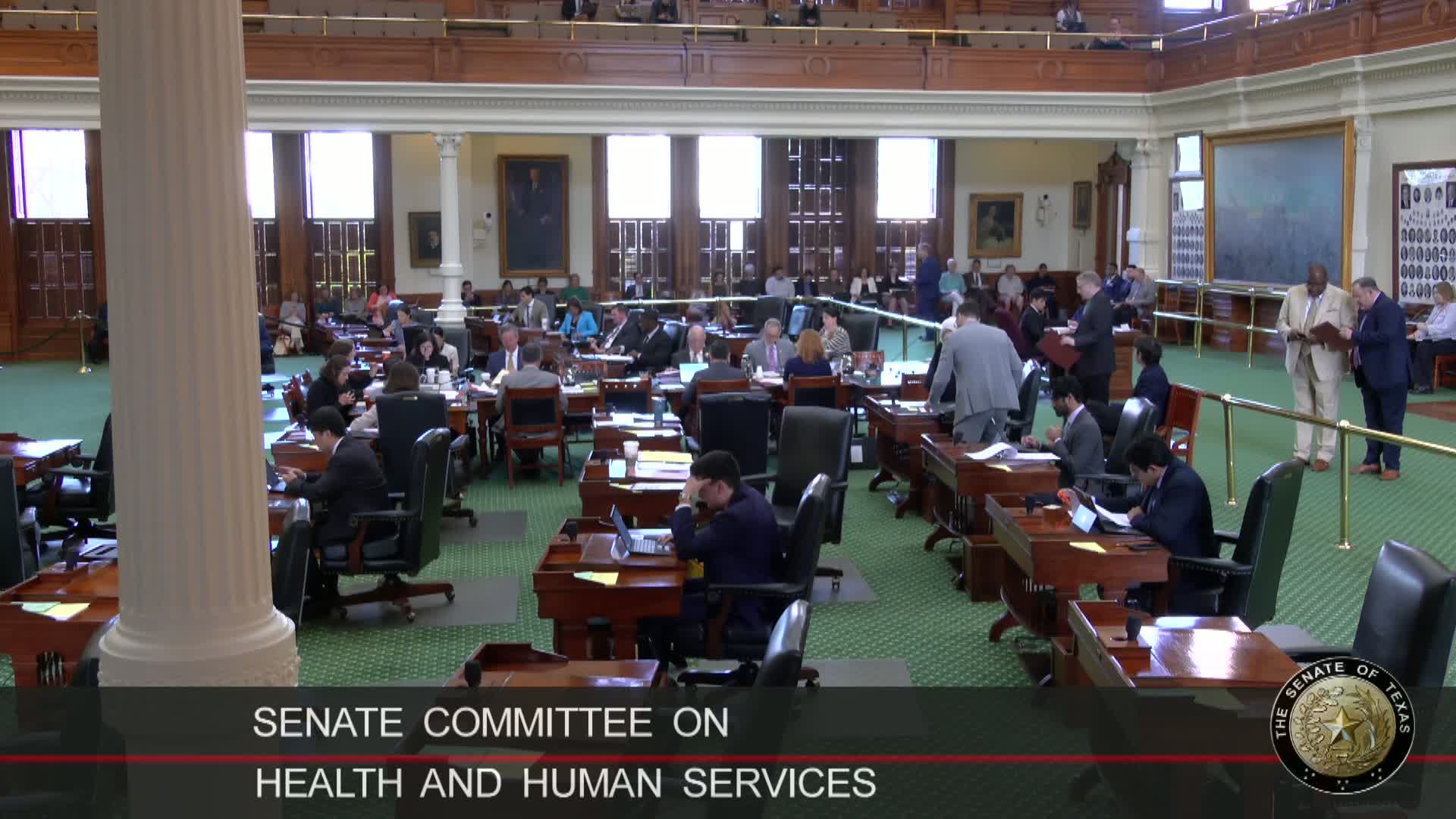
Senate committee hears bill to require court adjudication before names added to DFPS central registry
Loading...
Summary
Lawmakers considered House Bill 20 70 and a committee substitute to require court substantiation before adding most individuals to the Department of Family and Protective Services central registry, with exceptions for narrowly defined, egregious offenses; agencies and advocates debated due-process, safety, and administrative implementation.
House Bill 20 70 would require a court to substantiate an allegation of child abuse or neglect before adding most individuals to the Department of Family and Protective Services central registry, the Senate Committee on Health and Human Services heard Tuesday.
The bill’s sponsor, Sen. Brian Birdwell, said the measure ‘‘provides due process to individuals by requiring a court to substantiate the claim of child abuse or neglect before adding that individual's name to the central registry.’’ The bill as filed would still allow DFPS to place people immediately on the registry in narrowly defined settings — for example, abuse in a licensed childcare facility, in a school, in DFPS conservatorship, or on church premises during church-related activities — and the committee substitute added “egregious” criminal offenses to those exceptions.
Why it matters: being listed on the DFPS central registry can prevent someone from working with children, getting professional licenses, fostering or adopting. Sponsors framed HB 20 70 as balancing child safety with due process for people who face long-term collateral consequences from administrative findings.
DFPS and HHSC witnesses described how the existing administrative process works. Marta Talbert, associate commissioner for Child Protective Investigations at DFPS, said about 24% of CPS investigations result in a “reason to believe” finding and that those determinations are reviewed by the caseworker and a supervisor and sometimes by a second-level reviewer. She told senators that roughly 3% of cases that include a removal are later adjudicated in civil court. "It is gathering information ... and it has to be about 51% preponderance of evidence to determine that abuse or neglect occurred," Talbert said.
Advocates and lawyers for parents and families urged stronger due process and said many people placed on the registry never receive effective notice or the resources to challenge a listing. Julia Hatcher of the Texas Association of Family Defense Attorneys said, "Most of these parents do not get the letters ... 90% of them do not get the letters, don't know that they even have a right to review." Witnesses representing child-safety organizations and providers urged maintaining exceptions that allow immediate listing in settings where children congregate.
Sponsors and agencies also discussed administrative fixes: staff-level review panels that would provide another nonjudicial review before an RTB is finalized, and potential technology and database cleanups to remove obsolete entries. "We've been discussing a path forward," DFPS witness said when asked if statutory guidance is needed to clean up legacy entries.
The committee closed public testimony and left House Bill 20 70 pending for later action.
Ending: Lawmakers and agency witnesses signaled continued negotiation on the substitute language and on operational steps — such as an internal review process and database clean-up — that would be needed to implement any statutory change without impairing access to background checks used by schools, child-care providers and foster agencies.