
Everett reports Q1 revenues above projections, expenditures below budget
Get AI-powered insights, summaries, and transcripts
Subscribe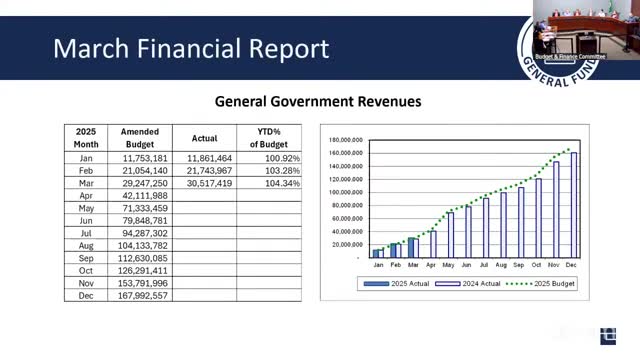
Summary
City finance staff told the Budget & Finance Committee that through March general government revenues were about $1.2 million above projections while expenditures trailed budget by roughly $4.1 million; officials said timing and seasonality explain much of the variance and that April quarterly receipts will clarify aerospace-sector impacts.
Everett finance staff told the City of Everett Budget and Finance Committee on May 21, 2025, that general government revenues through March exceeded budget projections by about $1,200,000 while expenditures were roughly $4,100,000 below budget.
The report, delivered by Heidi Brelantes, finance director, and Jamie Lee Graves, assistant finance director, said the revenue uptick was driven largely by timing of operating transfers and stronger business-and-occupation (B&O) tax receipts. "B and O tax receipts through March reflect an increase of $522,627, or 11.5% over budget," the presentation said. Sales tax collections were also slightly ahead of forecast, roughly $49,194 above the projection for the period, though staff emphasized sales tax is reported on a two-month lag.
The city noted that construction-related sales tax categories were below budget, reflecting winter seasonality: March receipts primarily represent January economic activity, when inclement weather can slow construction starts. Staff said they will monitor collections as spring and summer data appear.
On expenditures, presenters told the committee that timing differences — such as delayed construction spending or street maintenance — account for savings so far this year and that departments have managed to keep expenses below budgeted levels. "Overall, we ended the first quarter on a strong note," Brelantes said.
Council members raised whether last fall's Boeing strike is showing up in the city data. A councilor asked whether manufacturing declines might reflect a missed aircraft delivery; staff replied that the full impact is likely to appear in April, when Everett receives its largest quarterly receipts for sectors that report quarterly, including aerospace.
The presentation closed with staff saying they will provide a preliminary, unaudited 2024 year-end financial report and a refreshed beginning forecast for the 2026 budget at the June budget committee meeting. That report will form the basis for discussing possible revenue shortfalls or spending adjustments going into 2026.