
Senate File 127 expands legislative review of "major" administrative rules; questions raised about emergency rules and staffing
Get AI-powered insights, summaries, and transcripts
Subscribe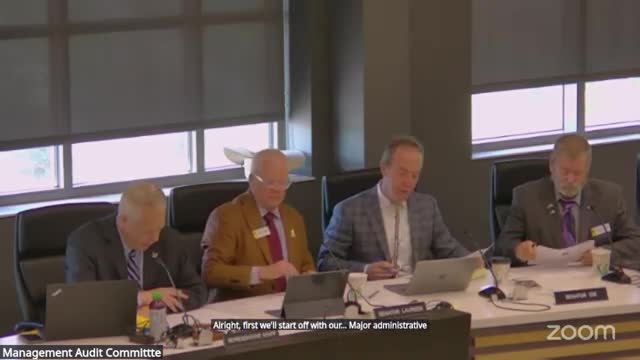
Summary
The Management Audit Committee on Friday received a detailed briefing on Senate File 127, the new law that requires the Legislative Service Office to perform economic analyses of so‑called "major rules," notify every legislator when those rules are proposed and make those regulatory impact analyses public.
The Management Audit Committee on Friday received a detailed briefing on Senate File 127, the new law that requires the Legislative Service Office to perform economic analyses of so‑called "major rules," notify every legislator when those rules are proposed and make those regulatory impact analyses public.
Josh Anderson of the Legislative Service Office summarized the bill and the existing rule‑review process, saying the Department of Administration’s Administrative Procedure Act governs rulemaking and that "these rules, when they're properly adopted, they do have the force and effect of law." He told the committee SF 127 directs LSO to provide a copy of each major rule to every member of the legislature within 15 days and to complete a regulatory impact analysis within 50 days.
Committee members and LSO research staff described how the new timeline and the bill's definition of a "major rule" could change oversight in Wyoming. Under the statute as passed, a major rule is one that "will result in or is likely to result in an annual impact on the economy of Wyoming of $1,000,000 or significant adverse effects on competition, employment, investment, productivity or innovation in the state." The law also authorizes any legislator, committee or management council to introduce a legislative order in the next session to prohibit enforcement of a major rule.
LSO Administrator Matt Petrie warned about operational complications if emergency rules are included in the definition. "By including emergency rules in the definition of major rules, LSO will potentially be required to conduct three regulatory impact analyses for essentially the exact same set of rules," Petrie said, noting emergency rules and the corresponding regular rules are often identical in content. He added that because emergency rules are time‑limited, "it’s giving you the authority to question something that will no longer exist when you have the authority to question it," meaning legislators may not have a practical opportunity to act before the emergency rule expires.
The committee heard a description of how the rule review process currently works: LSO performs a legal review of final (non‑emergency) rules and reports findings to Management Council, which then makes a recommendation to the governor; the governor has final authority to approve, amend or rescind rules. LSO's legal review is due within 15 days after a final rule is submitted; the new regulatory impact analysis required by SF 127 must be completed within 50 days and will be sent to each legislator and the public rather than routed to Management Council alone.
Committee discussion focused on three practical problems LSO staff flagged: - Designation ambiguity: SF 127 lets Management Council designate a major rule, but the statute does not prescribe how or when that designation is made. LSO staff suggested agencies could flag draft rules they believe may meet the major‑rule standard on the Secretary of State’s notice of intent form to allow earlier analysis. - Emergency rules: Staff warned that including emergency rules in the major‑rule definition could require duplicate analyses (initial emergency, extension, then final regular rule) and could create a situation where oversight arrives after the temporary rule has already expired. - Resources: SF 127 included a $400,000 appropriation to LSO for up to two full‑time positions to perform required analyses; LSO staff told the committee those positions have not yet been filled and signaled that the appropriation may need clarification (whether $400,000 was intended as an annual amount to be biannualized) and possibly expansion depending on workload.
Committee members asked whether the $1 million threshold should be changed. Several members said a lower numeric threshold would increase the number of rules subject to the new analysis; others cautioned that a lower threshold would increase staff needs and costs. LSO noted other states the office studied (including Florida and Kansas) take different approaches, and both states exempt emergency rules from the major‑rule economic analysis or handle timing differently because of longer or year‑round legislative calendars.
Following discussion, committee members asked staff to draft possible statutory amendments to clarify the designation process, to consider removing emergency rules from the major‑rule definition and to revisit the monetary threshold and staffing level. The committee agreed in voice vote to move those draft ideas to the next meeting for further work.
What happens next: The Management Audit Committee is required by law to study implementation issues for SF 127 and report recommendations to Management Council by Dec. 1. LSO will prepare options for clarifying when a rule should be designated as major, whether emergency rules should be excluded, and what staffing and funding will be needed to meet the law’s timelines.