
Caswell County considers availability fee and higher tipping rates as solid-waste fund runs deficit
Get AI-powered insights, summaries, and transcripts
Subscribe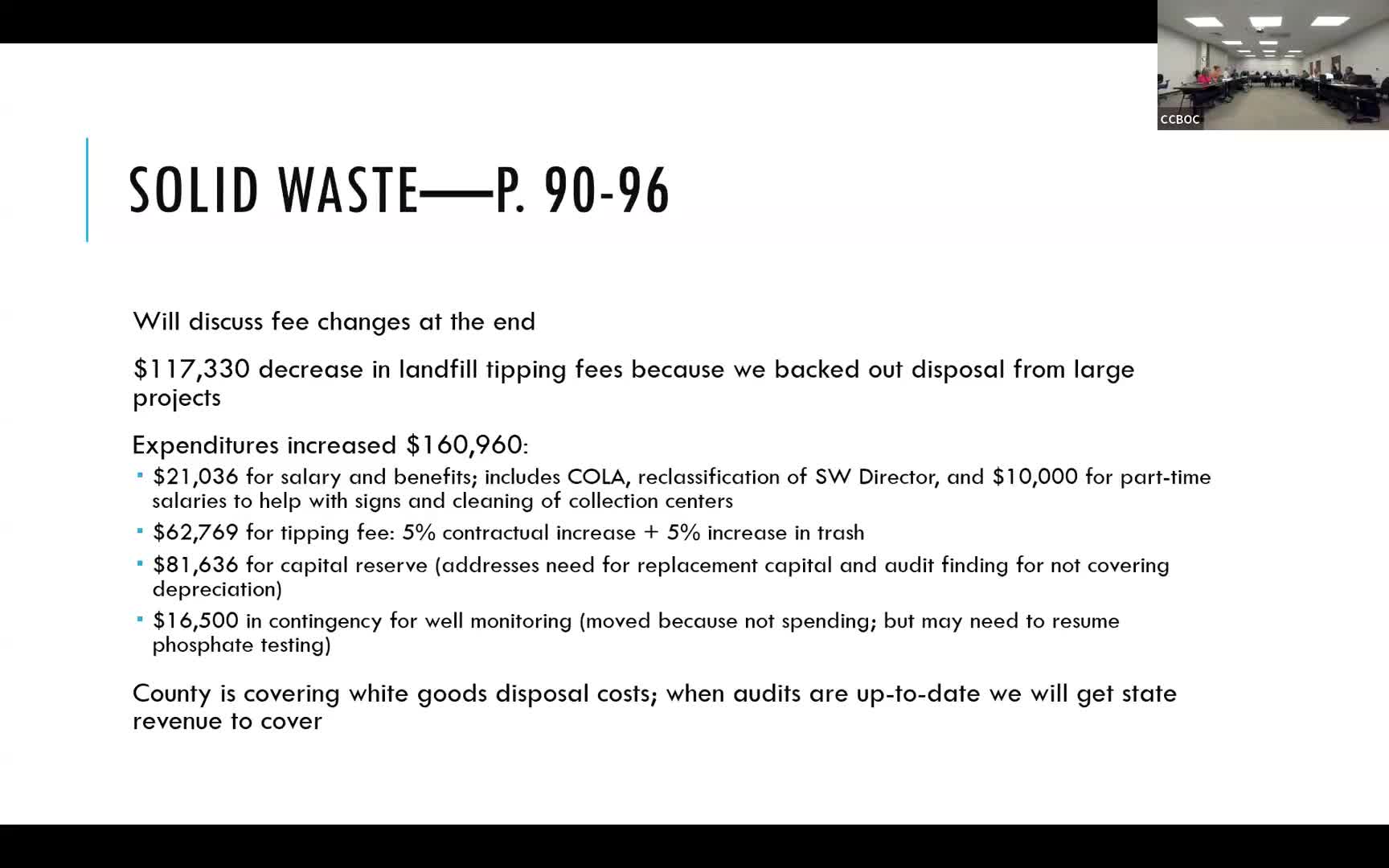
Summary
County staff proposed charging all residents a $65 annual availability fee and raising per-ton disposal fees to stabilize a deficit in the solid-waste fund; town officials are expected to push back and details of implementation remain unresolved.
Caswell County budget staff proposed a change to how the county pays for solid-waste services: a new annual availability fee for all county residents and higher tipping fees at county convenience centers.
The county—s solid-waste director, AJ (county staff), told commissioners the solid-waste fund has run a structural deficit and that prior practice—partnering with a small subset of residents to fund services—is no longer adequate. The recommended approach would bill all Caswell County households a $65 yearly availability fee for basic county solid-waste services and continue a separate charge for residents who do not have curbside collection (currently $125). Under staff—s preferred proposal, households with private curbside service or a dumpster would be assessed $65 (rather than $125); residents without curbside service would continue to pay $125.
Why it matters: AJ and county staff said the current funding structure places most convenience-site and landfill costs on a shrinking group of customers, requiring outsized fees for those households. A broader availability fee spreads the fixed costs of monitoring closed landfills, recycling and countywide code enforcement to all residents who can access the system.
Board discussion and implementation questions: Commissioners raised practical questions: how the county would identify households that already have private curbside or dumpsters, how to treat multi-parcel owners and apartment complexes, and whether towns should be charged or receive a discount. County staff said the plan would require an amendment to the solid-waste ordinance and the creation of an application or certification process for residents who qualify for a reduced charge because they have collection service. Staff also proposed to discuss a modest discount for town haulers so town residents would not face a sudden large increase. The board asked staff to return with detailed billing and exemption rules and with clearer estimates of revenue changes before final action.
Controversy and next steps: Several commissioners said they expected municipal leaders to resist charging town residents; staff said it is legal to apply an availability fee to town residents but acknowledged it will be politically sensitive. The board did not adopt a fee change at the session; staff was asked to prepare specific ordinance language and a billing workflow for further review and likely inclusion in the June budget ordinance process.
Taper: Solid-waste officials also outlined small increases in per-ton disposal fees for brush, construction debris and commercial trash to better reflect haul and disposal costs; those rate changes were minor compared with the availability-fee proposal and will be included in forthcoming ordinance drafts.