
State staff outlines school facilities planning, condition assessment and annual budget process
Get AI-powered insights, summaries, and transcripts
Subscribe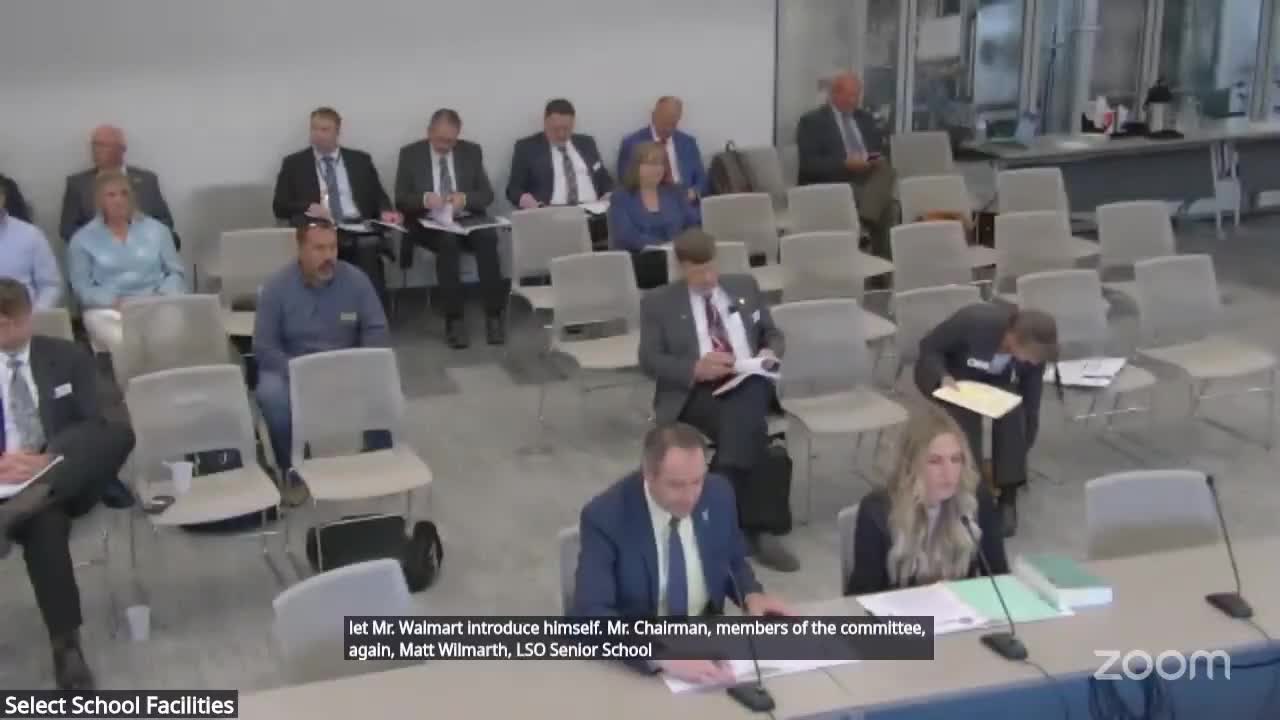
Summary
Legislative staff and the State Construction Department summarized how Wyoming’s school facility plans, condition assessments and the annual budget request are developed, emphasizing a new 2023 Bureau Veritas assessment, biennial facility plans and the commission’s role in prioritizing projects.
Legislative analysts and State Construction Department officials told the Select Committee on School Facilities that the state’s facility planning and budget process relies on recurring condition and capacity reviews and a coordinated budget request from the School Facilities Commission.
Matt Wilmarth, LSO senior school finance analyst, said the interim priority is “developing knowledge and expertise among members pertaining to school facilities,” and described the process by which the commission and State Construction Department work with school districts to develop facility plans and an annual budget that moves to the Joint Appropriations Committee and the governor for final consideration. He said those plans must comply with statewide adequacy standards and the School Facilities Commission must approve plans at least every two years.
The State Construction Department’s facility condition assessment for K–12 buildings was updated in 2023 by Bureau Veritas. John Rexes of the department told the committee that the Bureau Veritas assessment is “forward looking,” capturing roughly 48,000 individual assets and systems, some 50,000 photographs and “over 3,800,000 data points” across 617 buildings, and that the new methodology added site-related items previously not considered. Rexes said the assessment yields component life-cycle cost estimates and a dynamic facility condition index (FCI) that is updated annually to better represent building condition.
Officials described the typical workflow: districts and the state construction department meet on facility plans, which cover land, building square footage, leases, capacity, charter school leases, major maintenance lists and needs that might not appear in condition or capacity indices. The department now schedules facility planning meetings earlier in the year—September through December—to feed timely information into the budget process.
The budget request accompanying the annual report includes recommended remedies for capacity and condition problems, project cost estimates by phase (planning, design, construction), and possible refinements to previously approved projects. After appropriation, the commission may transfer up to 15% of funds between project phases with reporting requirements back to the legislature.
Committee members pressed staff about accessing the underlying data. Department officials said the annual report contains building-level scores and that approved facility plans and the full annual report are posted on the State Construction Department website once the commission approves them. The department said the publicly posted annual report includes the condition and capacity schedules and a building-by-building breakout of scores and projected deficiencies.
Officials also emphasized the connection between condition assessments and budget prioritization. Wilmarth and State Construction Department staff said districts may challenge decisions under the Wyoming Administrative Procedures Act if they disagree with the department’s or commission’s determinations during planning or remedy selection. The committee requested the department bring the annual report and budget request materials to the August meeting for review.