
Assembly committee hears SB507 to centralize services for state boards; stakeholders press for more work on taxi/TNC language
Get AI-powered insights, summaries, and transcripts
Subscribe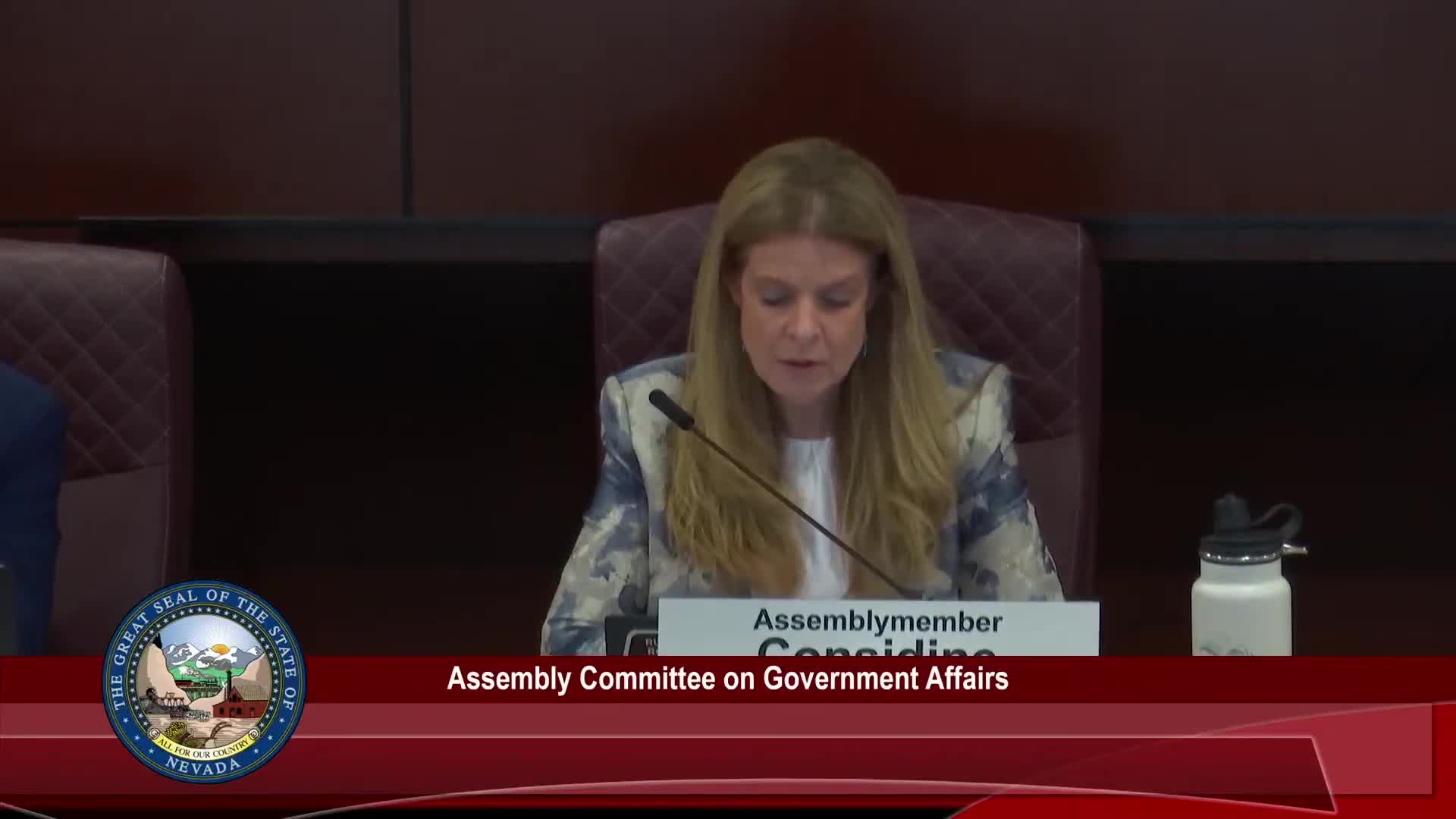
Summary
The Assembly Committee on Government Affairs heard Senate Bill 507 on Jan. 19, a budget-implementation measure that would allow the Office of Nevada Boards, Commissions and Council Standards to collect fees from boards to fund centralized staff and operations and that includes late amendments affecting taxi and transportation network company regulation.
The Assembly Committee on Government Affairs on Jan. 19 heard Senate Bill 507, a budget-implementation measure that would let the Office of Nevada Boards, Commissions and Council Standards collect fees from boards and commissions to fund centralized staff and operations, and that included late amendments touching transportation network companies and taxicabs.
The measure would create an Office of Nevada Boards, Commissions and Council Standards account and authorize the office, by regulation, to prescribe and collect fees from boards and similar entities to recover costs for services. Committee staff said the office plans to fund roughly 11 positions with cost-allocation reimbursements over the 2025–27 biennium and two positions with general fund support in fiscal 2026. Madison Ryan, program analyst with the Legislative Counsel Bureau fiscal analysis division, summarized the bill and the office’s intent to implement a long-term funding plan tied to prior enactments including Senate Bill 431 of a prior session.
Why it matters: The bill changes how boards pay for shared services such as accounting, administrative law support and regulatory assistance. That alters fee structures for licensed businesses and could shift administrative burdens from individual boards to a centralized office overseen by the Department of Business and Industry (BNI).
Key facts and debate
- Cost allocation and budget. Emily Servi, administrative services officer with the Department of Business and Industry, said the boards’ total reported revenue is roughly $54,787,000 for fiscal 2025 and described the cost-allocation method: the office’s legislatively approved budget would be billed quarterly to boards based on each board’s share of total licensees. Servi said the office modeled the budget and expects to bill about $706,000 in year one and roughly $1,400,000 in year two; at year-end the office would “true up” expenses and refund any unexpended amounts to boards based on the same percentage. Servi gave examples: the Landscape Architecture Board’s share would be about 0.14% (roughly $973 in year one); the Contractors Board’s share would be about 6.9% (about $48,000 in year one) against an estimated revenue base above $8 million.
- Allocation formula. Committee members pressed whether the allocation is tied to board revenue or licensee counts. Servi and other BNI staff confirmed the formula is strictly based on licensee count, not individual board revenue, and that the total billed reflects the office’s approved budget.
- Exemptions and underfunded boards. BNI Director Chris Sanchez said a small number of boards that are financially troubled (he said three boards were identified) would not be included in the cost allocation while agencies work with LCB, the interim finance committee and administration to resolve deficits.
- Reporting and oversight. Sanchez told the committee BNI plans to post board reports on a boards portal and provide regular updates to the legislature; he said the department expects to begin posting quarterly reports once regulations are finalized and to appear before committees during the interim.
- Taxi/TNC language and stakeholder concerns. David Goldwater of Pinion Public Affairs, representing Captain (a transportation-technology vendor), asked the committee to delete section 8.7 of a recent amendment and leave section 8.3, saying that stakeholders had concerns about how section 8.7 would treat referrals between transportation network companies (TNCs) and taxicabs and that the “language in section 8.7 is … probably better to work that out in the interim.” The committee did not take formal action on the request during the hearing.
- Regulatory complexity. Yoni Wilburn, administrative attorney for the Nevada Transportation Authority, described separate statutory schemes governing taxis (NRS 706) and TNCs (NRS 706A) and noted that Clark County has a separate taxicab authority; she said the differences in fare structures, taxes and regulatory obligations are a reason stakeholders need more time to negotiate any statutory clarification about when a ride is treated as a taxi ride versus a TNC ride.
Public testimony and opposition
- Taxicab industry. Richard Perkins, representing Yellow Checker Star Transportation, testified in opposition, saying his client learned of the late amendment at the last minute and opposing section 8.3’s effect on Clark County taxicab regulation without fuller stakeholder input; Perkins said the change “is a policy change that should get stakeholder input” and that it could wait until the next session.
- Contractors and licensees. Alexis Moderex of the Associated General Contractors (Nevada chapter) opposed SB 507’s cost allocation as applied to the State Contractors Board, saying the contractors view the board as efficiently run and that the added allocation—while a small percentage—represents an additional cost to licensees and could reduce services or increase costs for contractors.
- Professional board leadership. Patty Mamola, former chair of the Nevada Board of Engineers and Land Surveyors, testified in opposition, saying the bill would obligate boards to pay for staff that might not match a board’s needs and would add cost to licensees without clear public benefit; she urged a no vote.
Distinguishing discussion, direction and decisions
- Discussion: Committee members and witnesses debated the fee structure, the allocation formula, transparency and whether the bill’s late amendments about taxi/TNC interplay should remain.
- Direction: BNI officials said they will draft implementing regulations, post quarterly reports on a public boards portal and return to interim committees with updates. David Goldwater requested deletion of section 8.7 to allow stakeholder work during the interim.
- Decision: The committee opened and closed the hearing on SB 507 and did not record a committee vote on the measure during this session of the hearing.
What’s next
The committee closed the hearing and went into recess. BNI said it will work on regulations to implement fee authority and on posting reports, and stakeholders asked to continue negotiation on the taxi/TNC language in the interim. No formal action or amendments were adopted on the record during the hearing.