
Nevada committee hears bill to let parents file notarized guardianship nominations, add form to state lockbox
Get AI-powered insights, summaries, and transcripts
Subscribe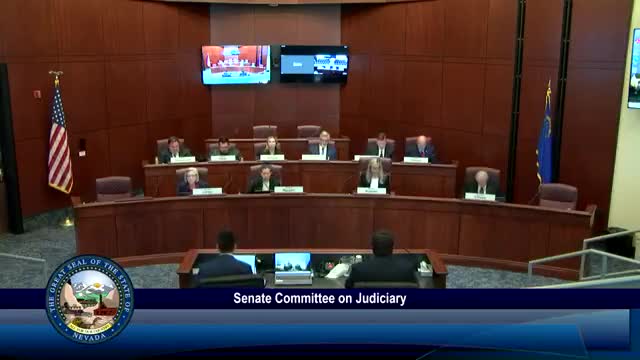
Summary
The Senate Judiciary Committee heard Assembly Bill 460, which would let parents file a notarized nomination naming a trusted person as temporary or permanent guardian, bar private for‑profit guardians, and place the form in the Secretary of State's secure Nevada lockbox with no registration fee.
The Senate Judiciary Committee on Wednesday heard Assembly Bill 460, which would let parents notarize a form naming a trusted person to serve as guardian of a minor's person, estate or both and place that form in the Nevada lockbox maintained by the Secretary of State.
Proponents said the bill is intended to give families a clear, private, and low‑cost way to document guardianship preferences for emergencies such as hospitalization, detention or terminal illness. Fabian Nunez, presenting on behalf of Assemblywoman Gonzales, said the measure also would prohibit appointment of private for‑profit guardians and remove the Secretary of State's fee for registering the nomination form. "With these reforms, we believe that AB 460 brings clarity, compassion, and procedural integrity to guardianship matters, empowering parents, and protecting children when stability is needed most," Nunez said.
The bill would explicitly integrate the notarized nomination form into the Nevada lockbox, a secure registry the presentation described as managed by the Secretary of State, to allow hospitals, courts and schools to verify a family's designation during a crisis while protecting privacy. The draft language requires a notarized form and makes clear a nomination is not itself a completed guardianship: a temporary guardian would still file in court if a full guardianship is sought, and the court would retain the authority to decide contested matters.
Committee members asked whether current statutes already allow temporary guardianships in emergencies. Jonathan Norman, speaking for legal staff, pointed to the state's minor‑guardianship statute and said temporary guardianships already exist; the bill would make that route more explicit for cases where a parent is unavailable. Norman described the nomination as a record of the parent's preference that a court could consider and noted a temporary guardian must later file for full guardianship with notice to family and a hearing. "A nomination isn't a guardianship. You still have to go to court, and then it would flow the same way all our minor guardianships do," Norman said.
Members also questioned scenarios such as competing nominations by divorced parents, how nominations are revoked, and whether a nomination has an end date. Committee counsel indicated the nomination is revocable and that termination of a guardianship would follow existing court procedures; the bill's nomination is intended as an evidentiary record to be updated by a parent but not to automatically alter custody without court action. Jeff Rogan testified in support on behalf of Clark County.
After questions and public testimony, the committee moved the bill out of committee in a work session. Vice Chair Flores moved an amendment and "do pass," seconded by Senator Winn. Senators Hanson and Ellison recorded nay votes; the motion carried and the bill was assigned a floor statement. The committee did not adopt policy changes beyond those described in the bill text during the hearing.
If enacted as drafted, AB 460 would (1) allow parents to file a notarized nomination naming a proposed guardian for a minor's person, estate or both; (2) prohibit appointment of private for‑profit guardians through the nomination pathway; (3) add the nomination form to the Nevada lockbox without a registration fee; and (4) preserve current court processes for converting temporary guardianships to full guardianships.
Committee materials, the bill draft and the hearing record provide the detailed statutory cross references and the amendment language; the committee scheduled the bill for floor consideration.