
Kansas adult education leaders ask TEA for $1.5 million to scale integrated training
Get AI-powered insights, summaries, and transcripts
Subscribe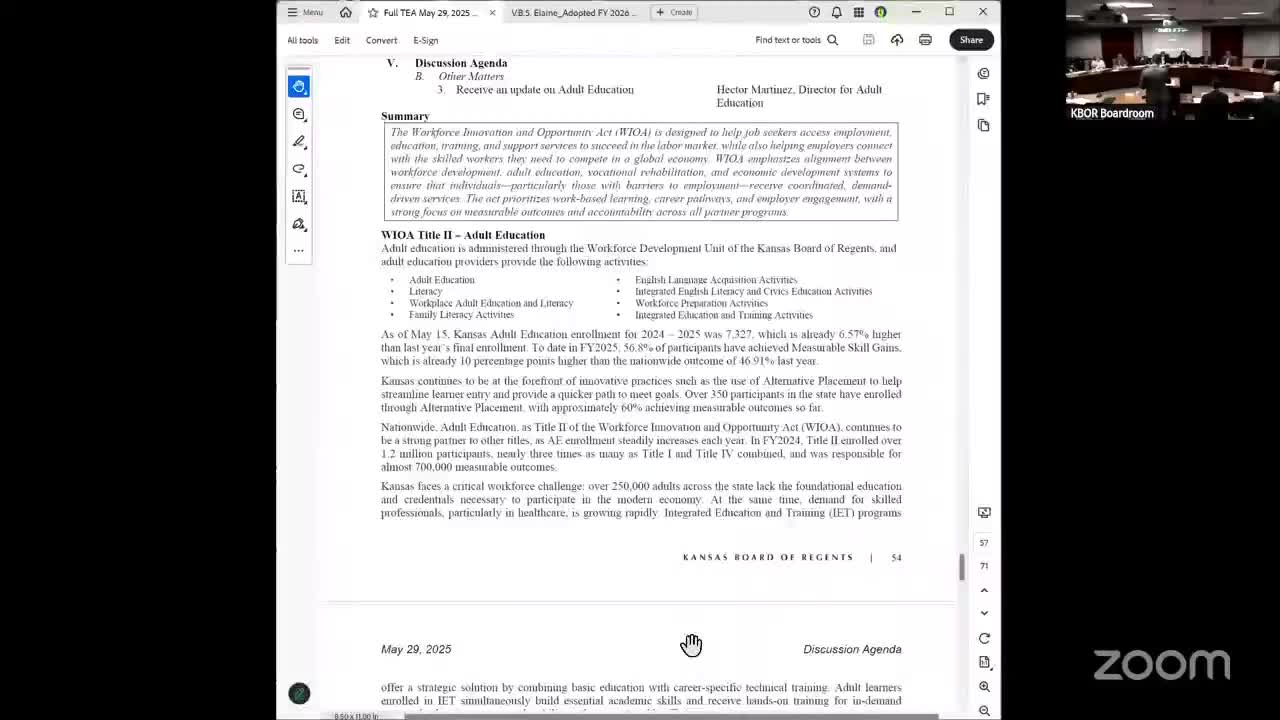
Summary
Adult education enrollment rose and measurable skills gains exceeded the national average; the adult education director asked the authority for $1.5 million to expand integrated education‑training programs across the state.
The director for adult education told the Technical Education Authority that Kansas adult education enrollment is rising and asked for $1.5 million to expand integrated education and training programs.
Director Hector Martinez reported that, as of May 15, Kansas adult education had enrolled more than 7,300 learners — a 6.5% increase from the prior year — and he said the state has achieved a 56.8% measurable skills gained rate compared with a 46% national average. "Our learners are not just enrolling. They are succeeding," Martinez said, and he noted that many adult education completers are working parents and older adults returning to school.
Martinez described a statewide gap: roughly 250,000 Kansans lack a high school diploma or equivalent and are therefore constrained in labor‑market participation. He recommended expanding integrated education and training — programs that combine basic literacy, math and digital skills with industry‑aligned credentials in sectors such as health care and information technology. The director requested $1,500,000 to support the expansion across 18 adult education providers and more than 50 sites. Martinez said the funding would support, at minimum, a 0.5 full‑time‑equivalent position at sites for career navigation and coordination with technical education partners.
"Adult education is not a remedial event or system," Martinez said. He argued that integrated training is a workforce and economic‑development strategy that connects unemployed or underemployed Kansans to in‑demand jobs and reduces reliance on public assistance.
TEA members praised the performance metrics and acknowledged the scale of unmet need; the request will be considered as staff and sector leaders assemble FY27 budget priorities. No vote on the funding request was held at the meeting.