
Polk County supervisors review changes to grants, sponsorships and application portal
Get AI-powered insights, summaries, and transcripts
Subscribe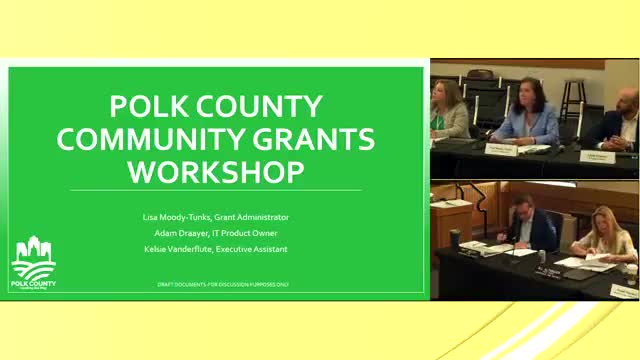
Summary
County staff and supervisors reviewed proposed guidelines and portal upgrades for Community Betterment, Community Development and Sponsorship programs to respond to surging demand, tighten reporting and implement targeted line-item funding. No formal board votes were recorded; staff were directed to draft guideline updates and technology changes.
Polk County supervisors and grants staff met in a workshop to review proposed revisions to the county's Community Betterment, Community Development and Sponsorship programs, discussing guideline clarifications, eligibility changes after recent state law updates, new portal features and potential standing line-item funding for recurring requests such as chambers, post-prom efforts and holiday assistance.
The discussion centered on managing rapidly rising demand for county grants and sponsorships and on making application and reporting requirements clearer and easier to enforce. Lisa, grants staff, said the programs "have made a significant impact, in Polk County" and noted that applications have grown sharply: "In 2025, the level of applications that we received tripled compared to the amount of funds that are available." She described existing Betterment guidelines (award range $500'0,000 to $10,000; current program budget $1,000,000; $200,000 allotment per supervisor) and asked for board guidance on multiple recurring policy questions.
Why it matters: supervisors and staff emphasized that demand far outstrips available funds and that clearer rules and portal features could reduce staff time spent chasing missing documents and repeated applicant calls. Adam, a county IT/staff speaker, proposed a portal pop-up and alert system to show applicants their historical ask vs. award levels and to warn when the same tax ID has multiple concurrent requests: "It looks like you're applying for another grant under the same tax ID number. Be aware only 1 grant is typically awarded." Kelsey, who handles reporting, described practical problems in verifying spending: "...they are purchasing a $25 gift card. We don't know if that's going to them for groceries or if it's going to someone that needs it."
Community Betterment: staff proposed formal Betterment guidelines and a clearer public-purpose statement on the portal. Current Betterment parameters discussed: one annual cycle (Dec. 1'Feb. 28), awards $500'$10,000, $1,000,000 program budget, $200,000 per supervisor; 2024 average award $5,558; reports due Feb. 28 following year. Supervisors discussed keeping the $500 minimum to allow smaller organizations to participate, but also flagged frequent multiple applications from the same organizations (e.g., schools submitting development, betterment and sponsorship asks for related activities). The group directed staff to pursue application-side warnings and an internal alert/report that lists other open requests under the same tax ID to reduce duplicate submissions.
Eligibility and reporting: supervisors asked staff to tighten reporting and to codify disallowed expenditures. Board members spoke in favor of banning gift-card purchases and routine salary or rent payments out of Betterment funds, characterizing those as non-sustainable uses; one supervisor said, "I don't want it to go to post due to salary or mileage. I want it to be, like, the light display." Staff said current practice already notifies applicants that county grants cannot be paid as cash or to individuals and that invoices plus proof of payment (paid invoices and bank statements) are the strongest available verification in an era of fewer canceled checks.
Community Development Grants (CDG): staff described CDG as the program for larger capital projects (annual cycle July 1'Aug. 31; awards $15,000'$100,000; current annual budget $2,000,000). The board discussed a policy trial to allocate a $500,000 "purse" of development money to each supervisor (effectively dividing the $2 million by district) so supervisors could commit funds directly to projects in or benefiting their districts while retaining competitive criteria (including the existing 50% local match). Several supervisors expressed support for piloting the $500,000-per-supervisor approach beginning July 1; one said simply, "Let's try it." Staff noted portal and administrative updates will be required to implement supervisor-level commitments in the application system.
Sponsorships and platinum-level regional events: staff proposed formal sponsorship guidelines and operational changes including raising the sponsorship minimum from $500 to $1,000 (award range $1,000'$5,000), removing fixed cycles in favor of a fiscal-year approach, and creating a "platinum" category for large regional events (Principal Charity Classic, Celebrate, Des Moines Art Festival) with criteria tied to attendance and economic impact. Staff recommended increasing the supervisor allotment for sponsorships (currently $55,000 per supervisor) to $100,000 per supervisor pending budget review.
Religious organizations and state law: Andrea, a legal/staff speaker, briefed the board on two recent state laws. She said House File 2264 amended Iowa Code section 331.901(5) to allow certain public funds to go to religious organizations when the project serves a public purpose and does not require religious membership; and House File 856 places restrictions on public funding for DEI offices or officers. Andrea summarized: "That law did make that adjustment last year, and we're able to do that now," but added applications involving faith-based entities will require closer scrutiny to ensure projects meet public-purpose tests and constitutional limits (for example, funds cannot be used to repair houses of worship or to fund ministerial services).
Operational and outreach directions: staff will draft updated guidelines for the three programs, implement portal improvements (pop-ups, tax-ID alerts, internal reports, contribution-tracking and read-only histories of past agreements), and prepare proposed budget line items for recurring categories (chambers, post-prom, neighborhood associations, veterans coat drive and holiday food/turkey/gift-card assistance). Lisa said staff will return a consolidated follow-up to supervisors, and the portal changes and platinum-level sponsorship structure were targeted for a staged rollout (portal/administrative changes beginning July 1 for development allotments; platinum sponsorship changes proposed for Jan. 1 rollout to allow IT and legal time to implement).
No formal votes were recorded during the workshop. The board generally endorsed the staff direction to draft guideline revisions, tighten reporting rules, add portal alerts/warnings and prepare budget recommendations for standing appropriations, but supervisors acknowledged these are staff recommendations that will return for formal action at a future meeting.
Ending: Staff will circulate revised guideline drafts and follow-up materials for supervisor review; staff warned that recommended changes will increase administrative workload and asked for board support on necessary staffing or resource adjustments.