
Fargo committee sets RFP minimums and adopts 40/30/30 scoring split for convention center proposals
Get AI-powered insights, summaries, and transcripts
Subscribe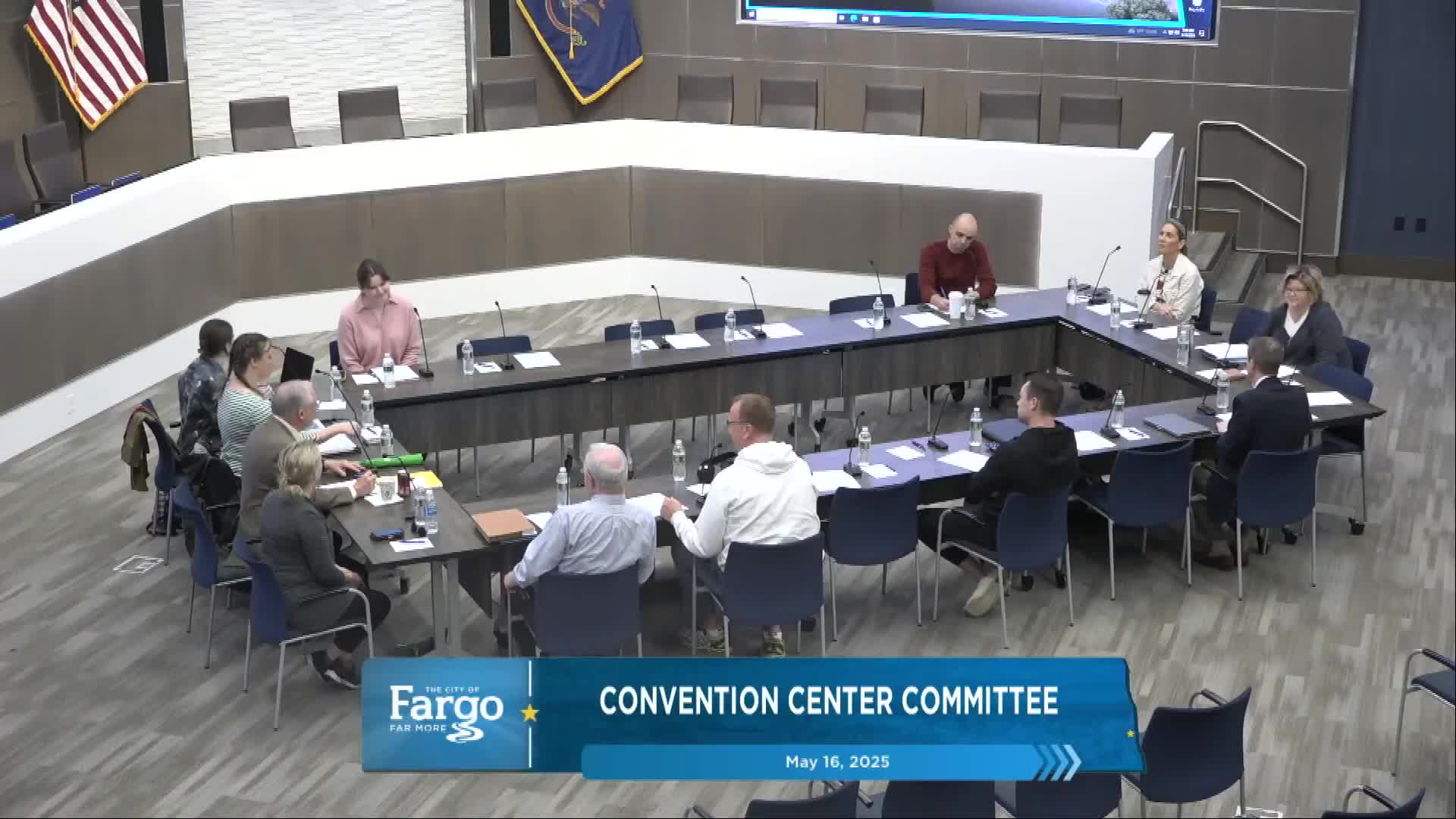
Summary
A Fargo committee agreed on recommended minimum facility requirements for a proposed convention center and hotel and voted to weight RFP criteria 40% site, 30% conceptual plan and 30% development/management, with a two‑phase selection process and further financial review planned for finalists.
A Fargo committee working on a proposed convention center and attached hotel agreed on recommended minimum facility requirements and approved a scoring split that emphasizes site considerations.
At a committee meeting, Charlie Johnson, president and CEO of Visit Fargo Moorhead, said the group was “narrowed down” on what it wanted in the request for proposals and outlined minimums including an attached hotel with 150 to 200 guest rooms and a combined ballroom/exhibit hall of about 50,000 square feet.
The vote to adopt the committee’s weighting — 40% site considerations, 30% conceptual plan and 30% development/management — passed on a voice vote after Commissioner Michelle Turnberg moved the motion and speakers indicated assent. The committee noted the percentages could change after developer questions and the RFP question‑and‑answer period.
Why it matters: The committee’s minimums and scoring framework will shape what developers submit and which proposals move to a more detailed Phase 2 review, where financial capacity and management models will be examined more closely.
Key agreed minimums and guidance provided at the meeting included: an attached hotel of 150–200 rooms; a combined ballroom/exhibit hall around 50,000 square feet, dividable by sound‑proof air walls; a minimum commercial kitchen area of about 6,000 square feet; additional meeting-room space of roughly 8,800 square feet (10,000–12,000 preferred); at least 10,000 square feet of single‑level back‑of‑house storage; a 200‑amp minimum for power access with floor access roughly every 20 feet for trade shows; and loading docks including one ground‑level dock with an approximately 15‑foot‑high door plus truck‑height docks (truck bed height discussed as roughly 4½–5 feet).
Committee members also discussed pre‑function space (estimates ranged from roughly 10,000 square feet to the 20,000–24,000 square feet cited in the HVS study), elevator access for any second‑floor meeting spaces, and built‑in audio‑visual for breakout rooms while leaving elaborate ballroom/exhibit AV to event producers. Kent Kolstead, president of Livewire, cautioned against installing costly, fixed ballroom technology that can limit reconfiguration; he said basic overhead announcement capability is sufficient for the large spaces.
On project phasing, staff and committee members said Phase 1 should demonstrate the site can accommodate up to a 150‑room hotel and that more detailed hotel branding, operator and financing information would be developed in Phase 2 for shortlisted proposals. Jim Gilmore, Fargo staff, advised that leaving flexibility in the RFP could increase the number of proposals but warned the commission must decide whether a hotel is required to open simultaneously with the convention facility.
The committee asked staff to include a management/partnership model and city financial impact as evaluation topics. Susan Thompson, City of Fargo Finance, and committee members said outside advisors (for example, Baker Tilly or a hospitality‑operations reviewer) will be used in Phase 2 to evaluate pro forma financials and operational realism for finalists.
Next steps and process: The committee expects the RFP to include a 30‑day developer Q&A period after issuance. The group signaled it intends to advance a small set of finalists for Phase 2 (committee discussion suggested up to three to five finalists) and to complete its work for presentation to the City Commission in June, with staff returning to the committee next week to weigh and assign points to individual line items.
A voice vote carried the committee motion to adopt the 40/30/30 weighting; the meeting record shows no detailed roll‑call tally was taken during that voice vote. Committee members emphasized that many of the numeric minimums were presented as “recommended minimums” to preserve flexibility and to encourage a broad pool of respondents.
The committee’s homework is to assign weights to the individual line items in each category and to return with proposed point allocations at the next meeting.