
Romano Capital pitches phased master-development plan for St. Helens waterfront
Get AI-powered insights, summaries, and transcripts
Subscribe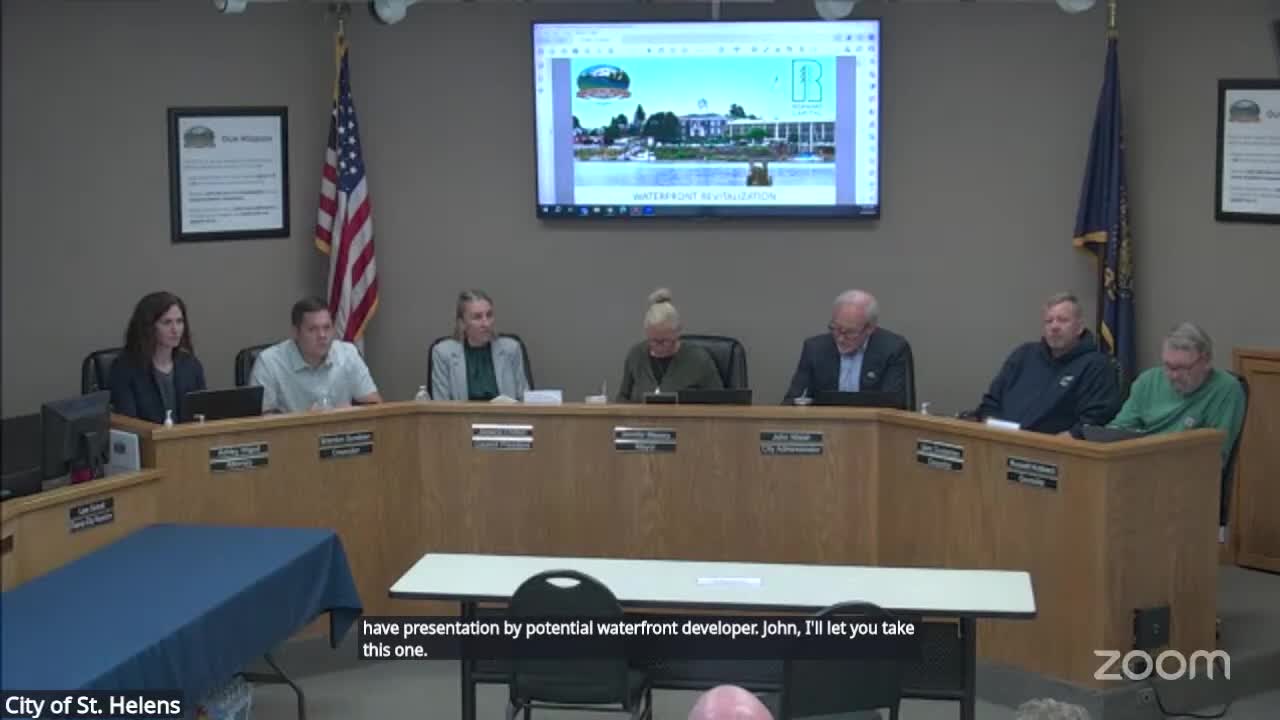
Summary
Romano Capital told the City Council it can act as a master developer for the city's waterfront project, proposing phased mixed-use development, local investment options and a market-driven funding approach; council members asked about design, parking and protection against '''cherry-picking' parcels.
Romano Capital representatives presented a vision to the St. Helens City Council on June 18 to serve as a master developer for the city's waterfront, saying a phased approach that blends residential, commercial and public spaces could unlock the site's potential.
The presentation, led by Greg McGreevy, vice president of development for Romano Capital, framed the waterfront as a unique regional asset with direct river access and urged a master-developer role to ensure design consistency and effective phasing. McGreevy said Romano would combine design oversight with financial capacity and local investor participation.
McGreevy said Romano sees the site as suited to a range of building types and uses and argued a master developer can prevent fragmented outcomes. "One of the things we'll talk about is having a master developer that is really kind of working on the project to kind of keep some of that consistency," McGreevy said. He also noted market timing, saying "projects live and die 3 times" and describing the firm's view that careful phasing improves odds of success.
Eric Christiansen, Romano's chief operating officer, and Nick Cernondi of Slyworks Architecture described the firm's regional experience, citing projects from dense master-planned communities to riverfront townhomes. Romano representatives said their vertically integrated structure (development, lending and construction) enables local capital deployment and investor structures that could allow St. Helens residents to invest in the waterfront.
Council members pressed Romano on several local concerns. Councilor Russ Hubbard and other council members emphasized the need to avoid '''cherry-picking' parcels and to preserve a cohesive streetscape and parking strategy; Councilor Hubbard said strategic parcel planning and citizen input will be key. Romano said an early market analysis and phased plan would guide parcel sequencing and tenant recruitment. On the question of how much Romano holds versus sells, McGreevy described a roughly 30/70 hold-to-sell orientation depending on market conditions.
Councilors expressed interest in design examples and community integration; several cited Astoria-style placemaking as preferable to the denser Vancouver model Romano showed. Romano proposed next steps including execution of an exclusive negotiating agreement (ENA) to allow the firm time to complete studies and develop a funding plan and market analysis.
If the council wishes to continue, Romano representatives said they are prepared to work with city staff on an ENA and early market and site studies. The council did not take a formal vote; discussion ended with direction to continue negotiations and to request conceptual plans and more detailed financial and phasing analyses.