
Board pulls audio/video surveillance policy for further legal and procedural review
Get AI-powered insights, summaries, and transcripts
Subscribe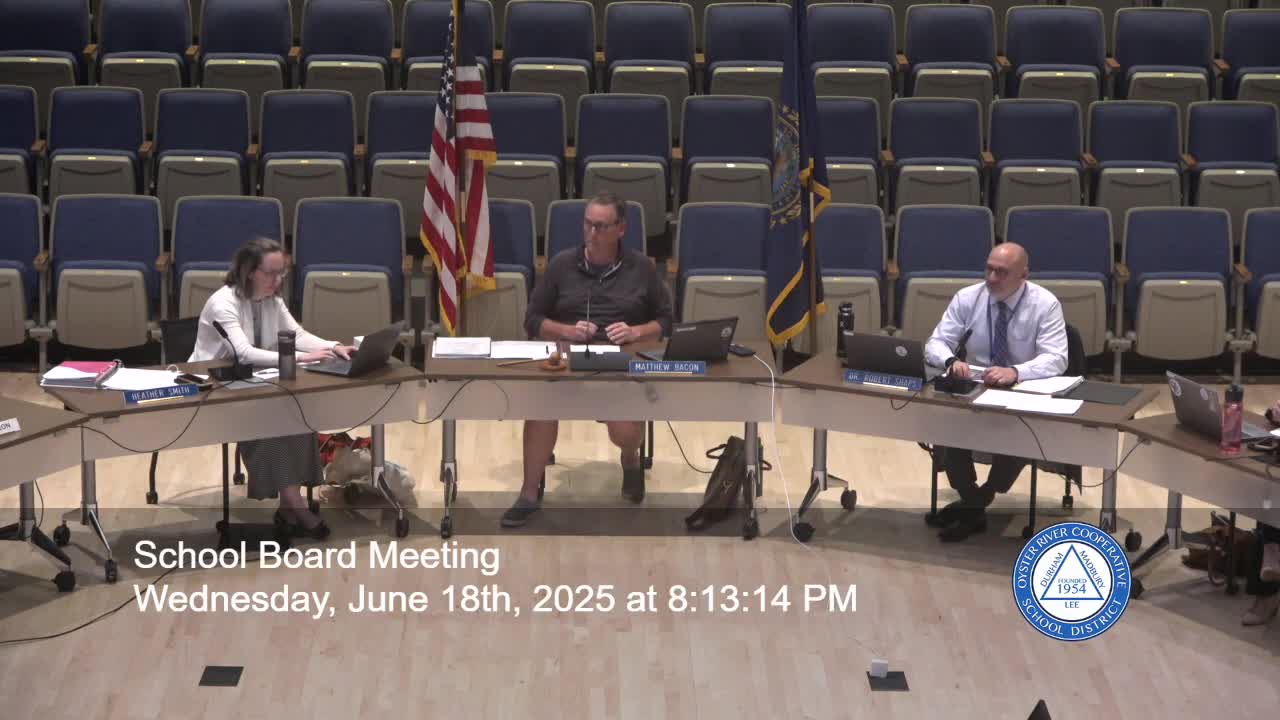
Summary
Board members removed the proposed ECAF audio/video surveillance on school buses from a first‑read policy packet and sent it back to the policy committee after legal review raised questions about audio access, video retention and who may view recordings.
OYSTER RIVER, N.H. — At the June 18 meeting the Oyster River school board removed a draft policy on audio and video surveillance of school buses from a package of first‑read policies and sent it back to the policy committee for clarification after members raised legal and procedural questions.
A board member moved to approve a slate of policies for first read that included ECAC (vandalism), ECAF (audio/video surveillance on school buses), EDC (authorized use of school‑owned materials), EFA (availability of healthy foods) and EFC (free and reduced‑price meals). During discussion members said the ECAF draft — reviewed by the district attorney — needed clearer language about exactly when audio or video may be viewed, who has permission to access recordings, and how long footage is retained.
One board member asked why audio required special permission while video “may be reviewed at any time,” and another requested explicit guardrails on which staff may access recordings. The board also suggested replacing language that said electronic recordings “will be taped over within 10 school days” with terminology reflecting modern storage (for example, “erased” or “deleted”) and asked staff to verify statutory citations. The nutrition director reviewed EFA/EFC language and recommended adding the federal Smart Snacks/National School Lunch Program rules to the cross references; staff confirmed those are federal USDA requirements.
After discussion the board amended the motion to remove ECAF from the first‑read packet and send it back to the policy committee for further work with legal counsel. The amended package of policies for first read was approved by roll call (6 in favor; one abstention; student representative abstained from the vote), and ECAF will be revised before being returned to the board.
Ending: The board directed policy staff and legal counsel to clarify who may access audio/video, retention language, and cross‑references (including FERPA and USDA guidance), and to return a revised policy to the policy committee for consideration before a public first‑read vote.