
Sierra Madre council weighs updated noise ordinance, landscaping-equipment limits
Get AI-powered insights, summaries, and transcripts
Subscribe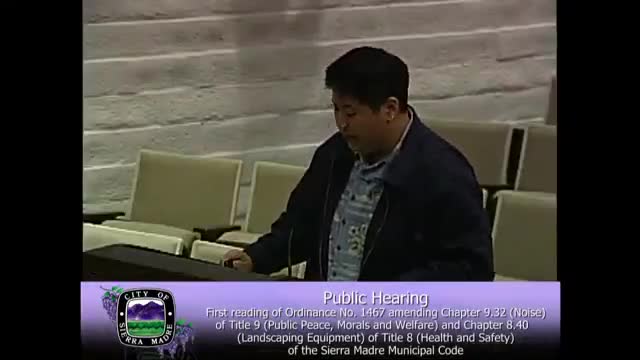
Summary
Sierra Madre’s City Council on July 8 held a public hearing on proposed changes to the city’s noise ordinance and related landscaping‑equipment rules that would add numeric decibel baselines, measurement procedures and updated hours for powered equipment.
Sierra Madre’s City Council on July 8 held a public hearing on proposed changes to the city’s noise ordinance and related landscaping-equipment rules that would add numeric decibel baselines, measurement procedures and updated hours for powered equipment.
Senior planner Caitlin Wong presented draft ordinance 14‑67, which would amend Chapter 9.32 (noise) and Chapter 8.4 (landscaping equipment). Wong said the draft narrows gaps in the 2009 code by adding definitions (for example, weighted decibels, ambient noise), establishing daytime and evening exterior noise thresholds and setting minimum measurement criteria for enforcement.
The draft sets a daytime exterior noise threshold of 60 dBA (7 a.m.–10 p.m.) and an evening threshold of 50 dBA, with measurements taken as 10‑minute averages using an ANSI Type 2 meter. Wong told the council the planning commission held two public hearings and recommended adoption of the municipal code text amendment (25‑01) to the council. She said Rincon Consultants helped draft the amendments.
Council members pressed staff on several details: whether DBA and DBC metrics were included (Wong said DBC captures low‑frequency sound), whether the city has meters to enforce the new numeric limits (staff said the police department would need to buy a meter and estimated ANSI Type 2 units at about $600–$1,000 each), and how the proposed rules would affect enforcement practice.
On landscaping equipment the draft would generalize prohibited machinery, remove a list of specific machine types, and align permitted machine hours with the city’s construction hours (7 a.m.–7 p.m. Monday–Saturday; 10 a.m.–6 p.m. Sundays and holidays). The planning commission recommended syncing landscaping hours with construction hours; some council members urged keeping a more restrictive schedule for landscaping because lawn and garden work is more frequent and widespread than construction.
Councilmembers also asked why school activities (band practice, athletics) are listed in the ordinance’s exemptions. Wong said the exemption was intended to separate regularly scheduled institutional activities from “special events” and that school‑campus activities not governed by a campus conditional use permit would generally be treated differently in practice.
Council members and staff agreed the ordinance should include a practicable enforcement plan: numeric standards must be paired with the equipment and training to measure them. Several members supported buying at least one ANSI Type 2 meter so officers or code enforcement could take quantitative readings instead of relying only on warnings. Others asked staff to clarify how exemptions and construction provisions interact in the code text.
After public comment (one emailed submission, which staff distributed to council), the council closed the hearing and directed staff to return with amendments reflecting the council’s edits — including clearer wording about “landscaping machine or equipment,” the enforcement approach, and the construction/landscaping hours question. The council agreed to continue formal consideration at a later meeting so the revised ordinance can return for a subsequent reading.
Why this matters: numeric noise thresholds and measurement standards make enforcement more objective, but they also create practical demands (meters, staff training, documented procedures). Council members said they want the technical rules to be enforceable and to avoid a code that cannot be measured in the field.
The council scheduled the ordinances to return with the staff‑recommended refinements. If adopted, the amendments would replace portions of Chapters 9.32 and 8.4 with updated definitions, exterior noise standards, measurement criteria and revised landscaping‑equipment provisions.