
Framingham Police begin departmentwide body‑worn camera rollout after December pilot
Get AI-powered insights, summaries, and transcripts
Subscribe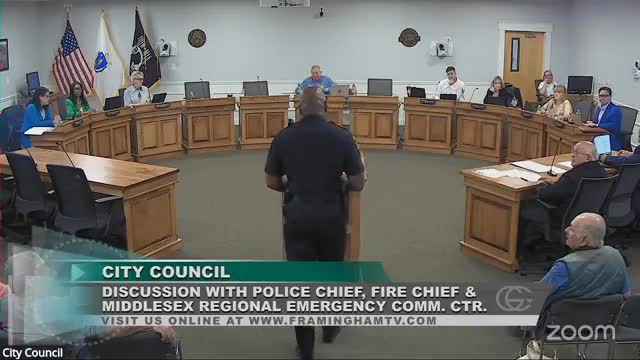
Summary
Police chief said a December pilot of body‑worn cameras expanded into a department‑wide rollout beginning June 9, 2025; the department discussed data handling, auto‑activation with weapons, FOIA burdens and storage questions.
The Framingham Police Department told the City Council on June 17 that a pilot of body‑worn cameras begun in December 2024 has moved to a department‑wide rollout, with training and technical changes completed and a plan to finish issuing cameras to all sworn personnel by the end of June.
Implementation and timeline: Chief Lester Baker described a pilot that began December 2024 with 5 supervisory/admin members and 18 patrol officers. The department began issuing cameras more widely on June 9 and expected to complete the rollout to all officers by the end of the month. Chief Baker said the department procured equipment only after aligning camera activation with recently adopted weapon platforms so cameras would auto‑activate when firearms or Tasers are deployed.
Equipment and staffing: Chief Baker told the council the department has a camera assigned for each sworn officer (the department has about 136 sworn officers) and a few spare devices for rapid replacement. The department built a dedicated storage room for hardware and decided between on‑premises and cloud storage during procurement and planning phases.
Freedom of Information Act and redaction: The chief described FOIA and public‑records impacts: redaction of faces and sensitive content requires staff time to review footage. During the pilot, 40% of FOIA requests requested footage from before cameras were in use; 27% requested footage where officers were not in the pilot; about 8% of requests generated a bill because the work exceeded two hours; 14% of requests covered incidents that were not a call for service. The department reported an auto‑tagging accuracy for incident linkage of about 99.4%, which it said exceeded industry norms.
Labor and policy issues: Chief Baker said the department negotiated with bargaining units and relied on union buy‑in to avoid litigation and secure a sustainable implementation. He said policy development, training and IT planning were completed before full deployment.
Council response: Council members praised the department’s work but asked for continued updates on FOIA workload, storage costs and any needed staff resources. No formal council action was requested or taken at the meeting.